
NECO GCE 2026 Marketing Questions and Answers
Do you know you can get NECO GCE 2026 Marketing Questions and Answers
For NECO GCE private candidates’ examination ahead of exam time? Welcome to Examrunz.com, your trusted platform for NECO GCE 2026 Marketing Questions and Answers. Candidates sitting for this exam should not panic; the Examrunz team is here with solutions
We are Examrunz Team, where candidates can pay a small fee to get correctly solved Questions and Solutions and study them carefully to improve their results in the NECO GCE 2026 Marketing Examination.
This page is designed to help candidates get sure exposure to NECO GCE 2026 Marketing Questions and Answers Midnight/5am Before Exam time.
Wednesday, 4th November 2026 Marketing Paper III (Objective) – 10:00am – 11:00am. Marketing Paper II (Essay) – 11:00am – 12:40pm.
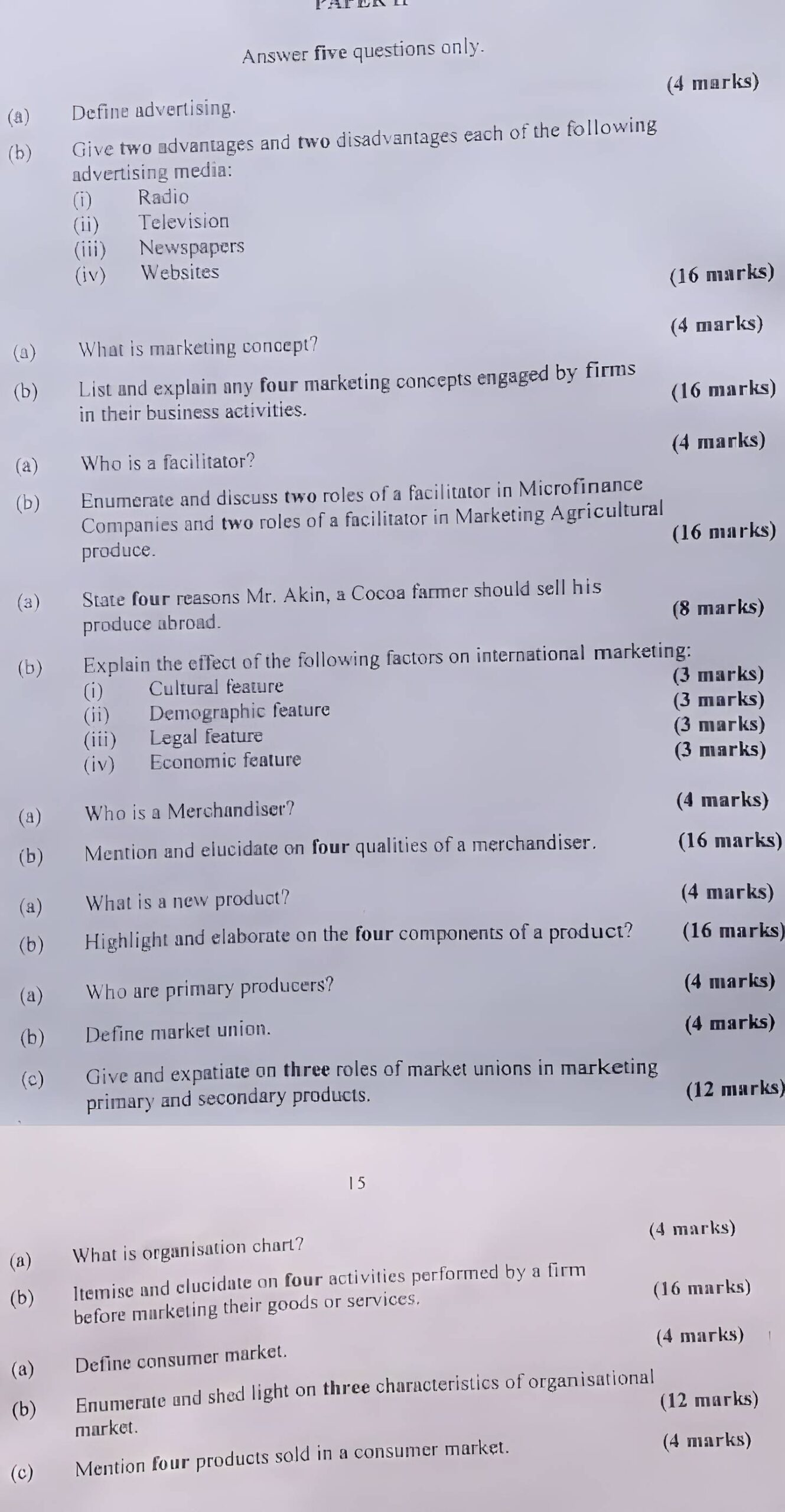
NECO GCE 2026 MARKETING THEORY QUESTIONS
NECO GCE 2026 MARKETING OBJ:
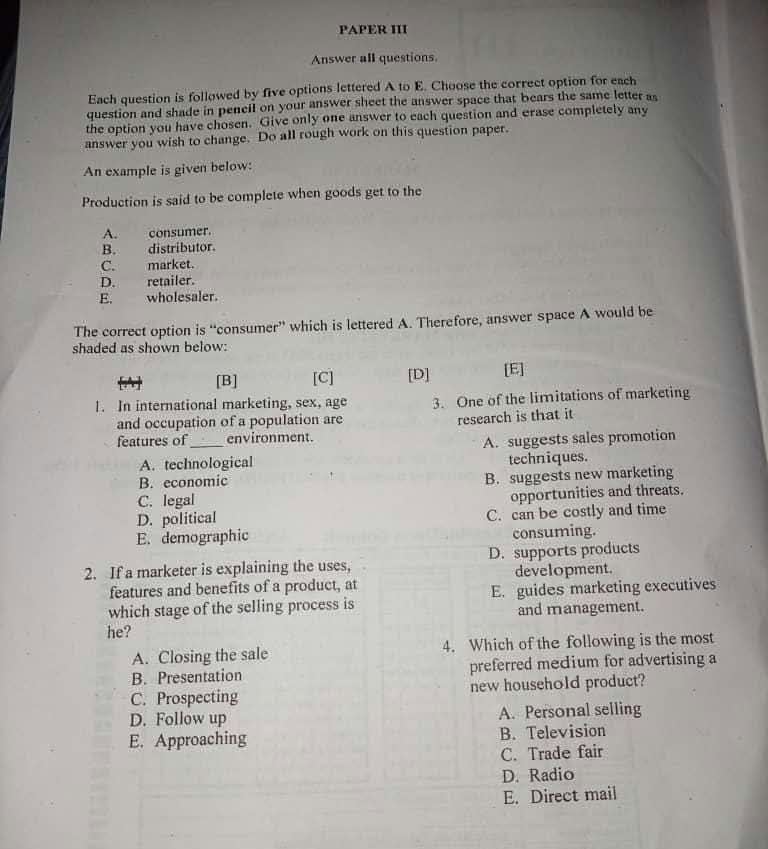
1-10: EBCBEBDDEA
11-20: DECDCBCBEA
21-30: BCEACBACBB
31-40: DDABADCEEA
41-50: CEBEAECABB
51-60: BBCDEAABEC
=======================================
MARKETING OBJ FOR CBT CANDIDATES)
Trace the OBJs by the wordings
1. E: demographic
2. B: Presentation
3. C: can be costly and time consuming
4. B: Television
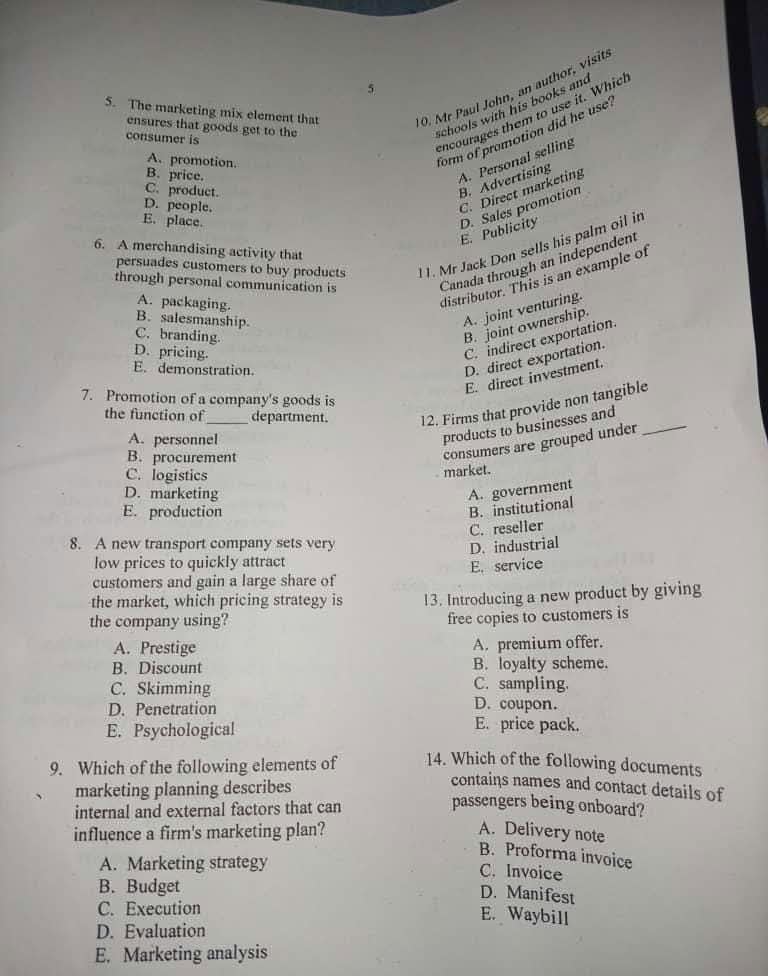
5. E: place
6. B: salesmanship
7. D: marketing
8. D: Penetration
9. E: Marketing analysis
10. A: Personal selling
11. D: direct exportation
12. E: service
13. C: sampling
14. D: Manifest
15. C: wholesale
16. B: air
17. C: Product display
18. B: trade
19. E: Goods are tangible while services are intangible
20. A: media
21. B: Delay in communication
22. C: marketing budget
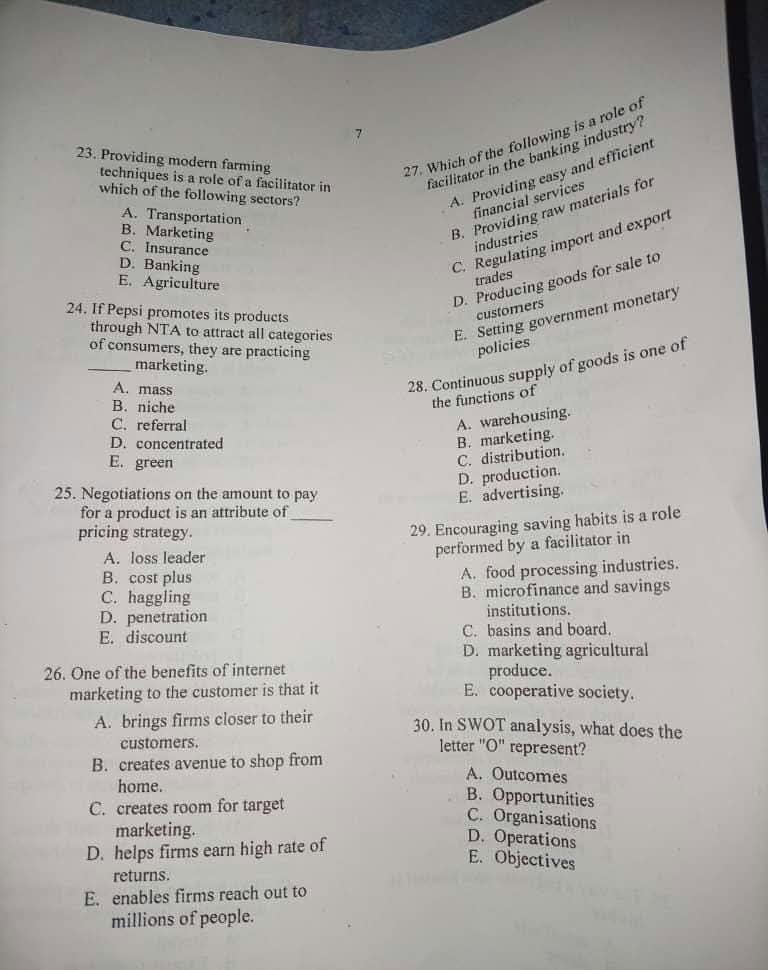
23. E: Agriculture
24. A: mass
25. C: haggling
26. B: creates avenue to shop from home
27. A: Providing easy and efficient financial services
28. C: distribution
29. B: microfinance and savings institutions
30. B: Opportunities
31. D: water
32. D: Industrial
33. A: shopping
34. B: Post purchase evaluation
35. A: actual self
36. D: supplier
37. C: directing
38. E: production
39. E: Export trading companies
40. A: Storage
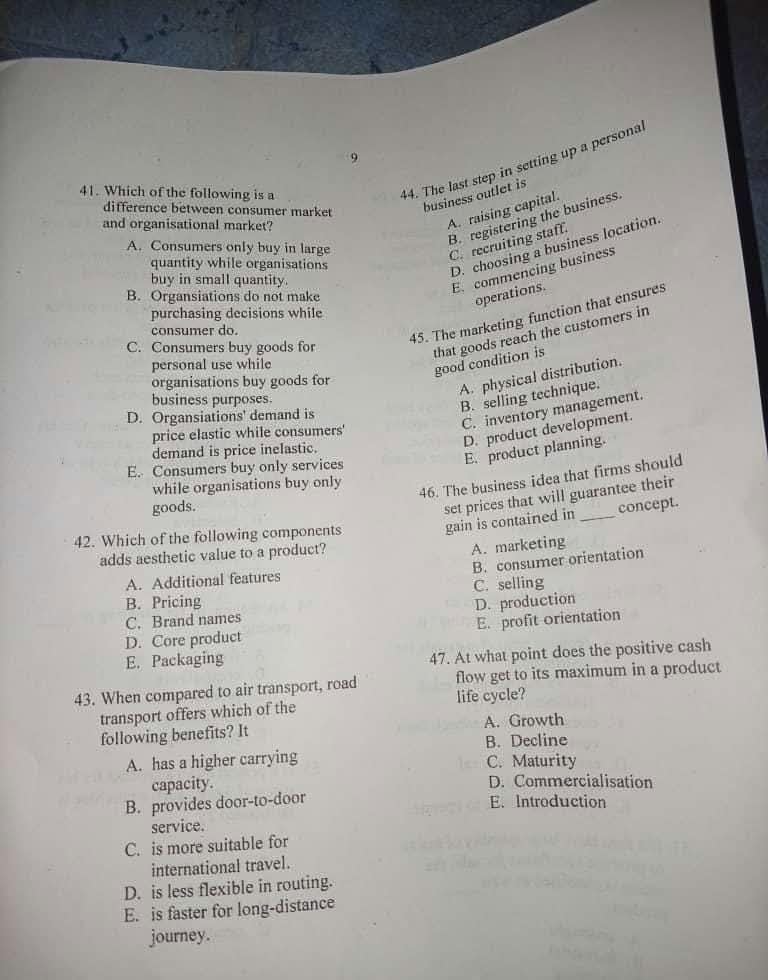
41. C: Consumers buy goods for personal use while organisations buy goods for business purposes
42. E: Packaging
43. B: provides door-to-door service
44. E: commencing business operations
45. A: physical distribution
46. E: profit orientation
47. C: Maturity
48. A: sending sexually suggestive messages over the internet
49. B: ₦50,000 (₦40,000 + 25% = ₦50,000)
50. B: allows businesses to reach customers quickly
51. B: industrial
52. B: message is communicated without direct personal contact
53. C: Intensive
54. D: bargaining
55. E: occupation
56. A: ATL promotion uses paid mass media while BTL promotion uses non-media forms of promotion
57. A: transaction
58. B: Nature of goods
59. E: economic
60. C: Evaluation of alternatives.
NECO GCE OBJECTIVES QUESTIONS
ETC……
NECO GCE MARKETING TEORY ANSWERS
(1a)
(PICK ANY ONE)
Advertising is the process of creating and presenting information about goods and services to the public through various media to inform, persuade and encourage people to buy or use them.
OR
Advertising is a form of communication used by individuals or organisations to promote goods, services or ideas to the public in order to attract customers and increase sales.
(1bi) Radio:
(PICK ANY TWO)
Advantages:
(i) It reaches a large number of people.
(ii) It is relatively cheap to advertise on radio.
(iii) It can reach people in rural and urban areas.
(iv) Advertisements can be repeated frequently.
(v) It does not require reading or writing skills.
(PICK ANY TWO)
Disadvantages:
(i) People cannot see the product being advertised.
(ii) Advertisements are usually short.
(iii) Listeners may miss the advertisement.
(iv) It cannot provide detailed information about a product.
(v) Some people may change the station during advertisements.
(1bii) Television:
(PICK ANY TWO)
Advantages:
(i) It reaches a large audience.
(ii) It combines sound, pictures and motion.
(iii) It attracts the attention of viewers.
(iv) It allows products to be demonstrated.
(v) It makes advertisements more interesting and convincing.
Disadvantages:
(PICK ANY TWO)
(i) It is expensive to produce and broadcast advertisements.
(ii) Advertisements are usually short.
(iii) Viewers may change channels during advertisements.
(iv) Not everyone owns a television.
(v) It requires electricity to watch.
(1biii) Newspapers:
Advantages:
(PICK ANY TWO)
(i) They provide detailed information about products.
(ii) They are relatively affordable for advertisers.
(iii) Readers can keep the newspaper for future reference.
(iv) Advertisements can be placed in specific sections.
(v) They reach a large number of readers.
Disadvantages:
(PICK ANY TWO)
(i) They cannot produce sound or motion.
(ii) Some people cannot read or understand the language used.
(iii) Newspapers may have a short lifespan.
(iv) Some advertisements may be overlooked by readers.
(v) They may not reach people who do not buy newspapers.
(1biv) Websites:
(PICK ANY TWO)
Advantages:
(i) They reach people across the world.
(ii) Advertisements can be updated easily.
(iii) They allow customers to make enquiries and purchases online.
(iv) They can contain pictures, videos and sound.
(v) They are available at any time of the day.
Disadvantages:
(PICK ANY TWO)
(i) They require internet access.
(ii) Some people do not have smartphones or computers.
(iii) Online advertisements may expose users to fraudulent activities.
(iv) Too many advertisements can annoy visitors.
(v) Website advertising may require money for design, maintenance and promotion.
(2a)
(PICK ANY ONE)
Marketing concept is a business philosophy that focuses on identifying and satisfying the needs and wants of customers in order to achieve the goals of an organisation and make profit.
OR
Marketing concept is the idea that a business should determine the needs and wants of its customers and provide goods and services that satisfy them better than its competitors while making profit.
(2b)
(PICK ANY FOUR)
(i) Production Concept: This concept focuses on producing goods and services in large quantities at affordable prices. It assumes that customers prefer products that are readily available and inexpensive. Firms that adopt this concept concentrate on improving production methods and reducing the cost of production.
(ii) Product Concept: This concept emphasises the production of high-quality goods and services with improved features, durability and good performance. It assumes that customers prefer products that offer better quality and value. Firms adopting this concept focus on product improvement and innovation.
(iii) Selling Concept: This concept involves using aggressive selling techniques and promotional activities to persuade customers to purchase goods and services. Firms adopting this concept believe that customers may not buy enough of their products unless they are encouraged through advertising, personal selling and sales promotions.
(iv) Marketing Concept: This concept focuses on identifying the needs and wants of customers and providing goods and services that satisfy them better than competitors. Firms adopting this concept carry out market research to understand customers’ preferences and use the information to improve their products and make profit.
(v) Societal Marketing Concept: This concept emphasises satisfying customers’ needs and wants while also protecting the interest and welfare of society. Firms adopting this concept consider public health, environmental protection and the responsible use of resources when producing and selling their goods and services.
(vi) Relationship Marketing Concept: This concept focuses on building and maintaining long-term relationships between a business and its customers. Firms achieve this through good customer service, after-sales services, customer support and loyalty programmes to encourage customers to continue buying from them.
(3a)
(PICK ANY ONE)
A facilitator is an individual, group or organisation that assists in making activities or business transactions easier by providing guidance, support, information, resources and necessary services to ensure that a task or process is successfully carried out.
OR
A facilitator is a person or organisation that helps to make a process, activity or transaction easier by providing the necessary support, resources or assistance.
(3b)
Roles of a Facilitator in Microfinance Companies:
(PICK ANY TWO)
(i) Providing Financial Assistance: A facilitator helps individuals, small-scale traders, farmers and business owners to gain access to financial services offered by microfinance institutions. This includes helping them obtain loans and other financial support needed to establish, expand or improve their businesses.
(ii) Creating Awareness: A facilitator creates awareness among members of the public about the services and opportunities available in microfinance companies. These services may include savings accounts, small business loans, insurance and other financial products that can improve people’s standard of living.
(iii) Mobilising Customers: A facilitator helps microfinance companies to identify, attract and register potential customers who need financial assistance. This is usually done through community meetings, business associations, market visits and other awareness programmes, especially in rural areas.
(iv) Assisting in Loan Applications: A facilitator guides customers through the loan application process by explaining the requirements, helping them complete application forms and ensuring that necessary documents are provided. This makes it easier for customers to access loans without unnecessary difficulties.
(v) Financial Education: A facilitator educates customers on the importance of saving money, managing income, controlling expenditure and making proper financial decisions. This helps borrowers to use loans wisely, manage their businesses effectively and avoid unnecessary debts.
(vi) Loan Recovery: A facilitator assists microfinance companies in recovering loans from customers by reminding borrowers about repayment dates and encouraging them to pay their debts as agreed. This helps to reduce loan defaults and enables the company to continue providing financial services to other customers.
(vii) Monitoring and Supervision: A facilitator helps to monitor the activities of customers who have received loans to ensure that the money is used for the purpose for which it was collected. This helps the microfinance company to assess business performance and reduce the risk of loan misuse.
(viii) Building Relationships: A facilitator helps to establish and maintain good relationships between microfinance companies and their customers. Through regular communication, guidance and customer support, the facilitator helps to build trust and encourage customers to continue using the company’s services.
Roles of a Facilitator in Marketing Agricultural Produce:
(PICK ANY TWO)
(i) Linking Farmers with Buyers: A facilitator connects farmers with potential buyers such as wholesalers, retailers, food processing companies, exporters and other agricultural traders. This helps farmers to find markets for their produce and reduces the difficulties involved in selling agricultural products.
(ii) Providing Market Information: A facilitator provides farmers with important information about market prices, consumer demand, available markets and seasonal changes in the agricultural sector. This enables farmers to make informed decisions about what to produce, when to sell and where to sell their products.
(iii) Price Negotiation: A facilitator assists farmers in negotiating reasonable and profitable prices for their agricultural produce. The facilitator helps both farmers and buyers reach an agreement that is beneficial to both parties, thereby reducing exploitation and ensuring fair transactions.
(iv) Transportation and Distribution: A facilitator helps farmers to arrange suitable means of transporting agricultural produce from farms to markets, warehouses, processing industries and other destinations. This ensures that products reach buyers on time and reduces losses caused by poor transportation and delays.
(v) Providing Storage Facilities: A facilitator helps farmers to identify and gain access to suitable storage facilities such as warehouses, cold rooms and silos. Proper storage helps to preserve the quality of agricultural produce, prevent spoilage and reduce post-harvest losses before the products are sold.
(vi) Promotion and Advertising: A facilitator helps farmers to promote their agricultural products through advertising, exhibitions, trade fairs, social media and other promotional activities. This creates awareness about the products, attracts potential customers and increases the chances of making more sales.
(vii) Providing Packaging and Grading Services: A facilitator advises farmers on proper packaging, sorting, grading and labelling of agricultural produce to meet market standards. This improves the appearance and quality of the products and makes them more attractive to consumers and potential buyers.
(viii) Providing Technical Advice: A facilitator provides farmers with useful information and guidance on modern agricultural practices, product handling, preservation and quality control. This helps farmers to improve the quality of their produce, reduce waste and meet the requirements of different markets.
(ix) Arranging Market Linkages: A facilitator establishes connections between farmers, agricultural cooperatives, financial institutions, processing companies and export organisations. These relationships provide farmers with better marketing opportunities and access to larger markets for their agricultural products.
(x) Assisting in Market Research: A facilitator helps farmers to understand consumers’ preferences, market trends and the demand for different agricultural products. This enables farmers to identify profitable opportunities and make better decisions about production and marketing.
(4a)
(PICK ANY FOUR)
(i) Higher Prices: Selling cocoa abroad may enable Mr Akin to obtain higher prices for his produce because cocoa is in high demand in many foreign countries.
(ii) Larger Market: Exporting cocoa gives him access to a wider market and more customers beyond the local market, thereby increasing his sales opportunities.
(iii) Higher Profit: Selling cocoa to foreign buyers may increase his income and profit, especially when international market prices are favourable.
(iv) Foreign Exchange Earnings: Exporting cocoa helps to generate foreign currency, which can improve his financial position and contribute to the country’s economy.
(v) High Demand: Cocoa is an important raw material used in producing chocolate, beverages, cosmetics and other products, making it highly demanded in international markets.
(vi) Business Expansion: The income generated from exporting cocoa can enable Mr Akin to purchase modern farming equipment, employ more workers and expand his cocoa farm.
(vii) Reduced Dependence on Local Markets: Selling abroad gives him alternative markets and reduces his dependence on local buyers, who may offer unfavourable prices.
(viii) Improved Standard of Living: The higher income earned from exporting cocoa can help Mr Akin provide better housing, education, healthcare and other basic needs for his family.
(4b)
(i) Cultural Features: Cultural factors such as religion, language, beliefs, customs and traditions influence the tastes, preferences and buying habits of consumers in different countries. Businesses must understand these cultural differences and adjust their products, packaging and advertising to suit the people.
(ii) Demographic Features: Demographic factors such as age, gender, population size, income, education and occupation influence the demand for goods and services in different countries. These factors help businesses identify their target customers and determine the type of products to produce and sell.
(iii) Legal Features: Legal factors include government laws, taxation, import and export regulations, trade restrictions and product standards. These laws determine how businesses operate in foreign markets. Companies must comply with them to avoid penalties, fines or the restriction of their products.
(iv) Economic Features: Economic factors such as inflation, exchange rates, income levels, employment and purchasing power affect the buying ability of consumers. They influence the prices of goods, demand for products and the profits businesses make in international markets.
(5a)
(PICK ANY ONE)
A merchandiser is a person who is responsible for promoting, displaying and selling goods to customers in an attractive manner to increase sales and ensure customer satisfaction.
OR
A merchandiser is an individual who plans, organises and manages the presentation of products in a market or shop to attract customers and encourage them to purchase the products.
(5b)
(PICK ANY FOUR)
(i) Good Communication Skills: A good merchandiser must be able to communicate effectively with customers, suppliers and other workers. This helps the merchandiser to explain product features, answer customers’ questions and provide useful information about goods. Good communication also helps to build trust, maintain good relationships and encourage customers to make purchases.
(ii) Honesty and Integrity: A merchandiser must be honest and trustworthy when dealing with customers and business owners. He or she should provide correct information about products, prices and quality without deceiving buyers. Honesty helps to build customers’ confidence, maintain a good business reputation and encourage customers to continue buying from the business.
(iii) Good Appearance: A merchandiser should maintain a neat, clean and attractive personal appearance when attending to customers. Proper dressing and personal hygiene create a good impression and make customers feel comfortable. A presentable appearance also reflects professionalism and helps to promote a positive image of the business.
(iv) Product Knowledge: A merchandiser must have adequate knowledge of the products being displayed or sold. This includes their features, prices, quality, uses and benefits. Product knowledge enables the merchandiser to answer customers’ questions correctly, recommend suitable products and convince buyers about the value of the goods being offered.
(v) Patience: A good merchandiser must be patient when dealing with different types of customers. Some customers may take time to make purchasing decisions or ask several questions before buying. Patience helps the merchandiser to attend to customers politely, avoid unnecessary arguments and create a pleasant shopping experience that encourages repeat purchases.
(vi) Persuasive Ability: A merchandiser should have the ability to convince customers to buy products without forcing them. This involves explaining the advantages, usefulness and benefits of the products in a convincing manner. Good persuasive ability helps to attract customers, increase product demand and improve the sales performance of the business.
(vii) Good Customer Relations: A merchandiser must be friendly, polite and respectful when dealing with customers. He or she should listen to customers’ complaints, respond to their needs and provide helpful assistance. Maintaining good customer relations creates customer loyalty, encourages repeat purchases and helps the business to attract new customers through recommendations.
(6a)
(PICK ANY ONE)
A new product is a good or service introduced into the market for the first time to satisfy customers’ needs and wants. It may be completely new or an improved version of an existing product.
OR
A new product is any product that is newly developed, modified or improved by a producer and introduced into the market to meet consumers’ demands and provide satisfaction.
(6b)
(i) Branding: Branding is the process of giving a product a special name, symbol, sign or design to distinguish it from other products in the market. It helps customers to identify a particular product easily and differentiate it from competing products. Examples include Coca-Cola, Pepsi and Indomie.
(ii) Packaging: Packaging refers to the process of designing and producing the container or wrapper used to protect a product. It helps to prevent damage, contamination and spoilage during storage and transportation. It also makes the product attractive to customers and encourages them to buy it.
(iii) Labelling: Labelling is the process of attaching written information or printed materials to a product or its package. It provides important details such as the product name, ingredients, manufacturing date, expiry date, weight and instructions for use. It helps consumers to make informed purchasing decisions.
(iv) Grading: Grading is the process of classifying products into different groups according to their quality, size, weight, shape and other characteristics. It helps to ensure uniformity in products and makes it easier for buyers to compare products and determine their appropriate prices.
(7a)
(PICK ANY ONE)
Primary producers are individuals or organisations that are directly involved in the production of raw materials from natural resources through farming, fishing, forestry and mining for consumption or further processing.
OR
Primary producers are people who engage in the extraction and production of basic raw materials from nature. They include farmers, fishermen, hunters, miners and lumberjacks who produce goods for sale or further processing.
(7b)
(PICK ANY ONE)
A market union is an association of traders, farmers or producers who come together to protect their common interests, promote their businesses and solve problems affecting their marketing activities.
OR
A market union is an organised group of people involved in buying and selling who work together to regulate market activities, protect members’ interests and improve the conditions of trading.
(7c)
(PICK ANY THREE)
(i) Protection of Members’ Interests: Market unions protect their members against unfair treatment, exploitation and unnecessary charges. They ensure that members receive fair treatment from buyers, sellers and government authorities. They also speak on behalf of members when problems arise and help to defend their rights in the marketplace.
(ii) Price Regulation: Market unions help to maintain reasonable and fair prices for goods sold in the market. They may provide members with information about prevailing market prices and discourage unnecessary price manipulation. This helps producers and traders to avoid selling their products at extremely low prices or charging unfair prices to consumers.
(iii) Provision of Market Information: Market unions provide members with useful information about the availability, demand and prices of products in different markets. This helps farmers, producers and traders to know where and when to sell their goods. It also enables them to make better marketing decisions and reduce possible losses.
(iv) Settlement of Disputes: Market unions help to settle disagreements among members and other traders in the market. They provide a platform where complaints can be discussed and resolved peacefully. This helps to maintain unity, cooperation and peaceful business relationships among people involved in marketing activities.
(v) Promotion of Members’ Products: Market unions help members to create awareness about their products and attract more customers. They may organise exhibitions, trade fairs and other promotional activities. This increases the visibility of members’ goods, encourages sales and helps producers and traders to expand their businesses.
(vi) Provision of Financial Assistance: Some market unions assist members by providing loans, contributions or financial support when necessary. This helps traders and producers to obtain money for purchasing goods, transporting products and expanding their businesses. It also enables members to overcome temporary financial difficulties.
(vii) Maintenance of Market Orderliness: Market unions help to maintain cleanliness, discipline and proper arrangement of goods in the market. They encourage members to obey market rules and regulations, dispose of refuse properly and maintain a healthy trading environment. This makes the market safe and attractive to buyers and sellers.
(8a)
(PICK ANY ONE)
An organisation chart is a diagram that shows the structure of an organisation. It indicates the different departments, positions, levels of authority and relationships among workers in an organisation.
OR
An organisation chart is a graphical representation of how an organisation is arranged. It shows the chain of command, duties, responsibilities and communication channels between different levels of management and employees.
(8b)
(PICK ANY FOUR)
(i) Market Research: This is the process of gathering information about customers, competitors and market conditions before introducing a product. It helps a firm to understand consumers’ needs, preferences and purchasing behaviour. Through market research, a firm can identify business opportunities, reduce risks and make proper decisions about the goods or services to offer.
(ii) Product Planning and Development: This involves deciding on the type, quality, design and features of goods or services to be produced. A firm studies customers’ needs and develops products that will satisfy them. This activity helps the business to produce suitable goods, improve existing products and compete effectively with other firms.
(iii) Pricing: This involves determining the amount of money customers will pay for a particular product or service. Before marketing, a firm considers the cost of production, competitors’ prices, customers’ purchasing power and expected profit. Proper pricing helps the firm to attract customers, cover expenses and make reasonable profits from sales.
(iv) Packaging: This involves designing and producing suitable containers, wrappers or materials used to protect and present products. Before marketing, a firm selects packaging materials that will preserve the quality of goods and make them attractive to buyers. Good packaging also provides information about the product and makes handling, storage and transportation easier.
(v) Branding: This involves giving a product a unique name, symbol, sign or design that distinguishes it from other products. Before marketing, a firm chooses an appropriate brand identity that customers can easily recognise and remember. Branding helps to create customer loyalty, build the company’s reputation and differentiate its products from competitors.
(vi) Advertising and Promotion: This involves creating awareness about a product or service before it is introduced into the market. A firm selects suitable advertising methods such as radio, television, newspapers, posters and social media to inform potential customers. This helps to attract buyers, create interest in the product and encourage future purchases.
(9a)
(PICK ANY ONE)
A consumer market is a market where individuals and households buy goods and services for their personal use or consumption rather than for resale or further production.
OR
A consumer market refers to a group of individuals and households who purchase goods and services to satisfy their personal needs and wants. It consists of final users of products.
(9b)
(PICK ANY THREE)
(i) Few but Large Buyers: Organisational markets usually have fewer buyers compared to consumer markets. However, these buyers purchase goods in large quantities for business operations, production or resale. For example, a manufacturing company may purchase thousands of bags of raw materials from suppliers to support its production activities.
(ii) Derived Demand: Demand in an organisational market is usually derived from the demand for consumer goods and services. This means that when consumers demand more finished products, organisations increase their demand for the raw materials and equipment needed to produce them. For example, increased demand for bread leads to higher demand for flour.
(iii) Bulk Purchasing: Organisations usually buy goods and services in large quantities to meet their business needs. They purchase in bulk to ensure continuous production, reduce transportation costs and sometimes enjoy discounts from suppliers. For example, a supermarket may purchase hundreds of cartons of beverages from a manufacturing company for resale.
(iv) Professional Purchasing: Organisational buyers often employ trained purchasing officers and specialists to make buying decisions. These professionals examine product quality, prices, suppliers and contract conditions before placing orders. This helps organisations to obtain suitable products at reasonable prices and ensures that purchases meet their business requirements.
(v) Geographical Concentration: Organisational buyers are often concentrated in particular industrial and commercial areas. This makes it easier for suppliers to identify and reach them when marketing their goods and services. For example, many manufacturing companies are located in industrial estates where they can access raw materials, labour and transportation facilities.
(9c)
(PICK ANY FOUR)
(i) Food items.
(ii) Clothing
(iii) Footwear.
(iv) Household furniture.
(v) Electronic appliances.
(vi) Cosmetics and toiletries.
(vii) Books and stationery.
COMPLETED
For Neco GCE 2026 Questions and Answers, Solutions delivered to you before exam time. Contact ExamRunz Team via WhatsApp: 07034630271. All Subjects Available. We also deliver for NABTEB GCE examinations.
CLICK HERE TO CHAT US ON WHATSAPP QUICKLY FOR SUBSCRIPTION.
==============================================
NECO GCE 2026 Marketing Questions and Answers
NECO GCE 2026 Marketing Questions and Answers
NECO GCE 2026 Marketing Questions and Answers
NECO GCE 2026 Marketing Questions and Answers
NECO GCE 2026 Marketing Questions and Answers
NECO GCE 2026 Marketing Questions and Answers
NECO GCE 2026 Marketing Questions and Answers
NECO GCE 2026 Marketing Questions and Answers
NECO GCE 2026 Marketing Questions and Answers
NECO GCE 2026 Marketing Questions and Answers
NECO GCE 2026 Marketing Questions and Answers
NECO GCE 2026 Marketing Questions and Answers
NECO GCE 2026 Marketing Questions and Answers
NECO GCE 2026 Marketing Questions and Answers
NECO GCE 2026 Marketing Questions and Answers
NECO GCE 2026 Marketing Questions and Answers
NECO GCE 2026 Marketing Questions and Answers
NECO GCE 2026 Marketing Questions and Answers
NECO GCE 2026 Marketing Questions and Answers
NECO GCE 2026 Marketing Questions and Answers
NECO GCE 2026 Marketing Questions and Answers
NECO GCE 2026 Marketing Questions and Answers
NECO GCE 2026 Marketing Questions and Answers
NECO GCE 2026 Marketing Questions and Answers
NECO GCE 2026 Marketing Questions and Answers
NECO GCE 2026 Marketing Questions and Answers
NECO GCE 2026 Marketing Questions and Answers
NECO GCE 2026 Marketing Questions and Answers
NECO GCE 2026 Marketing Questions and Answers
NECO GCE 2026 Marketing Questions and Answers
NECO GCE 2026 Marketing Questions and Answers
NECO GCE 2026 Marketing Questions and Answers
NECO GCE 2026 Marketing Questions and Answers
NECO GCE 2026 Marketing Questions and Answers
NECO GCE 2026 Marketing Questions and Answers
NECO GCE 2026 Marketing Questions and Answers
NECO GCE 2026 Marketing Questions and Answers
NECO GCE 2026 Marketing Questions and Answers
NECO GCE 2026 Marketing Questions and Answers
NECO GCE 2026 Marketing Questions and Answers
NECO GCE 2026 Marketing Questions and Answers
NECO GCE 2026 Marketing Questions and Answers
NECO GCE 2026 Marketing Questions and Answers
NECO GCE 2026 Marketing Questions and Answers
NECO GCE 2026 Marketing Questions and Answers
NECO GCE 2026 Marketing Questions and Answers
NECO GCE 2026 Marketing Questions and Answers
NECO GCE 2026 Marketing Questions and Answers
NECO GCE 2026 Marketing Questions and Answers
NECO GCE 2026 Marketing Questions and Answers
NECO GCE 2026 Marketing Questions and Answers
NECO GCE 2026 Marketing Questions and Answers
NECO GCE 2026 Marketing Questions and Answers
NECO GCE 2026 Marketing Questions and Answers
NECO GCE 2026 Marketing Questions and Answers
NECO GCE 2026 Marketing Questions and Answers
NECO GCE 2026 Marketing Questions and Answers
NECO GCE 2026 Marketing Questions and Answers
NECO GCE 2026 Marketing Questions and Answers
NECO GCE 2026 Marketing Questions and Answers
If you found this post helpful or have any questions, please leave a comment below.