
 0703463027 |
  08133282049
Welcome to “EXAMRUNZ.COM” For Neco 2025 Expo
Questions & Answers
Wednesday 9th July, 2025
Chemistry (Objective & Essay) 10:00 am – 1:00 pm
2025 NECO CHEMISTRY ANSWERS
=================================
OBJ-ANSWERS
01-10: CEDADDCCEC
11-20: ECBAEBAEBD
21-30: BCBDEABCAE
31-40: CDDCBBCDED
41-50: DAEAADDAED
51-60: DBCEECDDBE
Completed
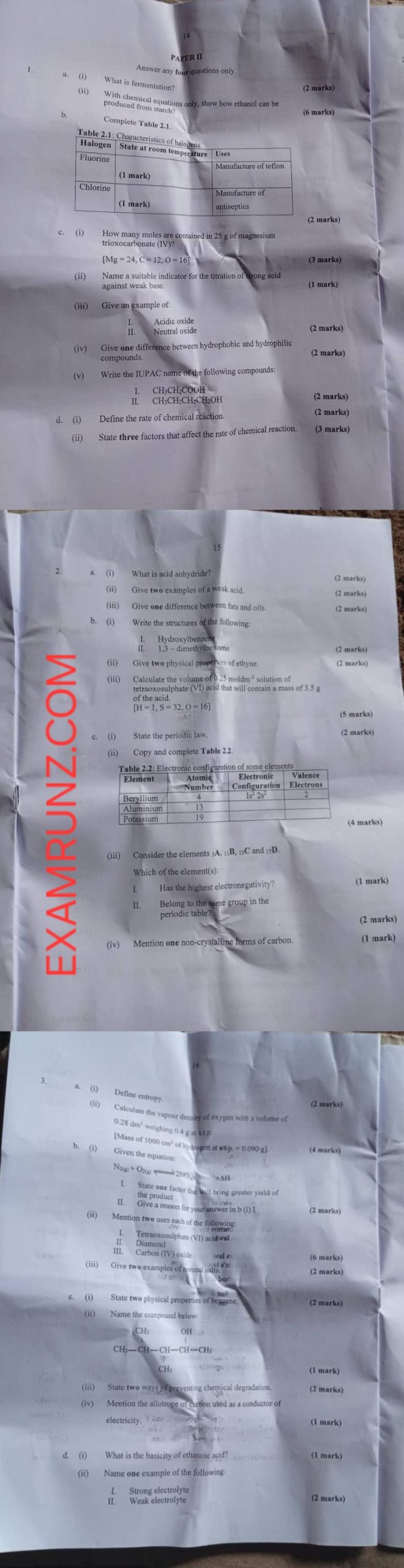
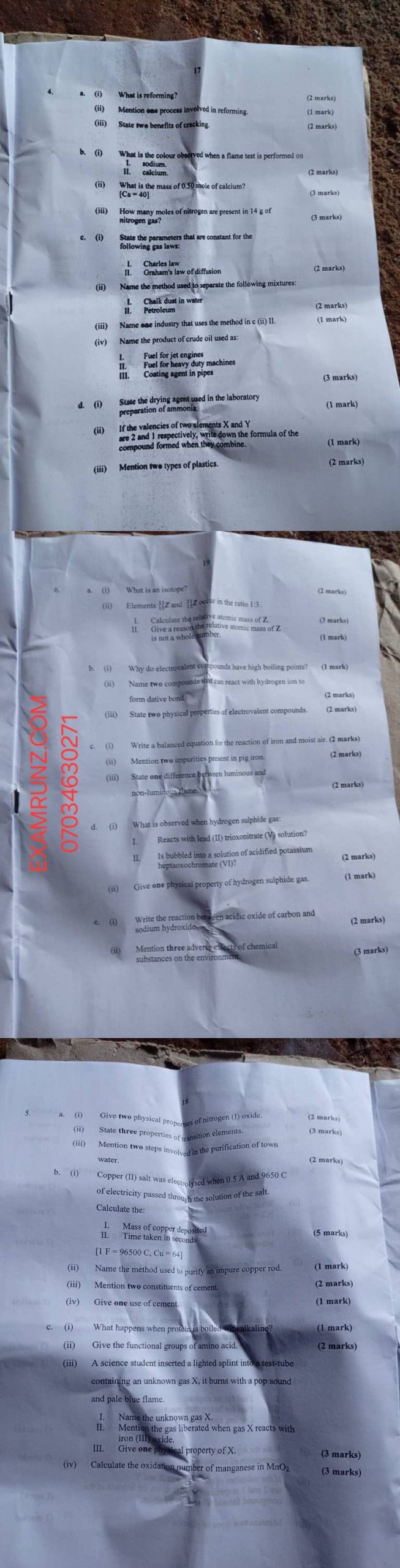
THEORY ANSWERS!
(1ai)
Fermentation is the chemical breakdown of organic substances, especially sugars, by enzymes produced by microorganisms such as yeast, resulting in simpler compounds like alcohol, acids, and gases under anaerobic conditions.
(1aii)
(i) Hydrolysis of starch to glucose:
(C₆H₁₀O₅)ₙ + nH₂O ->> nC₆H₁₂O₆
(ii) Fermentation of glucose to ethanol:
C₆H₁₂O₆ ->> 2C₂H₅OH + 2CO₂
(1b)
check the image below
(1ci)
Molar mass of MgCO₃ = 24 + 12 + (16 × 3) = 84 g/mol
Moles = Mass / Molar Mass = 25 / 84 = 0.299 moles
(1cii)
Methyl orange
(1ciii)
=Acidic oxides=
(i) Carbon dioxide (CO₂)
(ii) Sulphur dioxide (SO₂)
(iii) Nitrogen dioxide (NO₂)
(iv) Phosphorus pentoxide (P₂O₅)
=Neutral oxides=
(i) Nitrous oxide (N₂O)
(ii) Carbon monoxide (CO)
(iii) Water (H₂O)
(iv) Nitric oxide (NO)
(1civ)
(PICK ANY ONE)
(i) Hydrophobic compounds do not dissolve in water, while hydrophilic compounds dissolve easily in water.
(ii) Hydrophobic compounds repel water molecules, while hydrophilic compounds attract water molecules.
(iii) Hydrophobic compounds are usually non-polar, while hydrophilic compounds are often polar.
(iv) Hydrophobic compounds tend to cluster together in water, while hydrophilic compounds disperse evenly.
(v) Hydrophobic compounds are soluble in organic solvents, while hydrophilic compounds are soluble in aqueous solvents.
(1v)
(i) CH₃CH₂COOH ->> Propanoic acid
(ii) CH₃CH₂CH₂CH₂OH ->> Butan-1-ol
(1di)
The rate of a chemical reaction is the speed at which reactants are converted into products, usually measured by the change in concentration of a substance per unit time.
(1dii)
(PICK ANY THREE)
(i) Temperature
(ii) Concentration of reactants
(iii) Presence of a catalyst
(iv) Surface area of reactants
(v) Pressure (for gases)
(vi) Light (for photochemical reactions)
(vii) Nature of reactants
(viii) Stirring or agitation
=================================
(2ai)
An acid anhydride is a compound formed by the removal of water (H₂O) from two molecules of an acid. It reacts with water to form an acid.
(2aii)
(PICK ANY TWO)
(i) Ethanoic acid (CH₃COOH)
(ii) Carbonic acid (H₂CO₃)
(iii) Hydrofluoric acid (HF)
(iv) Phosphoric acid (H₃PO₄)
(v) Nitrous acid (HNO₂)
(vi) Sulphurous acid (H₂SO₃)
(2aiii)
(PICK ANY ONE)
(i) Fats are solid at room temperature, while oils are liquid at room temperature.
(ii) Fats are mostly found in animals, while oils are mostly obtained from plants.
(iii) Fats contain more saturated fatty acids, while oils contain more unsaturated fatty acids.
(iv) Oils tend to have lower melting points than fats.
(v) Fats are generally more stable and less prone to oxidation than oils.
(2bi)
check the image below
(2bii)
(PICK ANY ONE)
(i) It is a colourless gas.
(ii) It has a faint sweet smell.
(iii) It is slightly soluble in water.
(iv) It is less dense than air.
(v) It is highly flammable.
(vi) It burns with a sooty (luminous) flame in air.
(2biii)
Molar mass of H₂SO₄ = (2×1) + 32 + (4×16) = 98 g/mol
Moles of H₂SO₄ = 3.5 / 98 = 0.0357 mol
Molarity (M) = moles / volume ->> volume = moles / molarity
Volume = 0.0357 / 0.25
= 0.143 dm³ or 143 cm³
(2ci)
The periodic law states that the chemical and physical properties of elements repeat at regular intervals when the elements are arranged in order of increasing atomic number.
(2cii)
check the image below
(2ciii)
(i) 17D
(ii) 3A and 13C
(2civ)
(PICK ANY ONE)
(i) Carbon black
(ii) Charcoal
(iii) Lampblack
(iv) Coke
(v) Soot
=================================
(3ai)
Entropy is a thermodynamic quantity that measures the degree of disorder or randomness in a system. It represents the amount of energy in a system that is unavailable to do useful work.
(3aii)
Volume of oxygen = 0.28 dm³
Mass = 0.4 g
Molar volume at s.t.p. = 22.4 dm³
Vapour density = (Molar mass / 2) = (Mass × 22.4) / (2 × Volume)
First, find molar mass:
Molar mass = (0.4 × 22.4) / 0.28 = 32 g/mol
Vapour density = 32 / 2
= 16
(3bi)
I:
(PICK ANY ONE)
(i) Increase in temperature
(ii) Increase in pressure
(iii) Use of a suitable catalyst
(iv) Removal of product (NO) as it is formed
(v) Increasing the concentration of the reactants (N₂ or O₂)
II:
(PICK ANY ONE)
(i) The reaction is endothermic (ΔH > 0), so increasing temperature favours product formation.
(ii) Increasing pressure shifts equilibrium towards fewer gas molecules, but here, molecules are equal so pressure has limited effect.
(iii) A catalyst speeds up the rate without affecting equilibrium position.
(iv) Removing product (NO) shifts equilibrium to the right, increasing yield.
(v) Increasing reactant concentration increases the forward reaction rate.
(3bii)
(i) Tetraoxosulphate (VI) acid (H₂SO₄)
(PICK ANY TWO)
(i) Used in car batteries
(ii) Used in the manufacture of fertilizers
(iii) Used in the production of detergents
(iv) Used in petroleum refining
(v) Used in the manufacture of explosives
(vi) Used in dye and paint production
(ii) Diamond
(PICK ANY TWO)
(i) Used in cutting tools
(ii) Used in jewelry
(iii) Used in drilling bits for oil and gas
(iv) Used in engraving glass
(v) Used in high-precision scientific instruments
(vi) Used in thermal conductivity applications (heat sinks)
(iii) Carbon (IV) oxide (CO₂)
(PICK ANY TWO)
(i) Used in fire extinguishers
(ii) Used in carbonated drinks
(iii) Used in photosynthesis by plants
(iv) Used as a refrigerant in cooling systems
(v) Used to create inert atmospheres in welding
(vi) Used in dry ice for preservation and cooling
(3biii)
(PICK ANY TWO)
(i) Sodium chloride (NaCl)
(ii) Potassium nitrate (KNO₃)
(iii) Calcium sulphate (CaSO₄)
(iv) Magnesium chloride (MgCl₂)
(v) Ammonium chloride (NH₄Cl)
(vi) Zinc sulphate (ZnSO₄)
(3ci)
(PICK ANY TWO)
(i) It is a colourless liquid.
(ii) It has a characteristic aromatic (sweet) smell.
(iii) It is volatile (evaporates easily).
(iv) It is immiscible with water but dissolves in organic solvents.
(v) It has a boiling point of about 80°C.
(vi) It is flammable and burns with a sooty flame.
(3cii)
2-methyl-2,4-pentanediol
(3ciii)
(PICK ANY TWO)
(i) Use of stabilizers or preservatives
(ii) Storing chemicals in airtight, cool containers
(iii) Avoid exposure to light and moisture
(iv) Use of protective coatings or packaging
(v) Store in non-reactive or suitable containers
(vi) Control of temperature and pH during storage
(3civ)
Graphite
(3di)
The basicity of ethanoic acid refers to the number of replaceable hydrogen ions (H⁺) present in one molecule of the acid during a reaction with a base
(3dii)
(i) Strong Electrolytes
(PICK ANY ONE)
(i) Sodium chloride (NaCl)
(ii) Sulphuric acid (H₂SO₄)
(iii) Potassium hydroxide (KOH)
(iv) Nitric acid (HNO₃)
(v) Hydrochloric acid (HCl)
(ii) Weak Electrolytes
(PICK ANY ONE)
(i) Ethanoic acid (CH₃COOH)
(ii) Ammonium hydroxide (NH₄OH)
(iii) Carbonic acid (H₂CO₃)
(iv) Hydrofluoric acid (HF)
(v) Water (H₂O)
=================================
(4ai)
Reforming is a process in petroleum refining where hydrocarbon molecules are rearranged or altered to improve the quality or increase the octane number of fuels like petrol.
(4aii)
Catalytic reforming
(4aiii)
(PICK ANY TWO)
(i) Converts large hydrocarbon molecules into smaller, more useful ones.
(ii) Increases the yield of petrol (gasoline).
(iii) Produces alkenes used in making polymers (plastics).
(iv) Helps to meet the demand for more valuable fractions like gasoline and diesel.
(v) Increases the octane number of fuel, improving engine performance.
(vi) Provides raw materials for the petrochemical industry (e.g, ethene and propene).
(4bi)
(i) Sodium: Yellow flame
(ii) Calcium: Brick-red or orange-red flame
(4bii)
Given:
Molar mass of Ca = 40 g/mol
Mass = Moles × Molar mass
= 0.50 × 40 = 20g
(4biii)
Molar mass of N₂ = 28 g/mol
Moles = Mass / Molar mass = 14 / 28 = 0.5moles
(4ci)
(i) Charles’ law: Pressure is constant
(ii) Graham’s law of diffusion: Temperature and pressure are constant
(4cii)
(i) Chalk dust in water: Filtration
(ii) Petroleum: Fractional distillation
(4ciii)
(PICK ANY ONE)
(i) Petrochemical industry
(ii) Alcohol production industry
(iii) Perfume industry
(iv) Chemical manufacturing industry
(v) Air separation industry
(4civ)
(i) Fuel for jet engines: Kerosene
(ii) Fuel for heavy duty machines: Diesel
(iii) Coating agent in pipes: Bitumen
(4di)
Quicklime (CaO)
(4dii)
X₁Y₂ -> XY₂
(4diii)
(i) Thermoplastics
(ii) Thermosetting plastics
=================================
(5ai)
(PICK ANY TWO)
(i) It is a colourless gas.
(ii) It has a pleasant, sweet smell.
(iii) It is slightly soluble in water.
(iv) It supports combustion.
(v) It is heavier than air.
(vi) It is non-flammable.
(5aii)
(PICK ANY THREE)
(i) They exhibit variable oxidation states.
(ii) They form coloured compounds.
(iii) They act as catalysts in chemical reactions.
(iv) They form complex ions.
(v) They are good conductors of heat and electricity.
(vi) They are hard and have high melting points.
(vii) They show magnetic properties.
(5aiii)
(PICK ANY TWO)
(i) Sedimentation
(ii) Filtration
(iii) Coagulation
(iv) Chlorination
(5bi)
(i) Mass of copper deposited
Given:
Current (I) = 0.5 A
Charge (Q) = 9650 C
Faraday constant (F) = 96500 C/mol
Molar mass of Cu = 64 g/mol
n (valency of Cu²⁺) = 2
Mass (m) = (Q × M) / (n × F)
= (9650 × 64) / (2 × 96500)
= 617600 / 193000
= 3.2 g
Mass of copper deposited = 3.2 g
(ii) Time taken in seconds
Time taken:
t = Q / I = 9650 / 0.5 = 19300 seconds
Time = 19,300 seconds
(5bii)
Electrolysis
(5biii)
(i) Calcium oxide (CaO)
(ii) Silicon dioxide (SiO₂)
(5biv)
(PICK ANY ONE)
(i) It is used in building construction for walls, floors, and pillars.
(ii) It is used in making concrete for bridges, roads, and dams.
(iii) It is used for plastering walls and ceilings.
(iv) It is used in making precast items like blocks, pipes, and tiles.
(v) It is used in grouting to fill gaps and cracks in structures.
(5ci)
It undergoes hydrolysis to form amino acids.
(5cii)
(i) Amino group (-NH₂)
(ii) Carboxyl group (-COOH)
(5ciii)
I: Hydrogen gas (H₂)
II: Steam (H₂O vapor)
III: It is colourless, odourless, and less dense than air
(5civ)
Let the oxidation number of Mn be x
Oxygen has an oxidation number of -2
There are 2 oxygen atoms, so:
x + (2 × -2) = 0
x – 4 = 0
x = +4
=================================
(6ai)
Isotopes are atoms of the same chemical element that have the same atomic number (same number of protons) but different mass numbers due to a difference in the number of neutrons in their nuclei.
(6aii)
(i) Relative atomic mass=
= (13 × 1 + 15 × 3) / (1 + 3)
= (13 + 45) / 4
= 58 / 4
= 14.5
(ii) Because it is the average of the masses of the isotopes based on their natural abundance.
(6bi)
Because they consist of strong electrostatic forces of attraction between oppositely charged ions, which require a lot of energy to break.
(6bii)
(i) Ammonia (NH₃)
(ii) Water (H₂O)
(6biii)
(PICK ANY TWO)
(i) They have high melting points.
(ii) They have high boiling points.
(iii) They conduct electricity in molten or aqueous (solution) state.
(iv) They are usually soluble in water.
(v) They are crystalline solids at room temperature.
(vi) They are generally hard and brittle.
(6ci)
4Fe + 3O2 + 6H2O ->> 4Fe(OH)3
(6cii)
(PICK ANY TWO)
(i) Carbon
(ii) Silicon
(iii) Sulphur
(iv) Phosphorus
(v) Manganese
(vi) Aluminium
(6ciii)
(PICK ANY ONE)
(i) Luminous flame is yellow, while non-luminous flame is blue.
(ii) Luminous flame is sooty, while non-luminous flame is clean.
(iii) Luminous flame is cooler, while non-luminous flame is hotter.
(iv) Luminous flame is unsteady, while non-luminous flame is steady.
(v) Luminous flame is usually produced with limited air supply, while non-luminous flame is produced with sufficient air supply.
(6di)
I: A black precipitate of lead (II) sulphide (PbS) is formed.
II: The orange colour of the solution fades due to reduction of Cr(VI) to Cr(III).
(6dii)
(PICK ANY ONE)
(i) It is a colourless gas.
(ii) It has a foul smell like that of rotten eggs.
(iii) It is slightly soluble in water.
(iv) It is denser than air.
(v) It is poisonous and can be harmful when inhaled in large quantities.
(6ei)
CO2 + 2NaOH -> Na2CO3 + H2O
(6eii)
(PICK ANY THREE)
(i) Water pollution
(ii) Air pollution
(iii) Soil contamination
(iv) Acid rain
(v) Depletion of the ozone layer
=================================
Completed!
WHATSAPP US NOW 07034630271 FOR OTHER SUBJECTS
HOW WE SEND ANSWERS:
Do you Wish To Subscribe For Your Nine (9) Subjects or All Subjects at Once? Click Here
We all Also Available in JUPEB AND IJMB Examination
Thank you.
Be the first to comment