
 WhatsApp: 090
 Welcome to “EXAMRUNZ.COM” For Waec 2025 Animal Husbandry Practical Questions & Answers
- Waec 2025 Animal Husbandry Practical Questions Paper Click Here
- Waec 2025 Animal Husbandry Practical Questions Paper Click Here

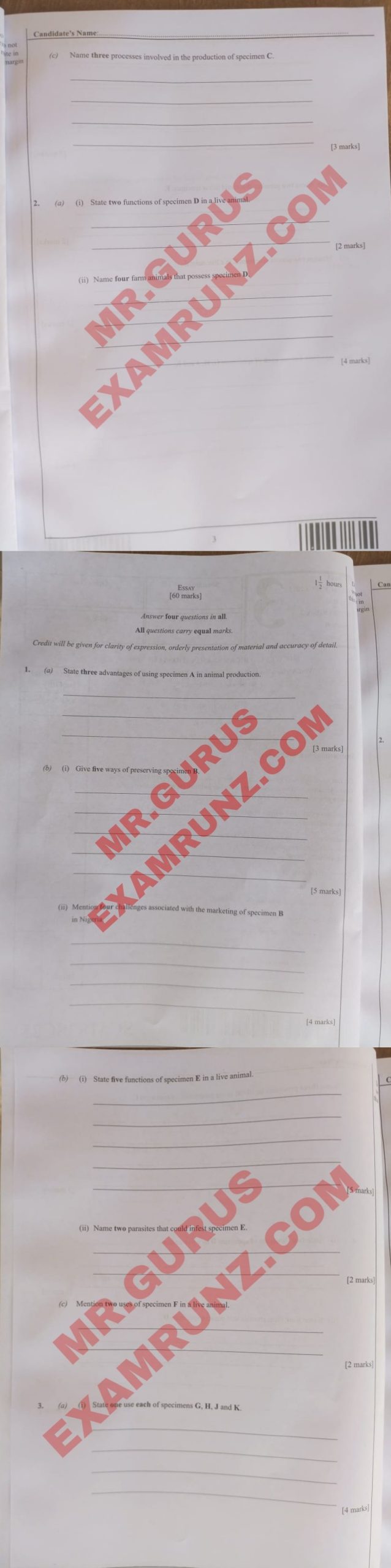
WAEC 2025 ANIMAL HUSBANDRY PRACTICAL
(1a)
(i)Comfort and reduced stress
(ii)Absorbency and hygiene
(iii)Insulation
(1bi)
(i)Refrigeration: Storing beef at low temperatures to slow down bacterial growth.
(ii)Freezing: Freezing beef to preserve it for longer periods.
(iii)Curing: Using salt or other curing agents to draw out moisture and prevent bacterial growth.
(iv)Smoking: Exposing beef to smoke to preserve it and add flavor.
(v)Canning: Sealing beef in airtight containers and heating them to kill bacteria and extend shelf life.
(1bii)
(i)Perishability
(ii)Competition from imports
(iii)Cultural and religious factors
(iv)Infrastructure and logistics
(1c)
(i)Tanning
(ii)Finishing
(iii)Dyeing
(2ai)
(PICK ANY TWO)
(i) Temporary storage of food
(ii) Softening of food before digestion
(iii) Regulation of food passage to the gizzard
(iv) Initial microbial fermentation of food (in some birds)
(2aii)
(PICK ANY FOUR)
(i) Chicken
(ii) Duck
(iii) Turkey
(iv) Pigeon
(v) Guinea fowl
(vi) Quail
(2bi)
(PICK ANY FIVE)
(i) Detoxification of harmful substances
(ii) Metabolism of carbohydrates, fats, and proteins
(iii) Storage of glycogen, vitamins, and minerals
(iv) Production of bile for digestion
(v) Breakdown of red blood cells
(vi) Regulation of blood composition
(vii) Synthesis of blood clotting factors
(2bii)
(PICK ANY TWO)
(i) Liver fluke
(ii) Tapeworm larvae
(iii) Roundworms
(iv) Coccidia
(2c)
(PICK ANY TWO)
(i) Protection of the foot
(ii) Support of body weight
(iii) Aid in locomotion and movement
(iv) Absorption of shock while walking or running
(3ai)
(i)Weighing scale: Measuring the weight of animals or objects.
(ii)Egg Candler: Checking the fertility and development of eggs.
(iii)Thermometer: Measuring temperature in animals or environments.
(iv)Hypodermic syringe: Administering medications or vaccines to animals.
(3aii)
(i)Weighing scale: Regular calibration.
(ii)Egg Candler: Cleaning and dusting.
(iii)Thermometer: Calibration and storage.
(iv)Hypodermic syringe: Sterilization and proper storage.
(3b)
(i)Darken the room: Reduce light to improve visibility.
(ii)Place egg on candler: Position the egg to view its contents.
(iii)Check for fertility: Observe the egg’s development.
(3c)
(i)Sterilization
(ii)Proper disposal
(4a)
(i)Cows
(ii)Goats
(iii)Sheep
(4bi)
(i)Hand milking: Manual milking using hands.
(ii)Machine milking: Using milking machines
(4bii)
(i)Preparation: Clean and sanitize the udder and teats.
(ii)Stimulation: Massage the udder to stimulate milk letdown.
(iii)Milking: Gently grasp the teat and milk into a clean container.
(iv)Filtering: Filter the milk to remove any debris or bacteria.
(4ci)
(i)Protein
(4cii)
(i)Toxic compounds: Fresh leucaena contains toxic compounds like mimosine, which can be harmful to livestock.
(ii)Digestive issues: Fresh leucaena can cause digestive issues in some animals, such as bloating or diarrhea.
Completed
Note: Other Subjects Are available Contact us now on WhatsApp 07034630271 for subscription
Be the first to comment