
WAEC GCE Literature-in-English 2026: Prose Questions, Objective Answers and Solutions
Welcome to EXAMRUNZ.COM – Your Trusted and Verified Source for WAEC GCE Literature-in-English 2026 Prose Questions, Objective Answers and Solutions
WAEC GCE Literature-in-English 2026: Prose Questions, Objective Answers and Solutions
We are a trusted online platform providing candidates with useful and up-to-date solutions about the 2026 WAEC GCE Literature-in-English examination. If you are preparing for the Literature-in-English paper, you are in the right place for examination questions, answers, and detailed solutions.
Tuesday, 6th October, 2026
Literature-In-English 2 (Prose) – 1hr 15mins – 09:30 hrs – 10:45 hrs.
Literature-In-English 1 (Objective) – 1hr – 10:45 hrs – 11:45 hrs.
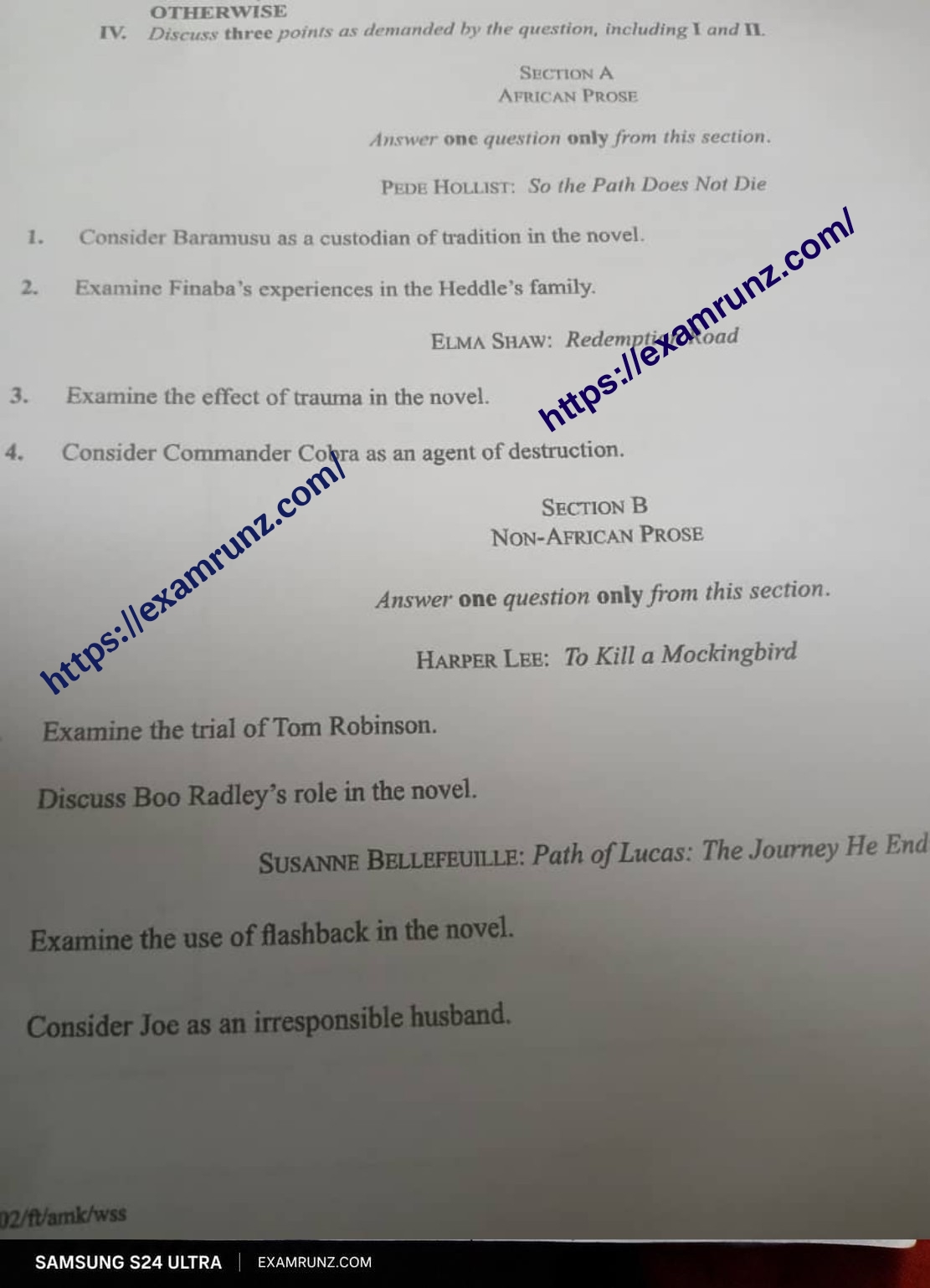
WAEC GCE Literature-in-English 2026: Prose Questions, Objective Answers and Solutions
NUMBER 1
(1)
A custodian of tradition is a person who guards a community’s customs and beliefs and makes sure they are passed to the next generation. In Pede Hollist’s So the Path Does Not Die, Baramusu, the grandmother of Finaba (Fina) Marah, is that guardian. She is presented as the “Guardian of the Path” in the Fula village of Talaba. She defends the female initiation rite and stands against anything she believes threatens the old ways.
She insists on the initiation and secretly arranges it for Fina.
Baramusu secretly arranges for Fina to undergo the ritual. She believes initiation turns a girl into a woman who is accepted, respected and marriageable. In the village scene where she visits Fina’s compound, she presses Fina’s mother, Nabou, to submit Fina to the rite. Her view is that a girl who skips it will be rejected by the community. One night she secretly takes Fina away. This shows she will go to any length to keep the custom alive.
She resists Western education and new ideas, which she sees as threats to culture.
Baramusu views Western education as a direct threat to cultural preservation. When she sees Fina’s Bible and hears of schooling, she reacts with scorn. She argues against Nabou’s wish to do things differently and learn new ways. For her, the old path must be followed so that it does not die out. Her stand puts her in direct conflict with Fina’s parents, Amadu and Nabou.
She passes on tradition through oral storytelling and refuses to blame the ritual for its failures.
She uses the myth of Musudugu to teach Fina. She sits Fina by the path and asks if she knows the story of Musudugu. This shows the oral tradition at work, because she hands down the values of her people through story. Amadu and Nabou doubt the rite because their first daughter, Dimusu, died after her circumcision. Baramusu dismisses that death as destiny and not as a fault in the ritual. She defends the tradition even when it costs a life.
Her loyalty to custom is shown most clearly when the ritual is broken.
When Amadu storms the Fafei and stops the ceremony, Baramusu and the villagers treat it as an unforgivable offence against the custom. The family is shunned and leaves Talaba. This is the result of her uncompromising commitment to tradition, and it sets the course of Fina’s life.
In other words
Baramusu is the strongest defender of tradition in the novel. She arranges the initiation, rejects Western education, passes on culture through story and defends the custom even after a death. Hollist uses her to show how deeply tradition is held. Through Fina’s later search for belonging, he also shows that a tradition must be reshaped into something life-affirming if the path is not to die.
=================================
WAEC GCE Literature-in-English 2026: Prose Questions, Objective Answers and Solutions
NUMBER 2
(2)
In Pede Hollist’s So the Path Does Not Die, Finaba (Fina) Marah is taken into the home of the wealthy Heddle family in Freetown after her father dies. She goes there hoping for security and education. Her experience is a mixture of humiliation, cruelty and hardship, and it also pushes her towards education and independence. Her time with the Heddles shows the class divisions of Freetown and the endurance that carries her through the rest of the novel.
She enters the family as an outsider and is treated as a social inferior.
Fina’s family first meets Pa Heddle when they must jump aside to let his car pass. This shows the gap between the elite and the poor, and it marks the family as people at the bottom of the city’s social ladder. After her father’s death, the Heddles take Fina in as a foster child, and she enters the house through the back door, which symbolises her permanent status as an outsider. The family accepts her only as a dependant, so she is never treated as an equal member of the household.
She suffers physical abuse and psychological trauma.
The Heddle home becomes a place of psychological trauma where Fina suffers physical abuse, and her only photograph of her mother is destroyed. The loss of the photograph is especially painful because it is her last link to her mother and her past. These experiences leave her lonely and vulnerable, and they add to the trauma of her broken initiation. Hollist uses them to criticise the hypocrisy and cruelty of the elite, who appear respectable while mistreating a child in their care.
She endures the suffering for the sake of education.
Fina adopts the mantra pain for gain and chooses to endure Pa Heddle’s abuse as her only viable path towards an education. This shows her determination and maturity. Her time with the Heddles leads to her enrolment at Crowther College, which opens the way to her later success. Her suffering therefore gives her the means to escape poverty and shape her own future.
She later returns to the Heddles as a benefactor.
Fina returns to Freetown and walks through the front door of the Heddle home to provide for those who once fostered her. The front door reverses the back door of her arrival and shows her change from victim to benefactor. It also shows her generosity, because she helps the people who mistreated her instead of taking revenge.
In other words
Fina’s experiences in the Heddles’ family expose class prejudice, cruelty and the hardships of dependence. They also show her resilience, because she endures the abuse to gain an education and later returns to help the family. Hollist uses this part of the novel to show that suffering can produce strength and growth.
===========================================
WAEC GCE Literature-in-English 2026: Prose Questions, Objective Answers and Solutions
NUMBER 5
(5)
The trial of Tom Robinson is the climax of To Kill a Mockingbird. Tom, a black field hand, is accused of raping Mayella Ewell, a young white woman. He is defended by Atticus Finch in the Maycomb courthouse before an all-white jury. The trial exposes racial prejudice in the town and shows the moral courage of Atticus. It also changes how Scout and Jem see their community.
It exposes racial prejudice and injustice in Maycomb.
The evidence clears Tom. Mayella’s injuries were mostly on the right side of her face, but Tom’s left arm was crippled in a cotton-gin accident, so he could not have inflicted them. Bob Ewell is left-handed. Tom testifies that Mayella invited him into the yard to help with a chore and then tried to kiss him, and that he ran away in fear. Despite this, the jury finds him guilty after a long deliberation. The verdict shows that a black man’s word counts for less than a white man’s lie. Tom is later shot seventeen times while trying to escape from the prison farm. His death confirms the injustice, and the newspaper editor, Mr. Underwood, compares it to the senseless killing of songbirds.
It reveals the courage, integrity and legal skill of Atticus Finch.
The town despises Atticus for defending a black man, but he takes the case because it is right. He tells Scout that he could not hold up his head in town if he refused. He cross-examines Mayella and Bob Ewell with care and reveals their lies. In his closing speech he appeals to the jury to treat Tom as an equal before the law and to judge the evidence without prejudice. He loses the case, but his conduct earns the respect of the black community. When he leaves the courtroom, they stand to honour him, and Reverend Sykes tells Scout to stand because her father is passing.
It exposes the social and moral failings of the Ewells and of Maycomb.
Mayella is lonely, poor and abused, and she accuses Tom to hide her shame at having made advances to a black man. Bob Ewell is violent, lazy and dishonest, yet the town believes him over Tom. The trial shows that race and class decide who is believed in Maycomb. It also shows the town’s hypocrisy, since people who call themselves Christians condemn an innocent man. Bob Ewell’s humiliation by Atticus leads to his later attack on Scout and Jem.
It brings loss of innocence and moral growth to the children.
Jem is sure Atticus will win, so the guilty verdict destroys his faith in justice and he weeps. Scout begins to see the cruelty beneath her town’s politeness. Both children learn Atticus’s lesson that one must understand people by standing in their shoes. The trial thus marks their passage from innocence to experience.
In other words
The trial of Tom Robinson is the moral centre of the novel. It exposes racial prejudice, displays the integrity of Atticus and unmasks the Ewells and Maycomb society. Tom is the mockingbird destroyed by prejudice, and the trial leaves the children with a new understanding of justice and human dignity.
=========================================
WAEC GCE Literature-in-English 2026: Prose Questions, Objective Answers and Solutions
WAEC GCE Literature-in-English 2026: Prose Questions, Objective Answers and Solutions
WAEC GCE Literature-in-English 2026: Prose Questions, Objective Answers and Solutions
WAEC GCE Literature-in-English 2026: Prose Questions, Objective Answers and Solutions
WAEC GCE Literature-in-English 2026: Prose Questions, Objective Answers and Solutions
WAEC GCE Literature-in-English 2026: Prose Questions, Objective Answers and Solutions
WAEC GCE Literature-in-English 2026: Prose Questions, Objective Answers and Solutions
WAEC GCE Literature-in-English 2026: Prose Questions, Objective Answers and Solutions
WAEC GCE Literature-in-English 2026: Prose Questions, Objective Answers and Solutions
WAEC GCE Literature-in-English 2026: Prose Questions, Objective Answers and Solutions
WAEC GCE Literature-in-English 2026: Prose Questions, Objective Answers and Solutions
WAEC GCE Literature-in-English 2026: Prose Questions, Objective Answers and Solutions
If you found this post helpful or have any questions, please leave a comment below.