
Welcome to
EXAMRUNZ.COM

– Your Source for
Authentic 2025 Neco Gce Biology Practical Answers
NECO GCE 2025 Biology Practical Exam,
this updated guide from
EXAMRUNZ.COM
will help you score high with
verified questions and step-by-step solved answers.
📅 Exam Date & Time
Wednesday 3 December
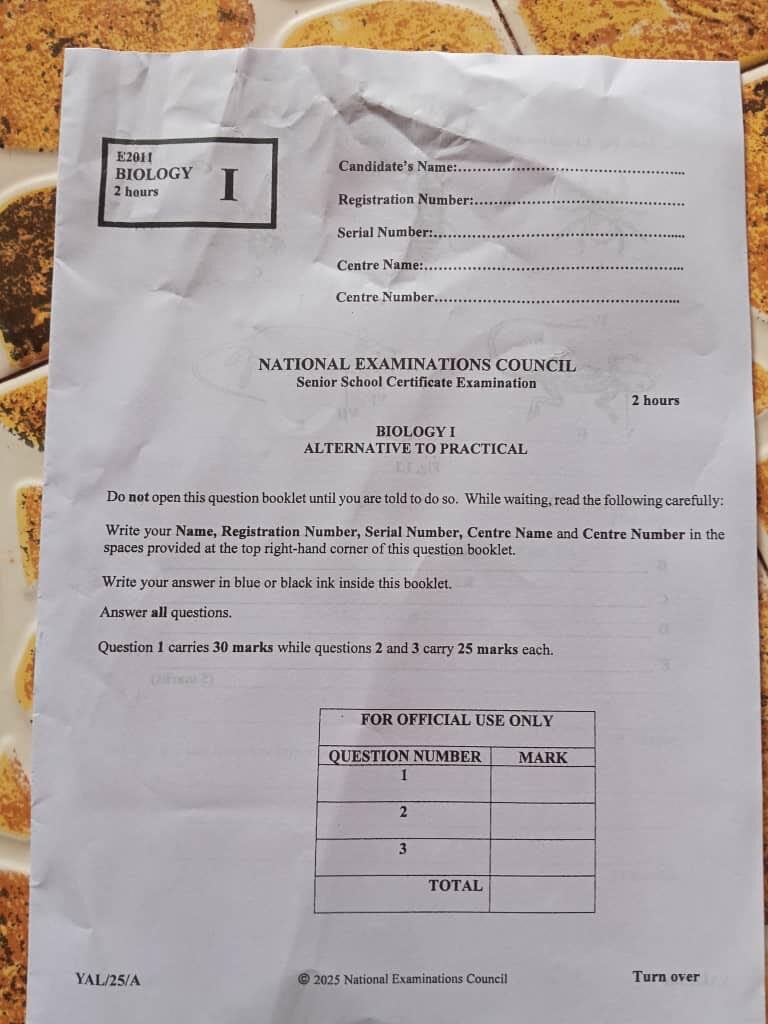
Biology I (Alternative to Practical) – 2:00 pm – 4:00 pm
Authentic 2025 Neco Gce Biology Practical Answers
(1ai)
A: Tick
B: Termite/Wingless insect
C: Pistil (or Carpel) of a flower
D: Lizard
E: Rat
(1aii)
A – Arachnida
B – Insecta
C – Angiospermae
D – Reptilia
(1ciii)
I. Mouthpart
II. Antenna
III. Stigma
IV. Tail
V. Head
VI. Eye
VII. Hind limb
(1bi)
I – Used for biting, chewing or sucking food.
II – Used for sensing smell, touch and vibrations.
III – Receives pollen grains during pollination.
IV – Used for balance, movement and escape from predators.
V – Contains the brain and sensory organs for coordination.
(1bii)
A – Causes diseases and reduces productivity in livestock.
B – Improves soil fertility by breaking down organic matter.
E – Destroys stored grains and causes heavy post-harvest losses.
(1ci)
[TABULATE]
=D
(i) Has dry scaly skin
(ii) Lays eggs
=E
(i) Has fur-covered skin
(ii) Gives birth to live young
(1cii)
(i) Sharp incisors for gnawing food and hard materials.
(ii) Strong sense of smell and hearing for detecting food and danger.
===========================
(2ai)
F – Digestive system of a domestic fowl
G – Alimentary canal of a cockroach
(2aii)
I – Mouth / Beak
II – Small intestine
(2aiii)
(i) It stores food temporarily before digestion.
(ii) It softens food by mixing it with digestive juices or moisture.
(2aiv)
(i) Both have a tube-like digestive tract running from mouth to anus.
(ii) Both possess regions specialized for food storage or processing.
(2av)
[TABULATE]
=F
(i) Has a muscular gizzard for grinding food
(ii) Possesses large intestine and cloaca
=G
(i) Has a gastric caeca for secretion and digestion
(ii) Possesses hindgut with malpighian tubules attached for excretion
(2bi)
Soda lime absorbs carbon dioxide (CO₂) from the incoming air.
(2bii)
The lime water in B remains clear (no change).
(2biii)
The toad serves as the organism that respires and produces carbon dioxide.
(2biv)
B: The lime water in B remains clear.
D: The lime water in D turns milky.
(2bv)
Experiment to Show that Respiration Produces Carbon Dioxide.
(2ci)
X₁: Water level in the beaker rises while the level inside the yam decreases.
X₂: Water level inside the yam increases while the level in the beaker drops.
(2cii)
Salt creates a hypertonic (concentrated) solution that draws water out of the yam by osmosis.
(2ciii)
The yam acts as a semi-permeable membrane, allowing water to move in or out by osmosis.
(2civ)
Demonstration of Osmosis Using Yam and Salt Solution.
(2cv)
(i) It enables roots to absorb water from the soil.
(ii) It helps maintain turgor pressure in plant cells.
===========================
(3ai)
H – Citrus Fruit
I. Oil Palm Fruit
J. Tridax Fruit
K. Pea Plant
(3aii)
H – Hesperidium
I – Drupe
J – Achene
K – Legume
(3aiii)
H – Has a leathery rind with juicy segments filled with vesicles.
I – Has a hard stony endocarp enclosing the seed.
K – Has a pod that splits open on two sides at maturity.
(3aiv)
I. Exocarp
II. Endocarp
III. Endocarp
IV. Pappus
V. Calyx
(3bi)
I – Animals
J – Wind
(3bii)
=I
(i) Fleshy mesocarp attracts animals which feed on it.
(ii) Sticky or oily pulp can attach to animals, aiding dispersal.
=J
(i) Has a pappus (hair-like structure) that increases buoyancy in air.
(ii) Fruit is lightweight, enabling easy wind carriage.
(3biii)
H – Axile placentation
I – Parietal placentation
K – Marginal placentation
===========================
Authentic 2025 Neco Gce Biology Practical Answers
Authentic 2025 Neco Gce Biology Practical Answers
Authentic 2025 Neco Gce Biology Practical Answers
Authentic 2025 Neco Gce Biology Practical Answers
Authentic 2025 Neco Gce Biology Practical Answers
If you found this post helpful or have any questions, please leave a comment below.