
Waec 2025 Authentic Literature Drama & poetry Answers

Welcome to “EXAMRUNZ.COM” For Waec 2025 Expo
Questions & Answers
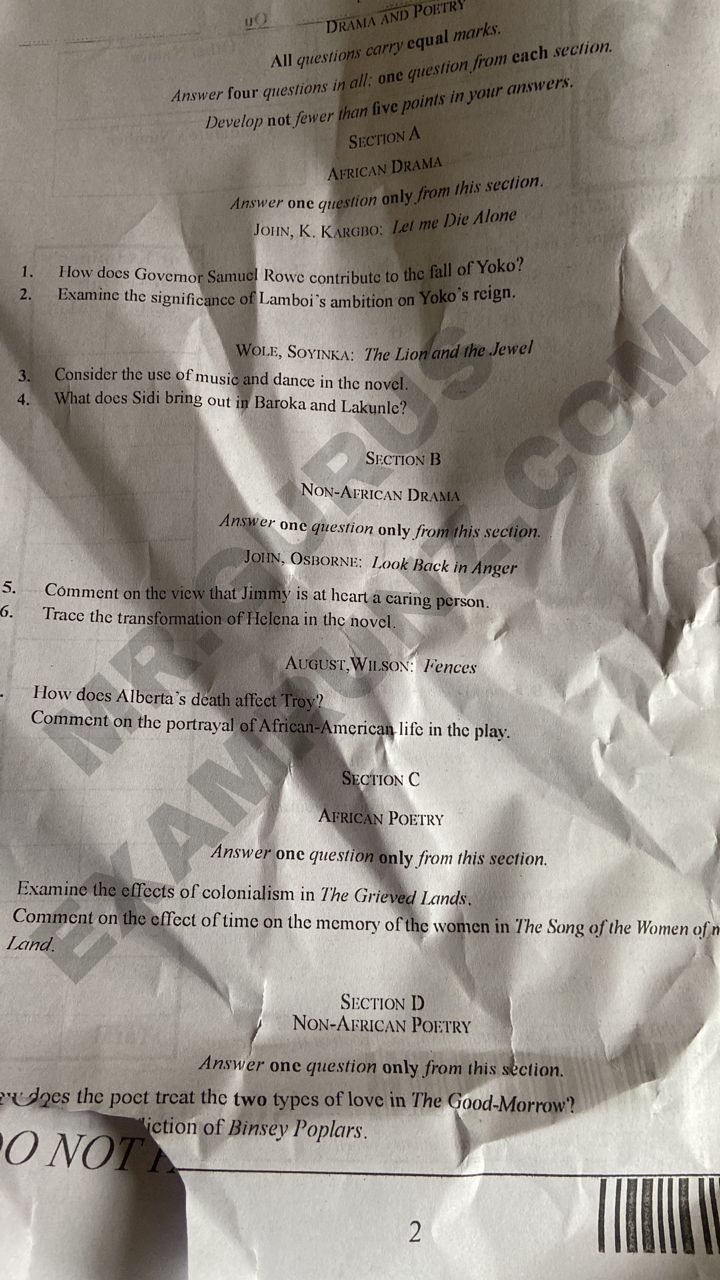
WAEC LITERATURE IN ENGLISH DRAMA AND POETRY ANSWERS FROM NUMBER ONE TO TWELVE
NUMBER 1
In the African drama Let Me Die Alone by John K. Kargbo, Governor Samuel Rowe is a pivotal figure in the decline and eventual fall of Queen Yoko. His influence is marked by political manipulation, exploitation of trust, and the colonial strategy of divide and rule.
Governor Rowe initially gains Yokos trust by recognizing her authority and promising her protection and support in exchange for her cooperation with British colonial interests. He encourages her expansionist ambitions, using her influence to stabilize British control over the Mende territories. This alliance gives Yoko a false sense of security and power, leading her to believe that the colonial government values her leadership.
However, Governor Rowe promises are largely deceptive. Despite Yoko loyalty and effective governance, he fails to honor commitments like granting her higher political status or genuine recognition under British rule. This unfulfilled promise not only demoralizes Yoko but also weakens her reputation among her people, who begin to doubt her authority and allegiance to colonial interests.
Furthermore, Governor Rowe employs a strategy of political manipulation. He stirs distrust between Yoko and other local leaders, subtly sowing seeds of discord that isolate her from traditional allies. His divide-and-rule tactics ensure that Yoko remains dependent on British favor while stripping her of local support.
Ultimately, Governor Rowe's betrayal and political strategy contribute to Yoko's isolation and loss of power. She becomes increasingly disillusioned, realizing too late that her reliance on colonial promises was a fatal mistake. This manipulation by Governor Rowe directly accelerates her downfall, symbolizing the destructive nature of colonial influence on African leadership.
===============================================
NUMBER 2
(2)
In the African drama Let Me Die Alone by John K. Kargbo, Lamboi’s ambition plays a significant and destructive role in the reign of Queen Yoko. His relentless pursuit of power and influence is marked by betrayal, manipulation, and a deep-seated desire to unseat Yoko from her position as the ruler of the Mende people.
Lamboi, Yoko’s own brother, harbors jealousy and resentment towards her rise to power. Despite Yoko’s competence and strategic brilliance as a leader, Lamboi perceives her authority as an obstacle to his ambitions. His patriarchal beliefs fuel his disdain for Yoko’s success, as he struggles to accept a woman occupying such a powerful position in their society.
Driven by envy, Lamboi conspires with Musa, the cunning and manipulative soothsayer, to undermine Yoko’s leadership. Their schemes are laced with deceit and treachery, aiming to destabilize Yoko’s rule through fear and political sabotage. Lamboi’s ambition blinds him to loyalty and familial bonds, as he is willing to betray his own blood to seize control of the throne.
The climax of Lamboi’s ambition is seen in his plot to poison Yoko, a desperate attempt to eliminate her and claim power for himself. His actions reflect not only his personal thirst for dominance but also the broader theme of betrayal and the consequences of unchecked ambition.
Ultimately, Lamboi’s ambition symbolizes the internal threats that powerful leaders often face, not just from external forces like colonial powers, but from within their own circles. His betrayal accelerates Yoko’s fall, revealing how envy and greed can corrode even the strongest of reigns.
===============================================
NUMBER 3
(3)
In Wole Soyinka’s The Lion and the Jewel, music and dance play a very important role in telling the story. They are not just used for entertainment, they help move the plot forward and show the rich culture of the village of Ilujinle.
From the beginning of the play, music and dance are used to bring the community together and to share stories. One clear example is when the villagers use dance and mime to reenact the arrival of the stranger with the camera. Through drumming, singing, and dancing, they retell the event in a lively and engaging way. This shows how music and dance are used as a way of remembering and passing down history in the traditional African setting.
Music and dance also help us understand the characters better. Baroka, the Bale, is often surrounded by music and dancers, which shows his connection to tradition, his authority, and his charm. On the other hand, Lakunle, the schoolteacher who wants to bring modern ways into the village, avoids music and dance. This difference highlights the main conflict in the play between tradition and modernity.
For Sidi, the dances she takes part in show her beauty and popularity in the village. When she dances, it reflects her confidence and growing sense of self-worth. But at the same time, the dance can also show how others try to control or influence her, especially in the scenes involving courtship and marriage.
Overall, music and dance in The Lion and the Jewel are used in a natural and meaningful way. They help tell the story, show the emotions of the characters, and celebrate the culture of the people. Soyinka uses them to remind the audience of the power of tradition and the richness of African storytelling.
===============================================
NUMBER 4
Sidi, the village belle, is central to the rivalry between Baroka, the cunning traditional chief, and Lakunle, the idealistic schoolteacher. Her beauty and pride provoke different reactions from both men. Baroka sees her as a symbol of youth and fertility, and he uses wit and strategy to win her over, reflecting his manipulative and patriarchal tendencies. On the other hand, Lakunle claims to love Sidi but refuses to pay the bride price, showcasing his misunderstanding of her culture and his own contradictions. He preaches equality and modernity but often belittles Sidi’s intelligence and traditions. Through her interactions with both men, Sidi exposes their flaws—Baroka’s scheming and Lakunle’s hypocrisy. Ultimately, her choice to marry Baroka suggests a complex negotiation of power, tradition, and female agency in a rapidly changing society.
===============================================
SECTION B
NUMBER FIVE
Concern for Alison (his wife): Despite his constant criticism and verbal attacks on her, Jimmy does show signs of caring for Alison. His emotional outbursts, while often directed at her, seem to stem from his deep frustration and emotional needs, which could suggest that he feels isolated and hurt. There are moments when he seeks comfort in Alison, and his actions suggest that he cares for her, even if he doesn’t know how to express it in a healthy way. For instance, in the scene where he shows concern for her wellbeing after the miscarriage, there is a glimpse of his emotional vulnerability and desire to protect her.
His relationship with Cliff: Jimmy’s bond with his friend Cliff is another indication that, beneath his gruff exterior, he is capable of care. Jimmy is protective of Cliff and often seeks his companionship, even though he pushes him away at times. Their friendship shows that Jimmy is not entirely devoid of compassion; rather, his expressions of affection are often masked by his anger.
===============================================
NUMBER SIX
(6)
In Look Back in Anger, Helena Charles begins as a strong, confident, and morally upright character. She enters the scene as Alison’s friend, clearly disapproving of Jimmy Porter and his aggressive, chaotic lifestyle. At first, she seems like the complete opposite of Jimmy, calm, controlled, and determined to protect Alison from what she sees as a toxic relationship. She even takes bold steps, such as contacting Alison’s father and encouraging her to leave Jimmy, believing it to be the right thing to do.
However, as the story progresses, Helena’s transformation becomes quite striking. Despite her earlier moral stance, she finds herself drawn to Jimmy in a way that surprises even her. The very passion and energy she once condemned begin to attract her, and she eventually falls into a romantic relationship with him. This shift shows that Helena is not as unshakably principled as she first appeared. Her affair with Jimmy blurs the line between right and wrong in her mind, revealing the complexity of human emotions and desires.
But the transformation doesn’t end there. Toward the end of the play, Helena experiences a deep sense of guilt and conflict. She realizes that, despite her feelings, what she is doing is wrong, especially since it has hurt Alison. Her final decision to leave Jimmy and end the relationship is a return to her earlier sense of morality, but now it’s tempered by personal experience and emotional growth. She is no longer just a symbol of order and control; she has become a more human and self-aware character who has faced her own flaws.
In the end, Helena’s transformation is a journey from moral certainty to emotional confusion, and finally to self-realization. Her character shows that even those who seem the strongest can be vulnerable, and that real strength sometimes comes from acknowledging one’s mistakes and walking away.
===============================================
NUMBER 7
-Alberta’s death in August Wilson’s play “Fences” has a profound impact on Troy Maxson, the protagonist. Alberta, Troy’s mistress, dies giving birth to their daughter, Raynell. This event forces Troy to confront the consequences of his actions and the realities of his life choices. Alberta’s death brings a significant turning point in Troy’s personal life and his relationships with his family.
-It exposes the strain and tension in his marriage to Rose, as it is the ultimate revelation of his infidelity. Troy is compelled to face Rose with the truth of his betrayal, which further fractures their relationship. Rose, who has been a supportive and dedicated wife, is deeply hurt by Troy’s actions but chooses to raise Raynell as her own, showcasing her resilience and capacity for forgiveness.
-For Troy, Alberta’s death is a moment of reckoning. It highlights the complexity of his character, revealing his vulnerabilities and the inner turmoil he experiences as a result of his decisions. He is forced to navigate the guilt and responsibility of raising a child born from an affair, while simultaneously dealing with the loss of Alberta, who represented an escape from his daily struggles and disappointments.
-In essence, Alberta’s death is a catalyst that accelerates the unraveling of Troy’s life. It compels him to confront the reality of his fractured relationships and the impact of his choices on his family. This event underscores the themes of responsibility, redemption, and the inescapable consequences of one’s actions, which are central to the play’s narrative.
===============================================
NUMBER 8
Fences provides a powerful portrayal of African-American life in mid-20th century America. It examines the impact of systemic racism on personal dreams and family relationships. Troy Maxson represents the generation of Black men who were denied opportunities due to segregation and prejudice. His bitterness over lost dreams as a baseball player reveals the psychological toll of racism. The play also explores the changing dynamics of African-American families, with tensions between traditional authority figures like Troy and younger generations like Cory who aspire for more freedom and opportunity. Through realistic dialogue and emotional conflicts, August Wilson captures the resilience, pain, and complexity of Black life in America, while emphasizing themes of responsibility, forgiveness, and legacy.
===============================================
NUMBER NINE
(9)
Colonialism as a Source of Pain and Loss: The title, “The Grieved Land”, immediately suggests a land that is burdened with sorrow and suffering. This grief is not just metaphorical but is deeply rooted in the historical impact of colonialism on African countries.
Colonialism is seen as a force that has wounded the land, not just in terms of physical damage (such as exploitation of resources and displacement of people), but also in a deeper, emotional sense, as it robs the people of their dignity, culture, and sense of identity.
Impact on the People and the Land: In the poem, there is a clear sense of alienation—the people are distanced from their land, and the land itself seems to mourn its lost integrity and freedom. This is a direct effect of colonial occupation, where colonial powers sought to control the land and its people, often disregarding indigenous practices, culture, and governance.
The exploitation of the land and its resources during the colonial period led to environmental degradation and a loss of connection between the people and their ancestral land. The poem might reference this in the description of the land’s grieving.
Loss of Culture and Identity: Colonialism often involved the imposition of foreign values, languages, and religions. In African poetry, this is commonly depicted as an assault on the native culture and identity of the people.
The loss of tradition and the forced adoption of Western norms are recurrent themes in African literature, with the land and its people described as grieving because they have lost their cultural heritage and freedom to foreign influences. “The Grieved Land” might reflect this cultural erosion under colonial rule.
African Poetry and the Effects of Colonialism:- Much of African poetry, especially post-colonial poetry, addresses the emotional and physical scars left by colonialism. Poets such as Wole Soyinka, Chinua Achebe, and others have explored themes of identity crisis, resistance, and the struggle for freedom from colonial oppression.
In this context, “The Grieved Land” shares commonalities with African poetry that focuses on the psychological and cultural wounds of colonization. The land is not only grieved for the exploitation it has suffered but also for the disillusionment and loss of direction that colonialism has left in its wake.
Post-Colonial Reflection: After independence, African poets often reflect on how colonialism left the land and its people in a state of grief, struggling to recover and rebuild. In “The Grieved Land,” the grieving land might represent a nation coming to terms with its past and the struggle to reclaim its dignity and self-worth after colonial rule.
The theme of grief is often used in African poetry to signal the lingering effects of colonization, but it is also a call for healing and recovery.
===============================================
NUMBER TEN
(10)
-Zhu Song’s poem “The Memory of the Land” reflects on the impact of time on the memory of women within a landscape marked by history and personal narratives. The poem captures how the passage of time weaves itself into the fabric of memory, influencing the way women recall and relate to their past experiences and their connection to the land.
-As time progresses, memories of the women in the poem become layered and complex. The effect of time is depicted as a dual force: it both softens the edges of past hardships and intensifies the longing for what has been lost.
Memories are portrayed as enduring yet evolving, shaped by the ongoing relationship between the women and their environment.
-This connection to the land serves as an anchor for their identities, grounding them even as time threatens to blur the details of their past. Moreover, time imbues the women’s memories with a sense of nostalgia and reflection. The poem suggests that as the years pass, the women gain a deeper understanding of their experiences, viewing them through the lens of wisdom acquired over time.
-This results in a rich tapestry of recollections that are both personal and collective, highlighting the shared history embedded within the land. In essence, “The Memory of the Land” illustrates how time affects memory by adding depth, perspective, and continuity to the women’s stories. It underscores the idea that while individual memories may fade, the collective memory associated with the land endures, preserving the essence of the women’s experiences across generations.
===============================================
SECTION D
NUMBER ELEVEN
Physical Love: The poem begins with the speaker reflecting on a past love that was superficial and based on physical attraction. This love is likened to a dream or sleep, implying that it was incomplete or unaware.
Spiritual/Intellectual Love: As the poem progresses, the speaker celebrates a deeper, more profound love. This love transcends the physical and is based on a spiritual and emotional connection. The lovers’ union is described as whole and perfect, where they form a complete world of their own, free from external distractions.
Donne elevates spiritual love as the true, lasting form, suggesting it is more fulfilling and eternal than mere physical attraction.
===============================================
SECTION D
NUMBER (12)
-In Gerard Manley Hopkins’ poem “Binsey Poplars,” the diction is carefully chosen to evoke both the beauty of nature and the sense of loss resulting from its destruction. Hopkins’ use of language is characterized by vivid and rich imagery, as well as a rhythmic and musical quality that enhances the emotional impact of the poem.
The poem begins with a tender and nostalgic tone, as Hopkins describes the poplar trees with affectionate detail.
-He uses words that convey the elegance and grace of these trees, capturing their visual and aesthetic appeal. The diction here is gentle and reverent, reflecting the poet’s deep appreciation for the natural world. As the poem progresses, the diction shifts to convey a sense of mourning and lamentation.
-Hopkins employs words that suggest violence and destruction, such as “hack and rack,” to describe the felling of the trees. This stark contrast between the beauty of the poplars and the brutality of their destruction serves to heighten the reader’s sense of loss and regret. Furthermore, Hopkins often uses compound words and alliteration to create a musicality in the poem, reflecting the natural rhythm of the landscape he describes.
-His choice of language also includes archaic and inventive terms, which add a unique and personal touch to the poem, drawing the reader into his emotional response to the irreversible change in the landscape. Overall, the diction in “Binsey Poplars” is a powerful tool that Hopkins uses to express both the beauty of nature and the profound sense of loss that comes with its destruction. Through his choice of words, he captures the delicate balance between appreciation and mourning, inviting the reader to reflect on the impact of human actions on the natural world.
COMPLETED
Note: All theory Answers was Sent To Our Subscribed Candidates on WhatsApp & on Our Online password protect Answers page. Click Here To Subscribe For All Subject
Contact us on WhatsApp – 07034630271
Waec 2025 Authentic Literature Drama & poetry Answers
Waec 2025 Authentic Literature Drama & poetry Answers
Waec 2025 Authentic Literature Drama & poetry Answers
Waec 2025 Authentic Literature Drama & poetry Answers
Waec 2025 Authentic Literature Drama & poetry Answers
Waec 2025 Authentic Literature Drama & poetry Answers.
Waec 2025 Authentic Literature Drama & poetry Answers
Waec 2025 Authentic Literature Drama & poetry Answers.
Waec 2025 Authentic Literature Drama & poetry Answers
Waec 2025 Authentic Literature Drama & poetry Answers
Waec 2025 Authentic Literature Drama & poetry Answers
Waec 2025 Authentic Literature Drama & poetry Answers
Waec 2025 Authentic Literature Drama & poetry Answers
Waec 2025 Authentic Literature Drama & poetry Answers
Waec 2025 Authentic Literature Drama & poetry Answers
Waec 2025 Authentic Literature Drama & poetry Answers.
Waec 2025 Authentic Literature Drama & poetry Answers
Waec 2025 Authentic Literature Drama & poetry Answers.
Waec 2025 Authentic Literature Drama & poetry Answers
Waec 2025 Authentic Literature Drama & poetry Answers
Waec 2025 Authentic Literature Drama & poetry Answers
Waec 2025 Authentic Literature Drama & poetry Answers
Waec 2025 Authentic Literature Drama & poetry Answers
Waec 2025 Authentic Literature Drama & poetry Answers
Waec 2025 Authentic Literature Drama & poetry Answers
Waec 2025 Authentic Literature Drama & poetry Answers.
Waec 2025 Authentic Literature Drama & poetry Answers
Waec 2025 Authentic Literature Drama & poetry Answers.
Waec 2025 Authentic Literature Drama & poetry Answers
Waec 2025 Authentic Literature Drama & poetry Answers
If you found this post helpful or have any questions, please leave a comment below.