
NECO GCE 2026 English Language Questions and Answers – Objective & Essay & Test Of Oral
Did you know that getting good grades in your NECO GCE 2026 English Language examination can improve your chances of gaining admission to a university or polytechnic?
Scoring A’s and B’s can strengthen your academic profile and give you an advantage during the admission process.
If you’re aiming for excellent grades, our exam expo support services can help you prepare more effectively and achieve your academic goals.
All our Subscribed students will get there NECO GCE 2026 English Language Questions and Answers – Objective & Essay & Test Of Oral before exam time
Remember, your admission journey starts with proper preparation.
Saturday, 14th November, 2026
English Language Paper III (Objective) – 10:00am – 11:00am.
English Language Paper II (Essay) – 11:15am – 1:00pm.
English Language Paper IV (Test of Orals) – 1:15pm – 2:00pm
NECO GCE 2026 English Language Questions and Answers – Objective & Essay & Test Of Oral
NECO GCE ORAL ENGLISH ANSWERS
The questions and options were RESHUFFLED, we had to write out the question and the answer wordings. Your number 1 might be my number 5, so just use the below answers for easy tracing)
1. Card (ANSWER = *class*)
2. Shoot (ANSWER = *moon*)
3. Sit (ANSWER = *kit*)
4. Toil (ANSWER = *boy*)
5. Bite (ANSWER = *dry*)
6. Bead (ANSWER = *key*)
7. Boat (ANSWER = *load*)
8. Blend (ANSWER = *claim*)
9. Word (ANSWER = *service*)
10. Bun (ANSWER = *begun*)
11. Pull (ANSWER = *book*)
12. Cloud (ANSWER = *blouse*)
13. Clay (ANSWER = *lace*)
14. Force (ANSWER = *caught*)
15. Sand (ANSWER = *pant*)
16) Grab (ANSWER = *blink*)
17) Pathetic (ANSWER = *trick*)
18) Perform (ANSWER = *sharp*)
19) Advocate (ANSWER = *begged*)
20) Wisdom (ANSWER = *repose*)
21) Yellow (ANSWER = *presume*)
22) Length (ANSWER = *menthol*)
23) Famous (ANSWER = *morpheme*)
24) Experienced (ANSWER = *contour*)
25) Grape (ANSWER = *congress*)
26) Either (ANSWER = *heathen*)
27) Join (ANSWER = *gauge*)
28) Long (ANSWER = *sanguine*)
29) Signal (ANSWER = *gnome*)
30) Chisel (ANSWER = *voucher*)
31. Judge (ANSWER = *grudge*)
32. Wash (ANSWER = *squash*)
33. Fierce (ANSWER = *pierce*)
34. Wood (ANSWER = *hook*)
35. Bait (ANSWER = *fate*)
36) Mobilisation (ANSWER = *mo-bi-li-SA-tion*)
37) Adulterated (ANSWER = *a-DUL-te-rat-ed*)
38) Possibility (ANSWER = *pos-si-BI-li-ty*)
39) International (ANSWER = *in-ter-NA-tion-al*)
40) Traditionalist (ANSWER = *tra-DI-tion-al-ist*)
41. (ANSWER = *massacre*)
42. (ANSWER = *indeed*)
43. (ANSWER = *idea*)
44. (ANSWER = *examine*)
45. (ANSWER = *above*)
46) (ANSWER = *Did she direct the first scene of the skit carefully?*)
47) (ANSWER = *Is the meeting going on in the national library?*)
48) (ANSWER = *Do we sometimes read for information?*)
49) (ANSWER = *Was the whole compound flooded when the river overflowed its bank?*)
50) (ANSWER = *Did I get some cowries from him?*)
51. /aː/ (ANSWER = *stark*)
52. /ɔɪ/ (ANSWER = *choice*)
53. /u:/ (ANSWER = *brood*)
54. /eɪ/ (ANSWER = *bake*)
55. /ŋ/ (ANSWER = *crank*)
56. /eə/ (ANSWER = *pear*)
57. /ɔ/ (ANSWER = *solid*)
58. /j/ (ANSWER = *union*)
59. /t/ (ANSWER = *jaundiced*)
60. /ʊə/ (ANSWER = pure)
NECO GCE 2026 English Language Questions and Answers – Objective & Essay & Test Of Oral
ENGLISH OBJECTIVES
Trace the options and answers alongside our solutions to make it easier and faster to identify them, as they have been reshuffled and rearranged.
SECTION: 1 (Opposites)
1. huge
2. conflict
3. consented to
4. legalising
5. continue
6. objected
7. complimentary
8. an inept
9. an unfortunate
10. garrulous
SECTION: 2 (Complete the sentence)
11. proof
12. stretcher
13. an abomination
14. confidence
15. lending
16. escapees
17. client
18. silver
19. souvenir
20. perjury
SECTION: 3 (Interpretation)
21. slightly more advanced
22. recorded
23. works differently
24. more impressive than mine
25. severely punish me
26. take directives from him
27. have different personalities
28. would do everything possible to get the cause of his son’s death
29. abandoned
30. deceive me
SECTION: 4 (Nearest meaning)
31. arrested
32. angry about
33. endless
34. memorable
35. rowdy
36. hinder
37. excessive
38. few
39. urgent
40. politely
SECTION: 5 (Most appropriate)
41. were
42. had
43. bravest
44. how often I went to the gym
45. which
46. didn’t
47. completion
48. had left
49. a bit of
50. gain
51. swarm
52. bunch
53. whose
54. know
55. Would
56. impeccable
57. would
58. under
59. so
60. -ant
61. or
62. pieces of information
63. isn’t
64. had been reading
65. nor
66. three brave little
67. by
68. briefly
69. occasion
70. for
SECTION: 6 (Passage)
71. professional
72. indicate
73. overtake
74. brake
75. radiator
76. knock
77. permit
78. teer
79. reverse
80. Rules
NECO GCE ENGLISH LANGUAGE ESSAY (TYPE A)
NECO GCE ENGLISH LANGUAGE ESSAY (TYPE B)
LENGLISH LANGUAGE IMPORTANT INSTRUCTION:
PLEASE READ CAREFULLY and don’t forget to trace and look each question very well before using our answers
All the questions are the same, but they have been reshuffled and rearranged and given different numbers in THEORY and options in objectives so that why you need to carefully Trace it and look the question each by each before selecting our answers.
Before answering any question, carefully look at the question in your examination paper and find the exact question and the numbering among our provided answers. Do not rely on the question number alone, because the numbering may be different and the question reshuffled also.
Take your time to match each question with its correct answer, one after the other. This applies to both OBJECTIVE AND ORAL OBJECTIVE AND THEORY questions.
Always check the actual question before using an answer. This will help you avoid mistakes.
Thank you, and best of luck in your examination!
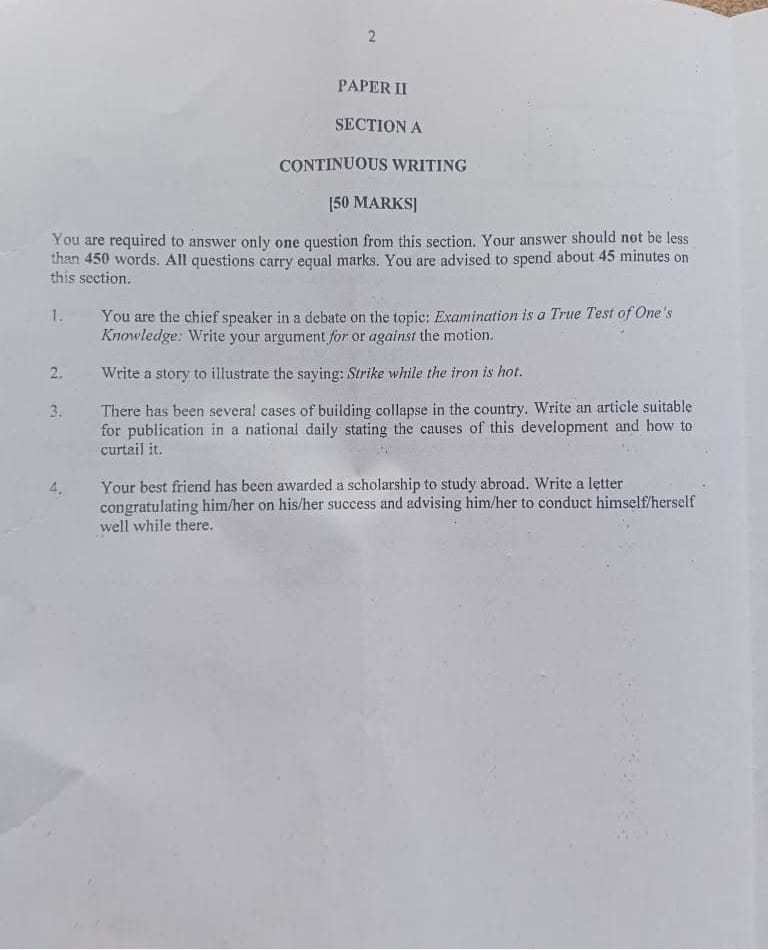
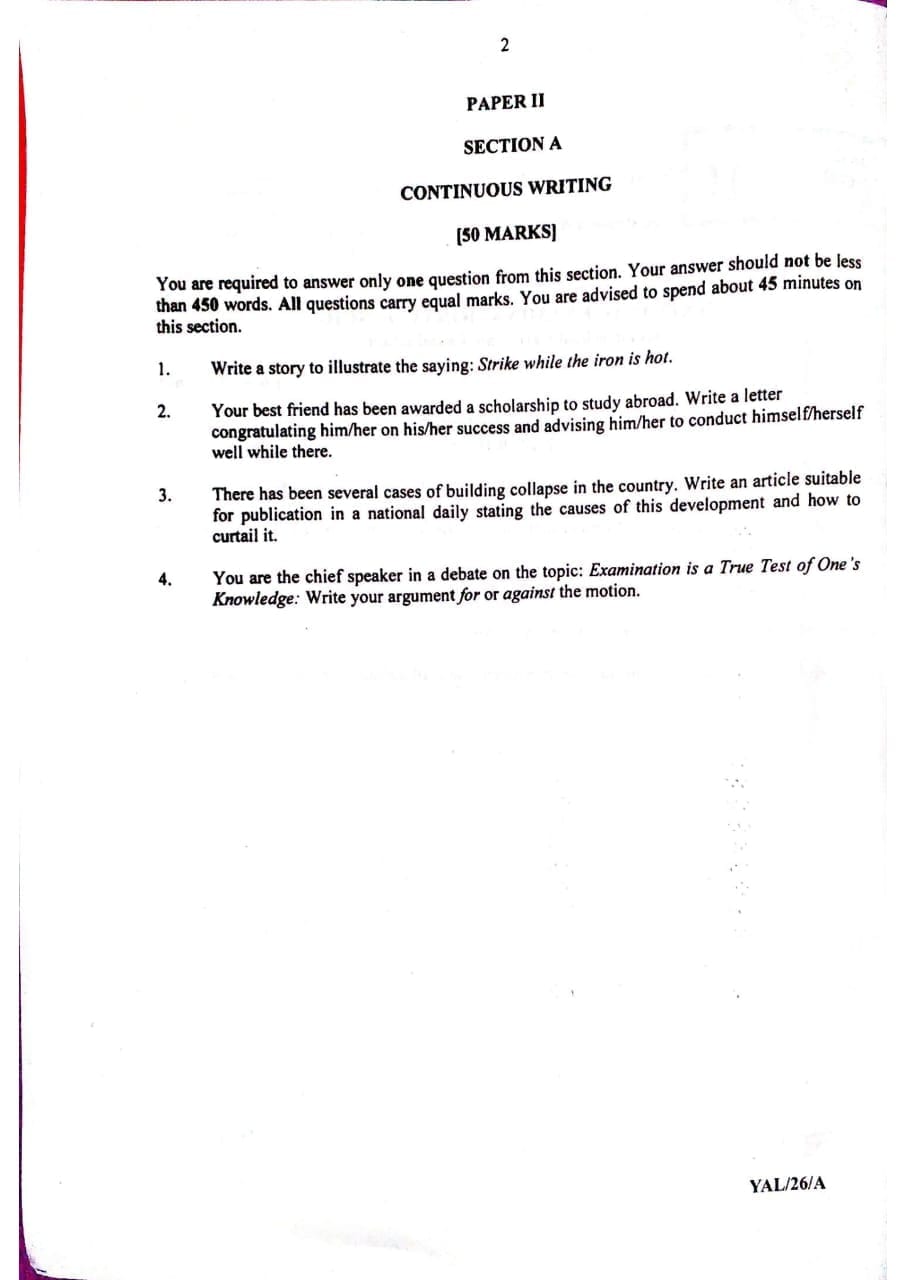
*QUESTION:* _There has been several cases of building collapse in the country. Write an article suitable for publication in a national daily stating the causes of this development and how to curtail it._
*(VERSION I)*
`THE PROBLEM OF BUILDING COLLAPSE IN NIGERIA: CAUSES AND SOLUTIONS`
Building collapse has become a serious problem in Nigeria. Almost every year, we hear reports of buildings falling down in different parts of the country. Sadly, many people lose their lives, while others suffer serious injuries. Some families also lose their homes and valuable property. This situation is very worrying and calls for urgent attention. It is therefore important to examine the causes of building collapse and suggest ways of preventing it.
One major cause of building collapse is the use of poor-quality building materials. Some contractors use fake cement, weak iron rods and other materials that are not strong enough for construction. They do this because they want to spend less money and make more profit. Unfortunately, such materials cannot support the weight of a building properly. As a result, the building may develop cracks and eventually collapse.
Another cause is the use of unqualified people for building projects. Some people employ ordinary bricklayers and other workers to handle important construction work without the supervision of trained professionals. They fail to employ qualified engineers and architects because they want to reduce the cost of building. This can lead to poor building designs, weak foundations and other serious mistakes that may cause a building to collapse.
Corruption is also one of the reasons for this problem. Some government officials who are supposed to inspect building projects collect money from contractors and allow them to continue with unsafe construction. In some cases, building owners add more floors to their buildings without checking whether the foundation can carry the extra weight. Such actions put the lives of people in danger.
To solve this problem, the government must make sure that building rules are properly followed. Officials responsible for inspecting buildings should visit construction sites regularly to check the quality of the work. Any contractor who fails to follow the approved rules should be punished. Government officials who collect bribes to approve unsafe buildings should also face the law.
Furthermore, only good-quality building materials should be allowed in the market. The government should work with the Standards Organisation of Nigeria (SON) to check cement, iron rods and other materials before they are sold to the public. Anyone caught selling fake building materials should be punished.
In addition, people should be encouraged to employ qualified architects, engineers and other building professionals whenever they want to construct houses. They should not allow untrained workers to make important decisions about their buildings. People should also avoid rushing construction work simply because they want to complete their houses quickly.
Finally, the government should organise public awareness programmes to educate people about the dangers of using poor materials and employing unqualified workers. This will help property owners understand the importance of following proper building procedures.
In conclusion, building collapse is a problem that can be prevented if everyone plays their part. The government, building owners, contractors and professionals must work together to ensure that buildings are properly constructed. Human lives are more important than making quick profits, and every building should be safe for the people living or working in it.
*QUESTION:* _Write a story to illustrate the saying: Strike while the iron is hot._
*(VERSION I)*
It was a bright Monday morning in Nnewi, and the market was already busy with traders and customers buying and selling different goods. Inside his uncle’s spare parts shop, Chinedu was busy cleaning the shelves and arranging the goods. He was a nineteen-year-old young man who had completed his secondary school education the previous year. He was learning the business from his uncle, Chief Okonkwo, with the hope of becoming a successful businessman in the future.
His uncle always advised him to make good use of every opportunity that came his way. He often told him, “My son, opportunity does not come every day. Whenever you have a good chance, make use of it immediately because delay can make you lose it.”
One morning, around ten o’clock, a lorry stopped in front of the shop. A man came down and introduced himself as Alhaji Musa, a spare parts dealer travelling to Lagos. He explained that his lorry had developed a fault and he needed money urgently to repair it. He therefore wanted to sell forty cartons of brake pads and filters at half the normal market price.
Chinedu became very interested when he heard the price. He knew that the goods were worth much more than the amount the man was asking for. However, his uncle was not around, and his phone was switched off. The man also made it clear that he had to leave before noon.
Chinedu knew that if he waited for his uncle to return, someone else might buy the goods. He quickly remembered his uncle’s advice about making use of opportunities. He decided to take the risk.
He went inside the shop, brought out the money he had been saving for two years and counted it carefully. Unfortunately, the money was only enough to buy twenty cartons. He did not give up. He quickly rushed to his friend Emeka, who lived nearby, and explained the situation to him. He begged Emeka to lend him the remaining money and promised to pay him back with some profit. After listening to him, Emeka agreed to help.
Chinedu returned to the shop and paid for all forty cartons before the agreed time. Alhaji Musa thanked him and quickly continued his journey to Lagos.
Later that evening, his uncle returned and was surprised to see the shop filled with cartons of spare parts. He became angry and asked Chinedu why he had spent so much money without his permission. Chinedu calmly explained everything and showed him the receipt of payment. After checking the goods and calculating their value, his uncle became happy and praised him for making a wise decision.
Within a few days, many mechanics and spare parts dealers heard about the cheap goods in the shop. Customers came from different towns to buy them. Before the end of the month, all the cartons had been sold at a good price. Chinedu paid back Emeka’s money and gave him an additional amount for helping him. His uncle was so impressed that he decided to make him a partner in the business.
Some weeks later, Chinedu met his friend Obinna, who told him that he had also seen Alhaji Musa that morning but was afraid to make a decision without thinking for a long time. By the time he returned, the goods had already been sold.
Chinedu smiled and told him, “You should have acted when you had the chance. I took the opportunity because I knew it would not wait for me.”
From that day, Chinedu learnt an important lesson that helped him throughout his business life. His small shop later grew into a big business with branches in different towns.
MORAL: The story teaches us that we should make good use of opportunities whenever they come our way because delaying may cause us to lose them.
*QUESTION:* _There has been several cases of building collapse in the country. Write an article suitable for publication in a national daily stating the causes of this development and how to curtail it._
*(VERSION I)*
`THE PROBLEM OF BUILDING COLLAPSE IN NIGERIA: CAUSES AND SOLUTIONS`
Building collapse has become a serious problem in Nigeria. Almost every year, we hear reports of buildings falling down in different parts of the country. Sadly, many people lose their lives, while others suffer serious injuries. Some families also lose their homes and valuable property. This situation is very worrying and calls for urgent attention. It is therefore important to examine the causes of building collapse and suggest ways of preventing it.
One major cause of building collapse is the use of poor-quality building materials. Some contractors use fake cement, weak iron rods and other materials that are not strong enough for construction. They do this because they want to spend less money and make more profit. Unfortunately, such materials cannot support the weight of a building properly. As a result, the building may develop cracks and eventually collapse.
Another cause is the use of unqualified people for building projects. Some people employ ordinary bricklayers and other workers to handle important construction work without the supervision of trained professionals. They fail to employ qualified engineers and architects because they want to reduce the cost of building. This can lead to poor building designs, weak foundations and other serious mistakes that may cause a building to collapse.
Corruption is also one of the reasons for this problem. Some government officials who are supposed to inspect building projects collect money from contractors and allow them to continue with unsafe construction. In some cases, building owners add more floors to their buildings without checking whether the foundation can carry the extra weight. Such actions put the lives of people in danger.
To solve this problem, the government must make sure that building rules are properly followed. Officials responsible for inspecting buildings should visit construction sites regularly to check the quality of the work. Any contractor who fails to follow the approved rules should be punished. Government officials who collect bribes to approve unsafe buildings should also face the law.
Furthermore, only good-quality building materials should be allowed in the market. The government should work with the Standards Organisation of Nigeria (SON) to check cement, iron rods and other materials before they are sold to the public. Anyone caught selling fake building materials should be punished.
In addition, people should be encouraged to employ qualified architects, engineers and other building professionals whenever they want to construct houses. They should not allow untrained workers to make important decisions about their buildings. People should also avoid rushing construction work simply because they want to complete their houses quickly.
Finally, the government should organise public awareness programmes to educate people about the dangers of using poor materials and employing unqualified workers. This will help property owners understand the importance of following proper building procedures.
In conclusion, building collapse is a problem that can be prevented if everyone plays their part. The government, building owners, contractors and professionals must work together to ensure that buildings are properly constructed. Human lives are more important than making quick profits, and every building should be safe for the people living or working in it.
*QUESTION:* _You are the chief speaker in a debate on the topic: Examination is a True Test of One’s Knowledge: Write your arguement for or against the motion._
*(VERSION I)*
`EXAMINATION IS A TRUE TEST OF ONE’S KNOWLEDGE`
Mr Chairman, Panel of Judges, Timekeeper, my fellow debaters, ladies and gentlemen, good day.
I am here today to speak against the motion which states that “Examination is a True Test of One’s Knowledge.” I strongly disagree with this statement because I believe that examination does not always show how much a student really knows. A student may understand everything taught in class but still perform poorly during an examination. Therefore, I will explain why examination cannot be regarded as the true test of one’s knowledge.
First of all, examination mainly tests how much a student can remember within a short period of time. Some students spend many hours studying and understanding their subjects, but when they enter the examination hall, fear and tension may make them forget what they have learnt. Such students may fail even though they understand the subject very well. This shows that examination results do not always reflect a student’s true knowledge.
Secondly, not all students have the same abilities and talents. Some students are good at answering written questions, while others are better at practical activities such as drawing, repairing machines, cooking and making things with their hands. There are also students who are good at speaking, acting and solving problems. Unfortunately, most examinations concentrate on written answers and do not give enough attention to these other abilities. How can we say that a student who is not good at writing examinations has no knowledge? This is clearly unfair.
Another reason is that examination malpractice has made many examination results unreliable. Some students do not prepare for their examinations but depend on cheating to pass. They use mobile phones, copy from others or buy answers before the examination. As a result, students who do not really understand their subjects may get better results than those who study hard. If examination is truly a test of knowledge, why should someone who knows little be able to obtain excellent marks through cheating?
Furthermore, examination does not consider the personal problems students may face. A student may fall sick on the day of an examination or have a serious family problem that affects his or her concentration. Some students may even come to school without eating because their parents cannot afford enough food. These situations can affect their performance. However, the examination will still be marked based on their answers without considering what they went through.
My opponents may argue that examination encourages students to study hard and helps teachers know the students who perform well. I agree that examination can encourage reading and help assess students, but it should not be the only way of measuring knowledge. Some students only read to pass examinations and forget almost everything afterwards. True learning should involve understanding what is taught and being able to use that knowledge in everyday life.
In conclusion, Mr Chairman, examination is important in our schools, but it is not a perfect way of measuring a person’s knowledge. Students should also be assessed through practical work, classroom activities, assignments and oral questions. These methods will help teachers understand the different abilities of their students.
I therefore strongly urge the members of this house to reject the motion because examination alone cannot be regarded as a true test of one’s knowledge.
Thank you for listening, and God bless you all.
*QUESTION:*_You are the chief speaker in a debate on the topic: Examination is a True Test of One’s Knowledge. Write your argument for or against the motion._
_*(VERSION II)*_
E̲x̲a̲m̲i̲n̲a̲t̲i̲o̲n̲ ̲i̲s̲ ̲a̲ ̲tr̲u̲e̲ ̲te̲s̲t̲ ̲o̲f̲ ̲on̲e̲’̲s̲ ̲kn̲o̲w̲l̲e̲d̲g̲e̲
Mr. Chairman, the panel of judges, the timekeeper, co-debaters, ladies and gentlemen. Good day. I am here to oppose the motion which states that “Examination is a True Test of One’s Knowledge.” I strongly disagree with this statement because examination alone cannot determine the true knowledge, intelligence, abilities and understanding of an individual.
To begin with, examination only tests a student’s ability to remember and reproduce information within a limited period of time. Many students spend several weeks studying different subjects, but during examinations, they may forget important points due to fear, anxiety or nervousness. Such students may perform poorly despite having a good understanding of what they have been taught. Therefore, it is unfair to judge their entire knowledge based on a few hours spent answering questions.
Another reason why I oppose this motion is that some students are naturally intelligent but do not perform well under examination conditions. There are students who can explain difficult topics perfectly during classroom discussions but find it difficult to express themselves in written examinations. This does not mean that they lack knowledge. Some people understand better through practical activities, demonstrations and oral explanations than through writing. Examination may therefore fail to reveal their actual abilities.
Furthermore, examination encourages memorisation rather than genuine understanding. Many students read their textbooks simply to pass examinations instead of acquiring lasting knowledge. They memorise definitions, formulas and explanations without understanding their meanings. Immediately after the examination, they forget most of what they have studied. If examination were truly the best measure of knowledge, students would be expected to retain and apply what they have learnt even after leaving the examination hall. Unfortunately, this is not always the case.
In addition, examination does not measure practical skills and talents effectively. There are people who are highly skilled in activities such as cooking, sewing, farming, music, sports, painting and mechanical repairs, yet they may not obtain excellent examination results. For instance, a student may understand how to repair an electrical appliance perfectly but may not be able to explain all the procedures correctly in a written examination. Such a student possesses valuable knowledge and practical ability which a conventional examination may not adequately measure.
Moreover, examination results can be affected by circumstances beyond the control of students. Poor health, lack of proper learning materials, inadequate teachers, family problems and financial difficulties can affect a student’s performance. Some students attend schools where there are insufficient facilities and qualified teachers, while others enjoy access to well-equipped schools and private lessons. Comparing their examination results without considering these differences may give a misleading impression of their actual knowledge and abilities.
Equally important, examination can sometimes promote cheating and examination malpractice. Some students who have little knowledge of a subject may obtain high marks through impersonation, leaked questions or other dishonest methods. On the other hand, hardworking students who depend entirely on their preparation may obtain lower marks. This shows that examination results do not always reflect the true knowledge of the candidates.
Finally, there are other reliable methods of assessing students’ knowledge apart from written examinations. These include continuous assessment, classroom participation, practical demonstrations, projects, assignments, oral presentations and group discussions. Such methods allow teachers to observe students over a period of time and understand their strengths and weaknesses. Combining these methods with examinations will provide a more accurate assessment of students’ abilities.
Mr. Chairman, distinguished judges, ladies and gentlemen, from the points I have presented, it is clear that examination is not a true and complete test of one’s knowledge. Although it is useful in assessing students’ academic performance, it cannot measure every aspect of intelligence, creativity, practical ability and understanding. I therefore urge you all to reject the motion because true knowledge should be measured by what an individual understands, remembers and can successfully apply in real-life situations.
Thank you.
*QUESTION:*_You are the chief speaker in a debate on the topic: Examination is a True Test of One’s Knowledge. Write your argument for or against the motion._
_*(VERSION III)*_
E̲x̲a̲m̲i̲n̲a̲t̲i̲o̲n̲ ̲i̲s̲ ̲a̲ ̲tr̲u̲e̲ ̲te̲s̲t̲ ̲o̲f̲ ̲on̲e̲’̲s̲ ̲kn̲o̲w̲l̲e̲d̲g̲e̲
Mr Chairman, panel of judges, accurate timekeeper, fellow debaters, ladies and gentlemen. I stand before you today to speak against the motion which states that “Examination is a True Test of One’s Knowledge.” I strongly oppose this motion because I believe that examinations cannot completely determine how knowledgeable, intelligent or capable a person is. There are several reasons why I hold this opinion.
One major reason is that examination measures what a student can remember at a particular moment rather than what the student truly understands. Some students study very hard and understand their lessons, but when they enter the examination hall, they become confused and forget important information. This may happen because of fear, tension or pressure. Consequently, they may score low marks even though they have acquired sufficient knowledge. It is therefore wrong to conclude that such students are not intelligent simply because they performed poorly in an examination.
Besides, examinations do not consider the different learning abilities of individuals. Some students learn faster through listening and observation, while others understand better through practical demonstrations. There are also students who can explain a topic very well during conversations but struggle to put their thoughts into writing. A written examination may favour those who are good at writing while placing others at a disadvantage. This clearly shows that examination cannot be regarded as a complete measure of knowledge.
Another point worth considering is that most examinations encourage students to cram information instead of developing a proper understanding of their subjects. Many candidates memorise textbooks, notes and past questions just to obtain good grades. They may reproduce the information correctly in the examination hall without knowing how to apply it in real-life situations. After the examination, they sometimes forget everything they have memorised. Genuine knowledge should involve understanding and the ability to use information appropriately, not merely remembering facts for a few hours.
Furthermore, examination does not adequately assess practical abilities and natural talents. A person may be very good at drawing, dancing, farming, tailoring, cooking or repairing machines without necessarily performing excellently in written examinations. For example, a student who has excellent skills in operating agricultural equipment may not be able to describe every operation in writing. Nevertheless, the student possesses useful knowledge that can contribute positively to society. Therefore, practical skills should also be considered when assessing an individual’s knowledge.
In the same vein, examination results are sometimes influenced by personal and environmental challenges. A student who is seriously ill, hungry or facing family difficulties may find it difficult to concentrate during an examination. Similarly, students from schools with inadequate learning materials and unqualified teachers may perform below expectations. These circumstances can affect their results even when they are hardworking and willing to learn. It is unfair to use such results as the only evidence of their intellectual abilities.
More importantly, examination malpractice has made examination results unreliable in some educational institutions. Some candidates obtain high scores through cheating, impersonation and the use of leaked questions. Such candidates may receive better grades than students who genuinely studied for their examinations. If examination were a true test of knowledge, dishonest candidates would not be able to obtain certificates without possessing the required understanding.
As a better alternative, students should be assessed through different methods such as continuous assessment, assignments, practical work, research projects, oral presentations and classroom participation. These methods give teachers a wider opportunity to discover the abilities and weaknesses of individual students. When combined with written examinations, they provide a fairer assessment of academic performance.
Mr. Chairman, distinguished judges and my fellow listeners, I have clearly explained why examination cannot be accepted as a true test of one’s knowledge. Although examinations are important in our educational system, they do not reveal every aspect of an individual’s intelligence, creativity, practical ability and understanding. I therefore strongly urge this gathering to reject the motion because knowledge should be judged by what a person understands and can demonstrate, rather than examination scores alone.
Thank you.
*QUESTION:*_You are the chief speaker in a debate on the topic: Examination is a True Test of One’s Knowledge. Write your argument for or against the motion._
_*(VERSION IV)*_
E̲x̲a̲m̲i̲n̲a̲t̲i̲o̲n̲ ̲i̲s̲ ̲a̲ ̲tr̲u̲e̲ ̲te̲s̲t̲ ̲o̲f̲ ̲on̲e̲’̲s̲ ̲kn̲o̲w̲l̲e̲d̲g̲e̲
Mr Chairman, members of the panel of judges, my fellow debaters, ladies and gentlemen. It is a great privilege to stand before this gathering to oppose the motion which says that “Examination is a True Test of One’s Knowledge.” I disagree with this statement because examination results do not always show the actual level of understanding, intelligence and competence of a person. I shall support my position with the following arguments.
To start with, examinations are usually conducted within a limited period, which may not give students enough time to express everything they know. A student may have studied a subject extensively and understood the lessons very well, but the limited time allowed may prevent the student from answering all the questions. In such a situation, the final score may not represent the student’s actual knowledge. Knowledge cannot be accurately measured by the number of questions someone answers within a short period.
Another weakness of examinations is that they create unnecessary pressure on students. The fear of failing, disappointing parents or losing an academic opportunity can make candidates nervous. Some students even experience headaches, confusion and forgetfulness during examinations. These conditions may affect their ability to answer questions correctly. A student who performs poorly under such pressure may actually understand the subject better than another student who scores higher. Therefore, examination performance should not be used as the only standard for judging intelligence.
It is also important to understand that people possess different forms of intelligence. While some individuals are excellent in mathematics and science, others are gifted in communication, sports, music, leadership and technical activities. Unfortunately, most school examinations concentrate on academic subjects and written answers. A student who is talented in football, fashion designing or carpentry may not receive recognition through ordinary written tests. Yet, such talents require knowledge, creativity and special abilities. This means that examinations fail to measure many important areas of human intelligence.
Additionally, examination encourages the habit of memorising information without necessarily understanding it. In an attempt to obtain high marks, some students cram their notes and reproduce them during examinations. They concentrate more on passing than on acquiring useful knowledge. Once the examination is over, they may forget most of the information they memorised. Such a system does not encourage independent thinking or the ability to solve everyday problems. True knowledge should be reflected in how a person understands and applies what has been learnt.
Apart from that, examination results may be affected by the quality of education available to students. Not every school has qualified teachers, modern laboratories, libraries and other necessary learning facilities. Students who attend poorly equipped schools may struggle to compete with those who enjoy better educational opportunities. Even when they are hardworking, the difference in learning conditions may affect their performance. It would therefore be unreasonable to conclude that students with lower grades have less knowledge than those who attended better-equipped schools.
Of equal importance is the fact that examination malpractice can destroy the reliability of examination results. Some candidates depend on leaked questions, copying from others or impersonation to obtain high marks. These dishonest practices allow people without sufficient knowledge to achieve excellent results. At the same time, honest students may obtain lower scores despite their efforts. This makes it difficult to accept every examination result as a genuine reflection of a person’s ability.
Finally, there are more effective ways of discovering what students know and can do. Teachers can assess learners through class exercises, assignments, practical demonstrations, research projects, debates and continuous assessment. For example, a student studying chemistry should not only be expected to answer theoretical questions but should also demonstrate an understanding of laboratory procedures. These different methods provide a clearer picture of the student’s knowledge and skills.
Mr Chairman, distinguished judges, ladies and gentlemen, I believe the arguments presented have shown that examination is not a true and complete test of one’s knowledge. Although it remains an important tool for evaluating academic progress, it cannot measure all the abilities and talents possessed by individuals. I therefore call on everyone present to oppose the motion. Let us recognise that true knowledge goes beyond examination scores and is best demonstrated through understanding, creativity, practical skills and the ability to solve problems in everyday life.
Thank you.
*QUESTION:* _There have been several cases of building collapse in the country. Write an article suitable for publication in a national daily stating the causes of this development and how to curtail it._
*(VERSION II)*
CAUSES AND POSSIBLE SOLUTIONS OF BUILDING COLLAPSE IN NIGERIA
Building collapse has become a serious problem in Nigeria, claiming many innocent lives and destroying valuable properties. Almost every year, reports of buildings collapsing in different parts of the country appear in newspapers and on television. This unfortunate development has caused fear among citizens and raised questions about the safety of buildings in our communities. It is therefore important to examine the major causes of building collapse and suggest practical ways of preventing it.
One of the major causes of building collapse is the use of substandard building materials. Some contractors and property developers deliberately purchase inferior cement, weak iron rods, poor-quality blocks and other materials in order to reduce construction costs and make more profit. These materials cannot withstand the weight and pressure placed on them, thereby making the buildings unsafe. When such structures are exposed to heavy rainfall, strong winds or excessive pressure, they may eventually collapse.
Another contributing factor is the employment of unqualified builders and contractors. Some property owners employ inexperienced individuals who lack the necessary technical knowledge to handle construction projects. Instead of engaging qualified engineers, architects and other professionals, they prefer cheap labour. Such inexperienced workers may make serious mistakes during construction, which can weaken the foundation and other important parts of the building.
Furthermore, poor foundation is another major reason for building collapse. Every building must have a strong foundation that is suitable for the type of soil on which it is constructed. Unfortunately, some developers fail to conduct proper soil tests before beginning construction. Others ignore the recommendations of professionals and use weak foundations to save money. As a result, such buildings may develop cracks, sink or collapse after a period of time.
In addition, corruption and the failure of government officials to perform their duties have contributed to this problem. Some building inspectors collect bribes from developers and approve buildings that do not meet the required standards. In certain cases, construction projects are allowed to continue without proper supervision. This negligence encourages people to disregard building regulations and puts the lives of innocent citizens at risk.
Moreover, illegal alterations and overloading of buildings can lead to structural failure. Some people construct additional floors on buildings that were originally designed to carry fewer floors. Others convert residential buildings into factories, warehouses or commercial centres without consulting structural engineers. These activities place excessive pressure on the structures and may eventually cause them to collapse.
However, this dangerous situation can be controlled through proper planning and strict enforcement of building regulations. Government should ensure that every construction project receives approval from the appropriate authorities before work begins. Regular inspections should also be carried out to ensure that builders follow approved plans and use standard materials. Anyone found violating these regulations should be punished accordingly.
Another important solution is the employment of qualified professionals in the construction industry. Property owners should engage registered architects, civil engineers, quantity surveyors and experienced builders to supervise their projects. Government should also organise regular training programmes for construction workers to improve their knowledge and skills. This will reduce mistakes and improve the quality of buildings across the country.
Equally important, building materials should be properly tested before they are used for construction. Relevant government agencies should monitor the production and sale of cement, iron rods, blocks and other materials. Manufacturers and suppliers who produce or distribute substandard materials should face severe penalties. This will discourage the circulation of dangerous construction materials in the country.
Finally, public awareness should be encouraged. Citizens should be educated on the dangers of occupying buildings with serious cracks, weak foundations or other signs of structural damage. People living in buildings suspected to be unsafe should report them to the appropriate authorities. Government should also provide emergency measures for evacuating occupants whenever a building is considered dangerous.
In conclusion, building collapse is a preventable disaster that requires urgent attention from the government, construction professionals and members of the public. The use of inferior materials, poor foundations, corruption and the engagement of unqualified workers are some of its major causes. If strict regulations are enforced and proper construction practices are adopted, the rate of building collapse in Nigeria will be greatly reduced. The protection of human lives should always be more important than the desire to make quick profits.
*QUESTION:* _There have been several cases of building collapse in the country. Write an article suitable for publication in a national daily stating the causes of this development and how to curtail it._
*(VERSION III)*
BUILDING COLLAPSE IN NIGERIA: A THREAT TO HUMAN LIVES AND PROPERTY
The increasing rate of building collapse in Nigeria has become a major source of concern to the government and the general public. In recent years, many buildings have collapsed in different parts of the country, resulting in the loss of lives, injuries and destruction of valuable property. This unfortunate situation has also left many families homeless and affected the economic activities of several communities. It is necessary to identify the factors responsible for this problem and provide lasting solutions to prevent further occurrences.
A major factor responsible for building collapse is greed among some property developers. Many contractors are more interested in making quick profits than providing safe and durable buildings. They deliberately reduce the quantity of materials required for construction and use cheaper alternatives that are below the approved standards. For instance, they may use weak iron rods, poorly mixed concrete and inferior cement. Such practices reduce the strength of buildings and make them vulnerable to collapse.
Another cause is the lack of proper supervision during construction. Some building owners leave their projects in the hands of ordinary labourers without employing qualified engineers and architects. As a result, important construction procedures may be ignored or wrongly carried out. Mistakes in measurements, concrete mixing and structural arrangements can seriously affect the stability of a building. Proper supervision by trained professionals is therefore necessary at every stage of construction.
Poor environmental assessment is also responsible for some cases of building collapse. Before constructing a building, it is important to examine the nature of the land and determine whether it can support the proposed structure. Unfortunately, some developers build on waterlogged areas, weak soil and other unsuitable locations without carrying out proper soil investigations. When the foundation cannot support the weight of the building, the structure may gradually become unstable and eventually collapse.
In the same way, the failure to obey approved building plans contributes to this problem. Some developers obtain approval for a particular number of floors but later add extra floors without considering the strength of the original foundation. Others make unnecessary changes to important structural parts of their buildings. These unauthorised alterations increase the pressure on the structures and can lead to serious damage.
Additionally, corruption among some government officials has encouraged the continuous violation of building regulations. Officials who are expected to inspect construction sites sometimes neglect their responsibilities or accept bribes from contractors. Consequently, unsafe buildings are allowed to remain under construction or even become occupied. This lack of accountability has increased the danger faced by people living and working in such structures.
To address this problem, government must strengthen the agencies responsible for monitoring construction activities. Regular inspections should be conducted at construction sites to ensure that approved standards are followed. Any contractor who uses inferior materials or violates building regulations should be prosecuted and made to face appropriate punishment. Government officials who approve unsafe buildings should also be held responsible for their actions.
Furthermore, only qualified and registered professionals should be allowed to supervise major construction projects. Property owners must understand that building construction is not a task that should be entrusted to untrained individuals. Architects, engineers and other relevant professionals should be involved from the planning stage until the completion of the project. This will help to identify and correct structural errors before they become dangerous.
Another effective measure is the proper testing of building materials. Government agencies should ensure that materials sold in the country meet the required quality standards. Cement, iron rods, blocks and other construction materials should be examined regularly. Producers and suppliers who distribute fake or substandard materials should be penalised to discourage such activities.
More importantly, public education should be intensified. Citizens should be informed about the dangers of occupying buildings with serious cracks, unusual movement, sinking foundations or other warning signs. Such buildings should be reported immediately to the relevant authorities for professional assessment. Where a structure is considered unsafe, occupants should be evacuated without delay.
In conclusion, building collapse is a serious national problem that requires the cooperation of government, construction professionals, property developers and the general public. Greed, corruption, poor supervision, weak foundations and the use of inferior materials are among its major causes. If appropriate measures are taken and building regulations are strictly enforced, this unfortunate occurrence can be greatly reduced. Human lives must never be sacrificed for the sake of financial gain.
*QUESTION:* _Your best friend has been awarded a scholarship to study abroad. Write a letter congratulating him/her on his/her success and advising him/her to conduct himself/herself well while there._
*(VERSION II)*
15, Independence Layout,
Enugu,
Enugu State.
13th November, 2026.
Dear Chinedu,
How are you doing? I hope you and your family are enjoying good health. I was extremely happy when I received the news that you had been awarded a scholarship to further your education abroad. I could hardly contain my excitement because I know how much effort, dedication and sacrifice you have put into achieving this dream. Accept my heartfelt congratulations on this wonderful achievement. You truly deserve this opportunity, and I pray that it will open greater doors for you in the future.
My dear friend, obtaining a scholarship to study in a foreign country is a great privilege that should not be taken for granted. Many students dream of having such an opportunity, but only a few are fortunate enough to receive it. Therefore, I encourage you to make the best use of this opportunity by remaining focused on your academic goals. Attend your lectures regularly, complete your assignments on time and prepare adequately for your examinations. Avoid unnecessary activities that may distract you from your studies. Remember that your major reason for travelling abroad is to acquire knowledge and return with valuable qualifications.
Furthermore, you should always respect the laws and regulations of the country you are going to. Every country has its own rules, customs and traditions, which may be different from those we practise in Nigeria. Make an effort to understand and obey their laws. Avoid engaging in any activity that could bring you into conflict with the authorities. Do not allow yourself to be influenced by people who may encourage you to participate in illegal activities. Always remember that you are responsible for your actions and that one careless decision could affect your future.
Another important piece of advice is that you should choose your friends wisely. While abroad, you will meet people from different backgrounds, cultures and ways of life. Some may have positive intentions, while others may try to influence you negatively. Associate with hardworking, responsible and disciplined individuals who share similar academic goals with you. Do not follow people blindly simply because they appear wealthy or popular. Good friends will encourage you to improve yourself, while bad company may lead you into trouble.
In addition, you must learn to manage your finances properly. Although you have been awarded a scholarship, you should not spend money carelessly. Prepare a budget for your feeding, transportation, accommodation and other necessary expenses. Avoid unnecessary shopping, expensive entertainment and excessive outings. Learn to save whatever money remains after meeting your basic needs. Financial discipline will help you avoid unnecessary difficulties and make your stay abroad more comfortable.
You should also remember that you are an ambassador of your family, community and country. Your behaviour will influence how people perceive Nigerians wherever you go. Therefore, be respectful, honest, humble and responsible in your dealings with others. Avoid arguments, discrimination, violence and unnecessary confrontations. Treat people equally, regardless of their race, religion, social status or nationality. Be willing to learn from others and respect their different opinions and beliefs.
Equally important, take good care of your health and personal safety. Eat balanced meals, exercise regularly and get enough rest. Do not allow academic pressure to make you neglect your physical and mental well-being. Keep your important documents safe and avoid visiting dangerous places, especially at night. You should also keep emergency contacts and know how to seek assistance whenever necessary.
Finally, do not forget your family, friends and loved ones back home. Keep in touch with your parents regularly and update them about your progress. Their prayers, encouragement and support have contributed to your success, so always appreciate them. Whenever you face challenges, do not hesitate to seek advice from trusted people. Remember that living in a foreign country may not always be easy, but patience, determination and a positive attitude will help you overcome difficulties.
Once again, congratulations on this remarkable achievement. I am confident that you will make us all proud and achieve even greater things in the years ahead. May God guide, protect and grant you success throughout your stay abroad. I look forward to hearing wonderful stories about your experiences.
Please extend my greetings to your family. I wish you a safe journey and a successful academic experience.
Your best friend,
Emeka.
*QUESTION:* _Your best friend has been awarded a scholarship to study abroad. Write a letter congratulating him/her on his/her success and advising him/her to conduct himself/herself well while there._
*(VERSION III)*
15, Allen Avenue,
Ikeja,
Lagos State.
13th November, 2026.
Dear Amaka,
I was filled with great joy when I heard the wonderful news that you had been awarded a scholarship to study abroad. Honestly, I was not surprised because I have always known you to be an intelligent, hardworking and determined person. Your success is a clear reward for your commitment to your education and your willingness to pursue your dreams despite the challenges you encountered. Please accept my warmest congratulations on this remarkable achievement. I am very proud of you, and I wish you greater success in your academic journey.
This scholarship is a golden opportunity that should be handled with great care. Studying in a foreign country will expose you to new experiences, modern facilities and different ways of learning. Therefore, you must remain serious with your studies and avoid anything that could affect your academic performance. Attend your classes, participate actively in academic activities and make proper use of the resources available in your institution. Always remember that the scholarship was awarded to help you achieve your educational goals.
Another important thing I want you to remember is the need to respect the laws of your host country. Different countries have different rules and regulations, and ignorance of the law may not excuse anyone who violates them. Make sure you understand the rules governing your school and the society in which you will live. Avoid criminal activities, drug abuse, fighting and other behaviours that could lead to trouble with the authorities. You should always be careful about the decisions you make.
Moreover, I advise you to be mindful of the people you associate with. You will meet students from different countries, cultures and backgrounds. While some of them may become good friends, others may have habits that could negatively influence you. Do not allow peer pressure to make you abandon your values or engage in activities that are against your principles. Choose friends who are responsible, respectful and committed to their education. Remember that the company you keep can influence your character and future.
You should also learn to respect the culture and traditions of the people in your host country. Avoid making negative comments about their beliefs, language, food or way of life. Be friendly, polite and willing to learn from others. At the same time, do not forget your own cultural values and identity as a Nigerian. You should be proud of your background while showing respect for the traditions of others. This will help you build good relationships and gain acceptance in your new environment.
In addition, financial discipline is very important. Even though your scholarship will cover some of your educational expenses, you should not assume that money will always be available whenever you need it. Spend wisely and make a proper budget for your daily needs. Avoid unnecessary purchases, expensive lifestyles and excessive entertainment. Learn to save part of whatever allowance you receive. This will prevent you from experiencing financial difficulties during your stay.
Furthermore, take your personal safety and health seriously. Avoid walking alone in dangerous areas, especially at night. Keep your travel documents, identification cards and other important belongings in safe places. Eat properly, maintain good personal hygiene and seek medical attention whenever you feel unwell. You should also obey the safety instructions provided by your school and the authorities.
Finally, do not allow the excitement of living abroad to make you forget your family and friends back home. Keep in regular contact with your parents and other loved ones. They will always be interested in your progress and will be happy to know that you are doing well. Whenever you encounter difficulties, do not hesitate to seek advice from people you trust. Be humble enough to learn from your mistakes and strong enough to overcome challenges.
Once again, congratulations on this outstanding achievement. I sincerely hope that you will make excellent use of this opportunity and return home with valuable knowledge and experience. May God protect you, guide your decisions and grant you success in all your endeavours. I eagerly look forward to hearing more good news from you.
Extend my greetings to your family, and have a safe journey.
Your loving friend,
Blessing.
*QUESTION:* _Your best friend has been awarded a scholarship to study abroad. Write a letter congratulating him/her on his/her success and advising him/her to conduct himself/herself well while there._
*(VERSION IV)*
28, Zaria Road,
Jos,
Plateau State.
13th November, 2026.
Dear Tobi,
I was delighted to receive the news that you have been selected for a scholarship to study abroad. I must confess that the news brought a big smile to my face because I know how long you have worked towards achieving this dream. Your determination, hard work and commitment to your education have finally paid off. I am extremely happy for you, and I pray that this opportunity will mark the beginning of greater achievements in your life. Please accept my sincere congratulations.
As you prepare to begin this new chapter of your life, I would like to offer you some important advice that will help you make the best use of this opportunity. First, you must remain dedicated to your academic work. Do not allow the excitement of travelling to another country to make you lose concentration. Attend your lectures regularly, complete your assignments and prepare seriously for your examinations. Make friends with students who are academically focused and always seek assistance whenever you have difficulties with your studies.
You should also learn to obey the laws and regulations of the country where you will be studying. Remember that you are no longer living in an environment where you are familiar with every rule and custom. Therefore, take time to understand the laws of your host country and make sure you abide by them. Avoid any behaviour that could bring you into conflict with the police or other authorities. You must understand that a single mistake could affect your scholarship and educational future.
Another piece of advice is that you should be careful when choosing your friends. You will meet people from different parts of the world with different attitudes and lifestyles. Some may have good intentions, while others may encourage you to engage in activities that could destroy your future. Do not allow anyone to pressure you into doing things you know are wrong. Associate with people who are disciplined, hardworking and respectful. Good friends will help you grow, while bad company can lead you into unnecessary problems.
In addition, you should respect the culture, beliefs and traditions of the people in your new environment. You may discover that some of their ways of life are different from what you are used to in Nigeria. Do not criticise or look down on their practices simply because they are unfamiliar to you. Be polite, open-minded and willing to learn. Respecting other people’s differences will help you develop good relationships and adapt easily to your new surroundings.
Financial management is another area you must take seriously. Do not spend your scholarship allowance carelessly or try to live an expensive lifestyle just to impress others. Prepare a reasonable budget for your feeding, transportation, books and other essential needs. Avoid unnecessary shopping, gambling and excessive entertainment. It is also important to save some money for emergencies. Being financially responsible will make your stay more comfortable and reduce the possibility of borrowing from others.
Furthermore, always remember that you are representing Nigeria wherever you go. Your behaviour and attitude may influence the way foreigners view our country. Therefore, be respectful, honest, humble and responsible in your dealings with people. Avoid fighting, stealing, dishonesty and other unacceptable behaviours. Treat everyone with kindness, regardless of their nationality, religion or background. You should also be proud of your country and never involve yourself in activities that could damage its reputation.
Most importantly, take proper care of your health and personal safety. Eat nutritious food, exercise regularly and get enough sleep. Avoid dangerous places and keep your important documents in safe locations. Whenever you feel unwell, visit a medical facility rather than neglecting your health. Also, maintain regular communication with your family so that they will always know how you are doing.
Finally, do not forget the people who supported and encouraged you throughout your journey. Keep in touch with your parents, relatives and friends back home. Remain humble, appreciate every opportunity you receive and never allow success to make you look down on others. Whenever you face challenges, remain patient and seek advice from responsible people.
Once again, congratulations on this great achievement. I am confident that you will make excellent use of this opportunity and become a source of pride to your family and the entire country. May God protect you, guide your steps and grant you outstanding success in your studies.
I look forward to hearing from you soon. Have a safe journey and remember that you will always be in my thoughts.
Yours sincerely,
Kosi
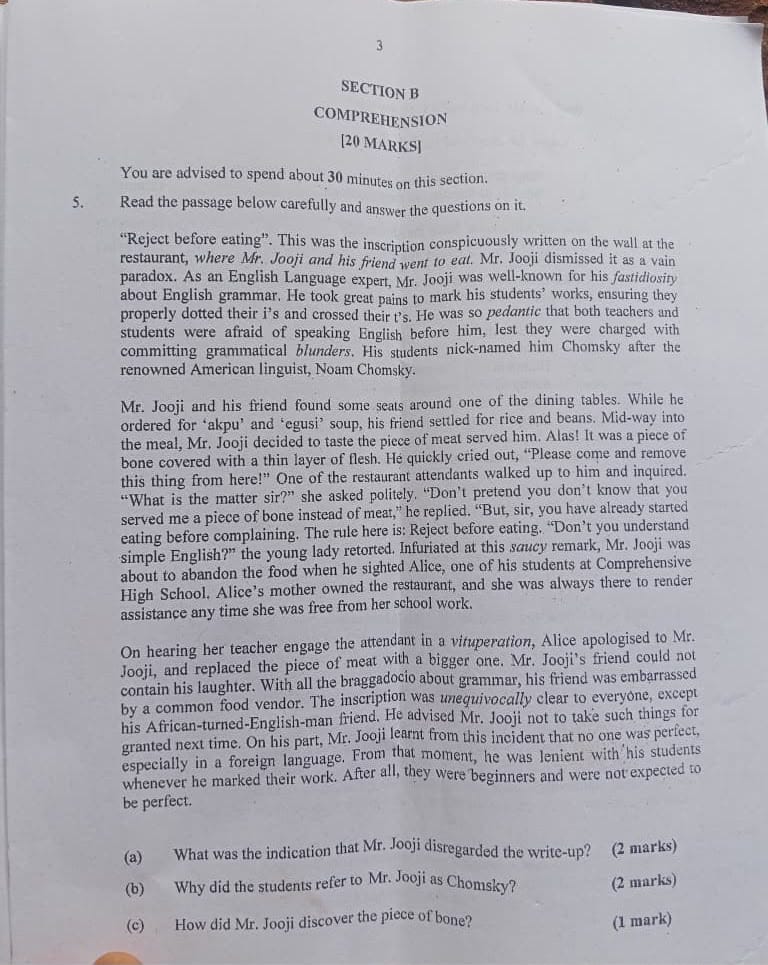
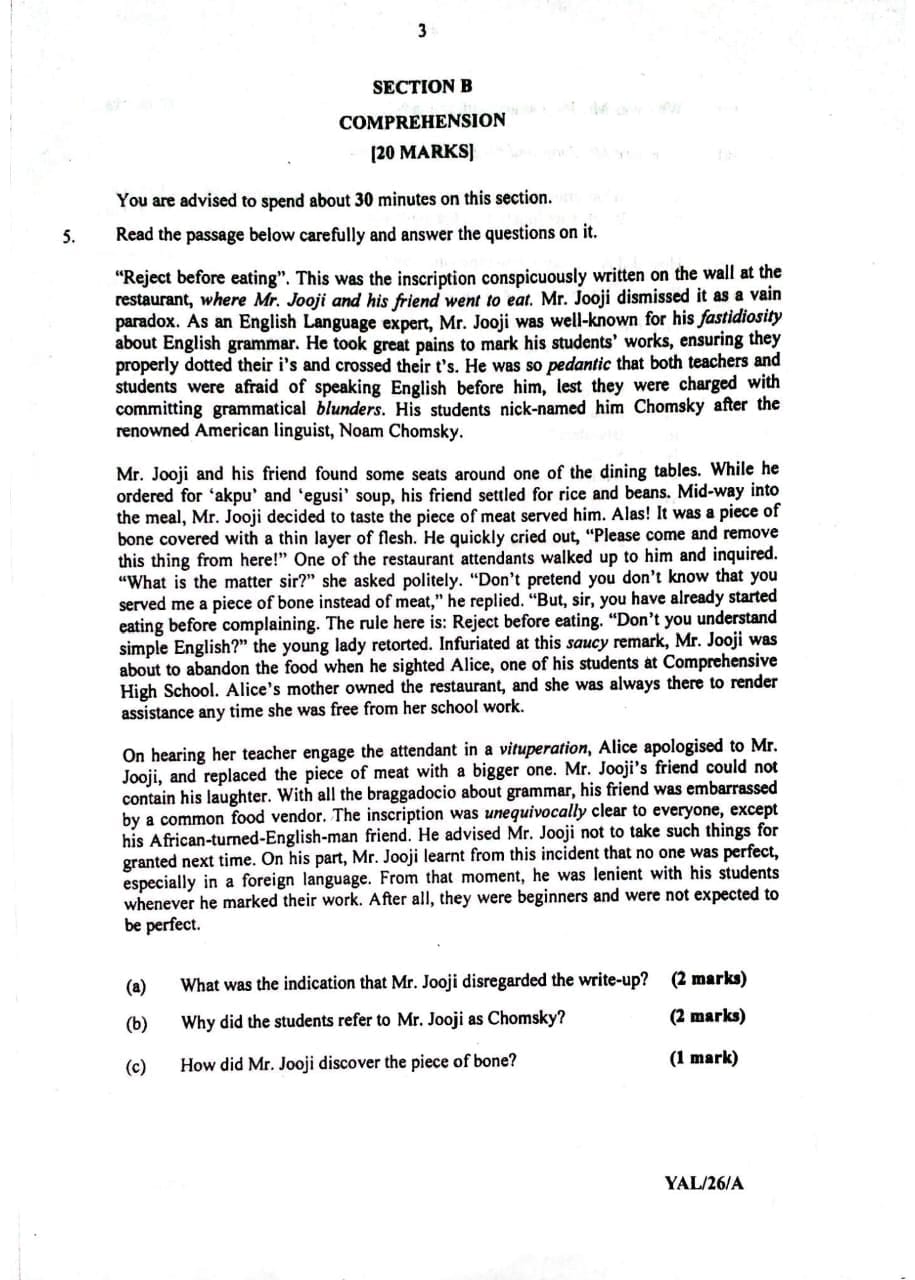
NECO GCE ENGLISH (COMPREHENSION)
(5a)
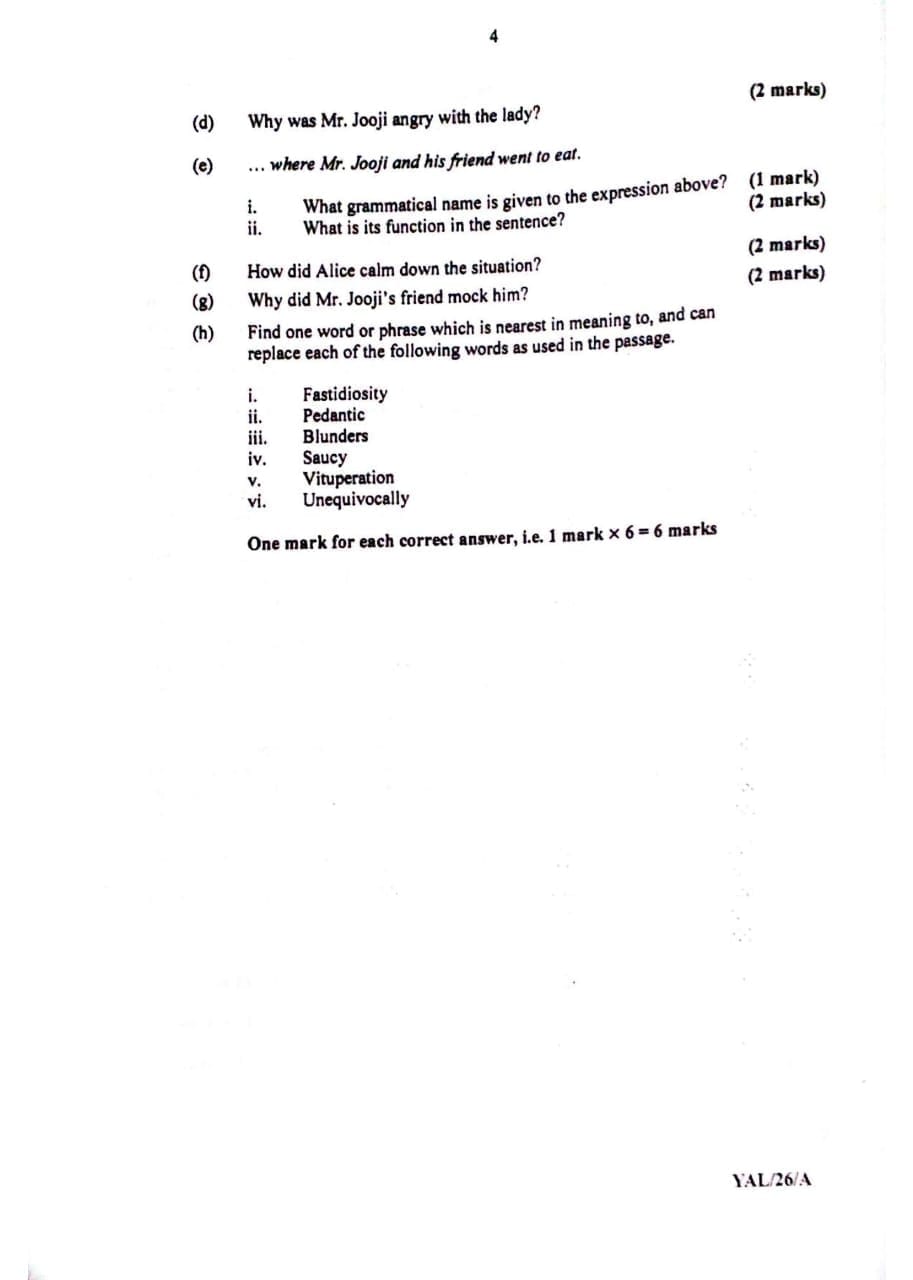
Mr. Jooji dismissed the inscription “Reject before eating” as a vain paradox.
(5b)
He was referred as Chomsky because he was an English language expert who was strict with pedantic about English grammar.
(5c)
Mid-day into the meal, he decided to taste the piece of meat served to him.
(5d)
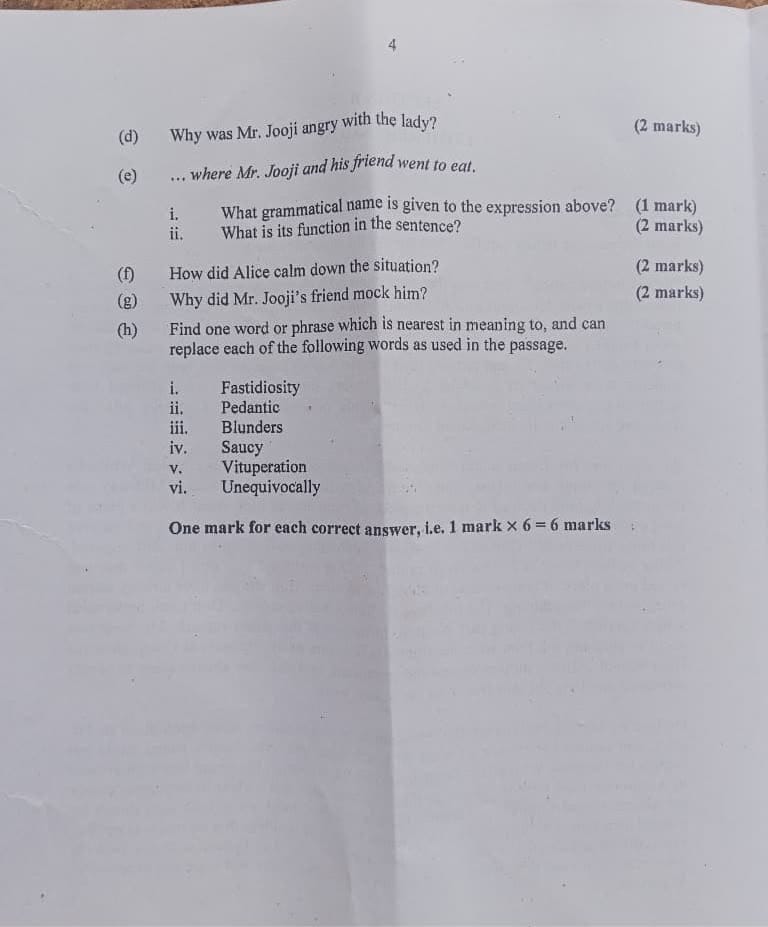
The lady was rude and saucy to him.
(5e)
(i) Adjectival clause
(ii) It qualifies the noun “restaurant”
(5f)
Alice apologised to Mr. Jooji and replaced the piece of meat with a bigger one.
(5g)
His friend mocked him because with all his brag about grammar, Mr. Jooji could not understand the simple inscription “Reject before eating”
(5h)
(PICK ANY ONE IN EACH)
(i) Fastidiousity – meticulousness, precision, scrupulousness
(ii) pedantic – dogmatic, fussy
(iii) blunders – mistakes, errors
(iv) saucy – rude, insolent, impudent
(v) vituperation – vilification, denunciation,
(vi) Unequivocally – Categorically, Certainly, clearly
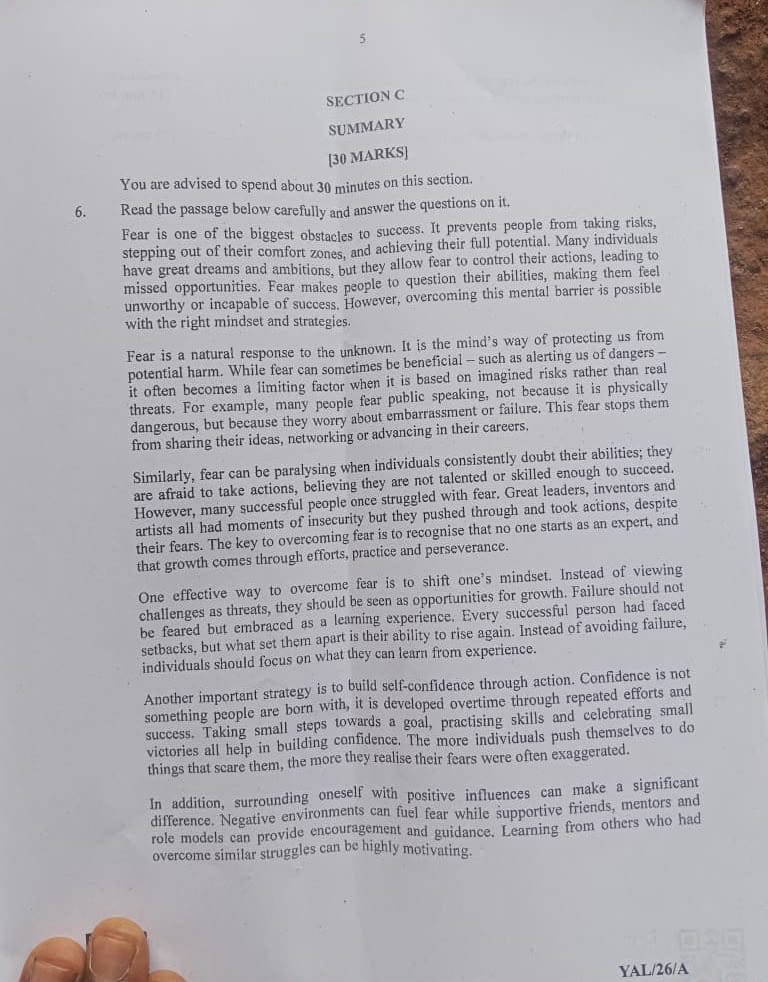
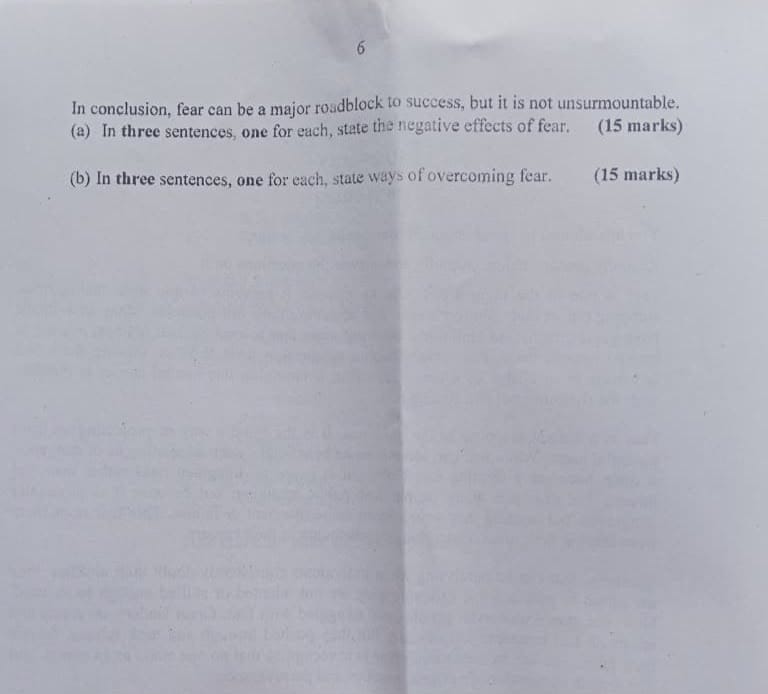
NECO GCE ENGLISH SUMMARY
(VERSION I)
(6a))
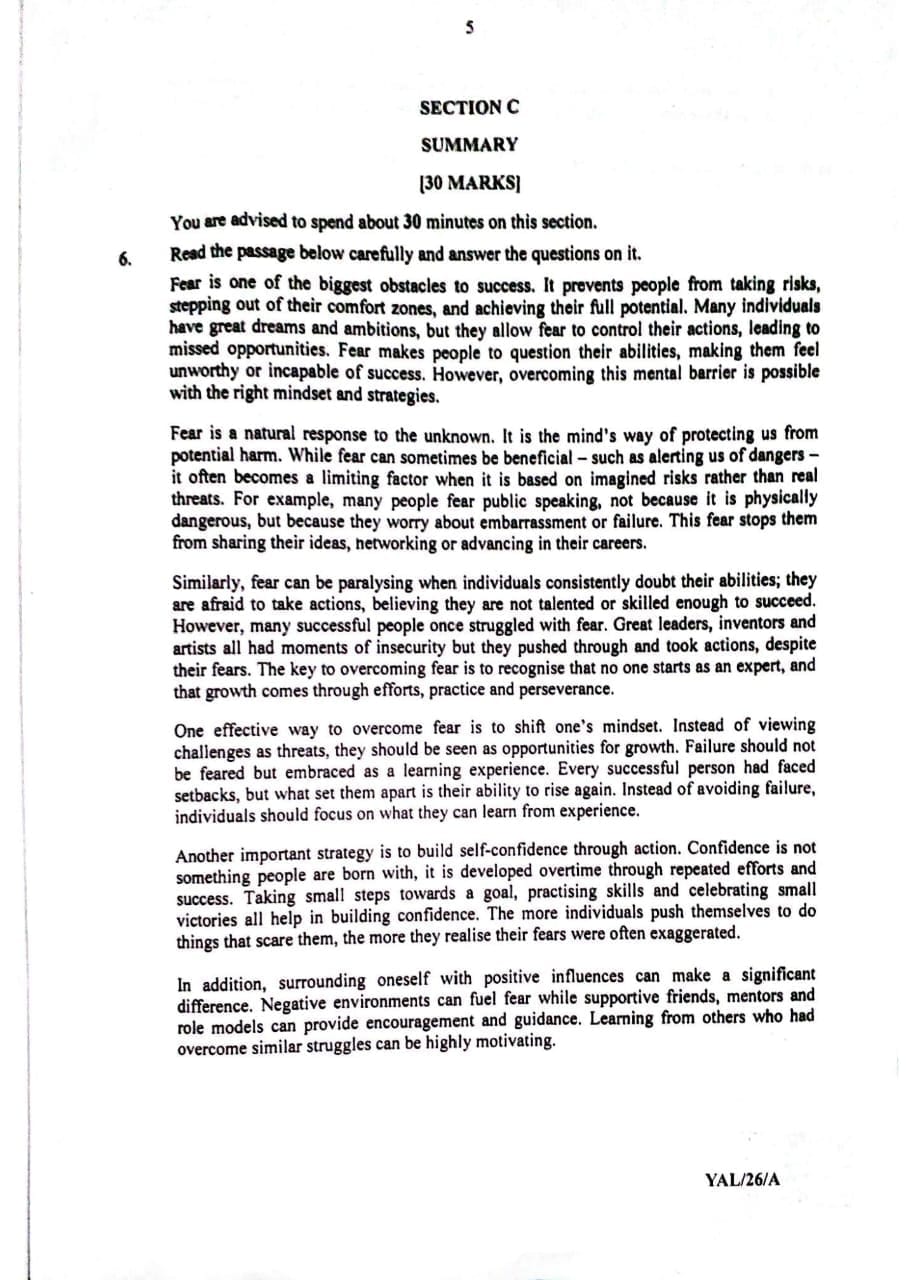
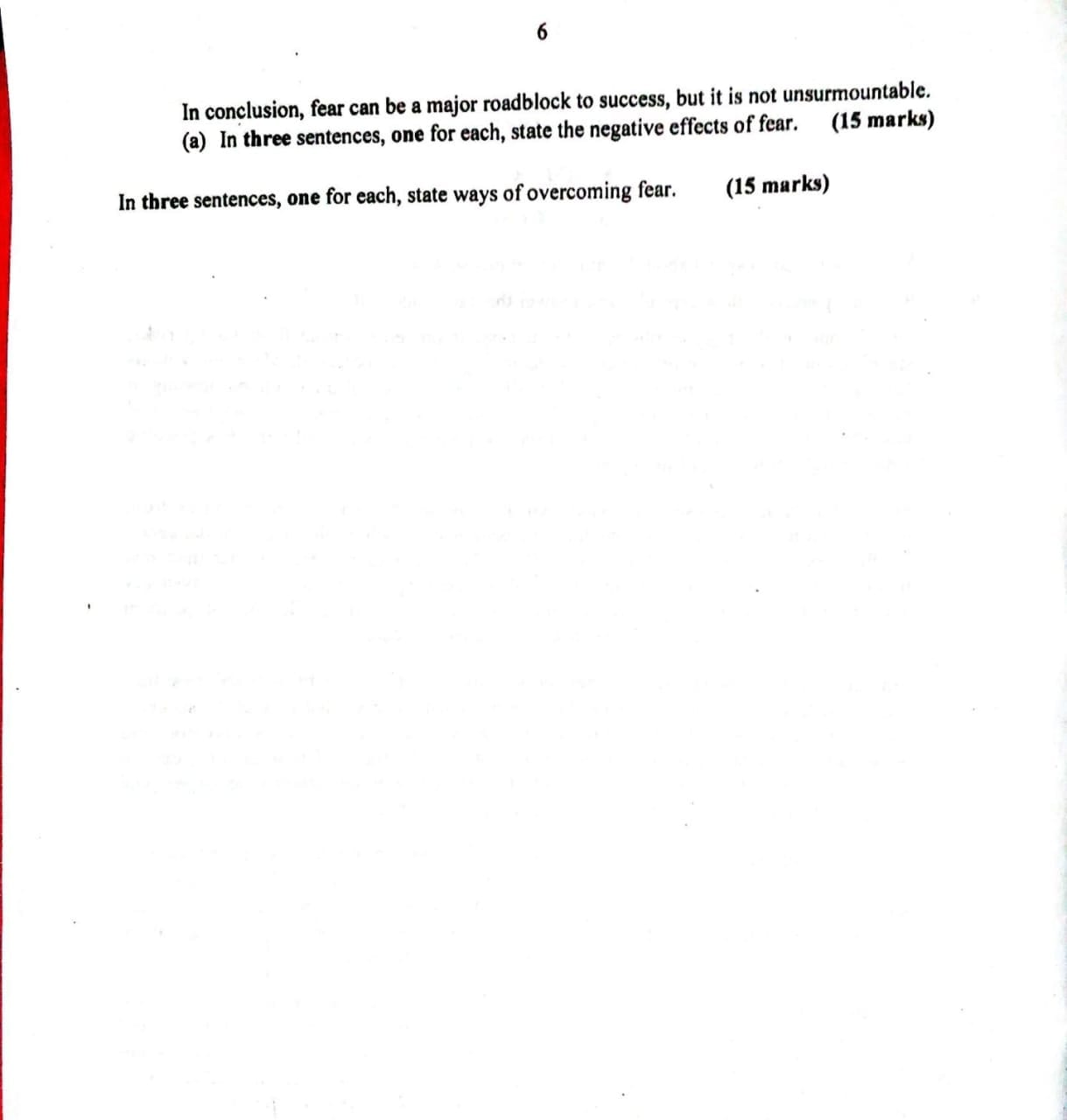
Fear serves as barrier to success.
Fear prevents people from achieving their potentials.
Fear has made a lot of people to miss great opportunities.
(6b)
Changing one’s mindset from negative to positive can make one overcome fear.
Building self confidence can make one overcome fear.
Moving with positive minded people can make one overcome fear.
NECO GCE SUMMARY
VERSION III)
(6a)
Fear limits success.
Fear cages people’s abilities.
Fear cost many people chances.
(6b)
A positive mind conquers fear.
Being self confidence destroys fear.
Moving with positive friends defeats fear.
=================================================
NECO GCE 2026 English Language Questions and Answers – Objective & Essay & Test Of Oral
NECO GCE 2026 English Language Questions and Answers – Objective & Essay & Test Of Oral
NECO GCE 2026 English Language Questions and Answers – Objective & Essay & Test Of Oral
NECO GCE 2026 English Language Questions and Answers – Objective & Essay & Test Of Oral
NECO GCE 2026 English Language Questions and Answers – Objective & Essay & Test Of Oral
NECO GCE 2026 English Language Questions and Answers – Objective & Essay & Test Of Oral
NECO GCE 2026 English Language Questions and Answers – Objective & Essay & Test Of Oral
NECO GCE 2026 English Language Questions and Answers – Objective & Essay & Test Of Oral
NECO GCE 2026 English Language Questions and Answers – Objective & Essay & Test Of Oral
NECO GCE 2026 English Language Questions and Answers – Objective & Essay & Test Of Oral
NECO GCE 2026 English Language Questions and Answers – Objective & Essay & Test Of Oral
NECO GCE 2026 English Language Questions and Answers – Objective & Essay & Test Of Oral
NECO GCE 2026 English Language Questions and Answers – Objective & Essay & Test Of Oral
NECO GCE 2026 English Language Questions and Answers – Objective & Essay & Test Of Oral
NECO GCE 2026 English Language Questions and Answers – Objective & Essay & Test Of Oral
NECO GCE 2026 English Language Questions and Answers – Objective & Essay & Test Of Oral
NECO GCE 2026 English Language Questions and Answers – Objective & Essay & Test Of Oral
NECO GCE 2026 English Language Questions and Answers – Objective & Essay & Test Of Oral
NECO GCE 2026 English Language Questions and Answers – Objective & Essay & Test Of Oral
NECO GCE 2026 English Language Questions and Answers – Objective & Essay & Test Of Oral
NECO GCE 2026 English Language Questions and Answers – Objective & Essay & Test Of Oral
NECO GCE 2026 English Language Questions and Answers – Objective & Essay & Test Of Oral
NECO GCE 2026 English Language Questions and Answers – Objective & Essay & Test Of Oral
NECO GCE 2026 English Language Questions and Answers – Objective & Essay & Test Of Oral
NECO GCE 2026 English Language Questions and Answers – Objective & Essay & Test Of Oral
NECO GCE 2026 English Language Questions and Answers – Objective & Essay & Test Of Oral
NECO GCE 2026 English Language Questions and Answers – Objective & Essay & Test Of Oral
NECO GCE 2026 English Language Questions and Answers – Objective & Essay & Test Of Oral
NECO GCE 2026 English Language Questions and Answers – Objective & Essay & Test Of Oral
NECO GCE 2026 English Language Questions and Answers – Objective & Essay & Test Of Oral
NECO GCE 2026 English Language Questions and Answers – Objective & Essay & Test Of Oral
NECO GCE 2026 English Language Questions and Answers – Objective & Essay & Test Of Oral
NECO GCE 2026 English Language Questions and Answers – Objective & Essay & Test Of Oral
NECO GCE 2026 English Language Questions and Answers – Objective & Essay & Test Of Oral
NECO GCE 2026 English Language Questions and Answers – Objective & Essay & Test Of Oral
NECO GCE 2026 English Language Questions and Answers – Objective & Essay & Test Of Oral
NECO GCE 2026 English Language Questions and Answers – Objective & Essay & Test Of Oral
NECO GCE 2026 English Language Questions and Answers – Objective & Essay & Test Of Oral
NECO GCE 2026 English Language Questions and Answers – Objective & Essay & Test Of Oral
NECO GCE 2026 English Language Questions and Answers – Objective & Essay & Test Of Oral
NECO GCE 2026 English Language Questions and Answers – Objective & Essay & Test Of Oral
NECO GCE 2026 English Language Questions and Answers – Objective & Essay & Test Of Oral
NECO GCE 2026 English Language Questions and Answers – Objective & Essay & Test Of Oral
NECO GCE 2026 English Language Questions and Answers – Objective & Essay & Test Of Oral
NECO GCE 2026 English Language Questions and Answers – Objective & Essay & Test Of Oral
NECO GCE 2026 English Language Questions and Answers – Objective & Essay & Test Of Oral
NECO GCE 2026 English Language Questions and Answers – Objective & Essay & Test Of Oral
NECO GCE 2026 English Language Questions and Answers – Objective & Essay & Test Of Oral
NECO GCE 2026 English Language Questions and Answers – Objective & Essay & Test Of Oral
NECO GCE 2026 English Language Questions and Answers – Objective & Essay & Test Of Oral
NECO GCE 2026 English Language Questions and Answers – Objective & Essay & Test Of Oral
NECO GCE 2026 English Language Questions and Answers – Objective & Essay & Test Of Oral
NECO GCE 2026 English Language Questions and Answers – Objective & Essay & Test Of Oral
NECO GCE 2026 English Language Questions and Answers – Objective & Essay & Test Of Oral
NECO GCE 2026 English Language Questions and Answers – Objective & Essay & Test Of Oral
NECO GCE 2026 English Language Questions and Answers – Objective & Essay & Test Of Oral
NECO GCE 2026 English Language Questions and Answers – Objective & Essay & Test Of Oral
NECO GCE 2026 English Language Questions and Answers – Objective & Essay & Test Of Oral
NECO GCE 2026 English Language Questions and Answers – Objective & Essay & Test Of Oral
NECO GCE 2026 English Language Questions and Answers – Objective & Essay & Test Of Oral
NECO GCE 2026 English Language Questions and Answers – Objective & Essay & Test Of Oral
NECO GCE 2026 English Language Questions and Answers – Objective & Essay & Test Of Oral
NECO GCE 2026 English Language Questions and Answers – Objective & Essay & Test Of Oral
NECO GCE 2026 English Language Questions and Answers – Objective & Essay & Test Of Oral
NECO GCE 2026 English Language Questions and Answers – Objective & Essay & Test Of Oral
NECO GCE 2026 English Language Questions and Answers – Objective & Essay & Test Of Oral
NECO GCE 2026 English Language Questions and Answers – Objective & Essay & Test Of Oral
NECO GCE 2026 English Language Questions and Answers – Objective & Essay & Test Of Oral
NECO GCE 2026 English Language Questions and Answers – Objective & Essay & Test Of Oral
NECO GCE 2026 English Language Questions and Answers – Objective & Essay & Test Of Oral
NECO GCE 2026 English Language Questions and Answers – Objective & Essay & Test Of Oral
NECO GCE 2026 English Language Questions and Answers – Objective & Essay & Test Of Oral
NECO GCE 2026 English Language Questions and Answers – Objective & Essay & Test Of Oral
NECO GCE 2026 English Language Questions and Answers – Objective & Essay & Test Of Oral
NECO GCE 2026 English Language Questions and Answers – Objective & Essay & Test Of Oral
NECO GCE 2026 English Language Questions and Answers – Objective & Essay & Test Of Oral
NECO GCE 2026 English Language Questions and Answers – Objective & Essay & Test Of Oral
NECO GCE 2026 English Language Questions and Answers – Objective & Essay & Test Of Oral
NECO GCE 2026 English Language Questions and Answers – Objective & Essay & Test Of Oral
NECO GCE 2026 English Language Questions and Answers – Objective & Essay & Test Of Oral
NECO GCE 2026 English Language Questions and Answers – Objective & Essay & Test Of Oral
NECO GCE 2026 English Language Questions and Answers – Objective & Essay & Test Of Oral
NECO GCE 2026 English Language Questions and Answers – Objective & Essay & Test Of Oral
NECO GCE 2026 English Language Questions and Answers – Objective & Essay & Test Of Oral
NECO GCE 2026 English Language Questions and Answers – Objective & Essay & Test Of Oral
NECO GCE 2026 English Language Questions and Answers – Objective & Essay & Test Of Oral
NECO GCE 2026 English Language Questions and Answers – Objective & Essay & Test Of Oral
NECO GCE 2026 English Language Questions and Answers – Objective & Essay & Test Of Oral
NECO GCE 2026 English Language Questions and Answers – Objective & Essay & Test Of Oral
NECO GCE 2026 English Language Questions and Answers – Objective & Essay & Test Of Oral
NECO GCE 2026 English Language Questions and Answers – Objective & Essay & Test Of Oral
NECO GCE 2026 English Language Questions and Answers – Objective & Essay & Test Of Oral
NECO GCE 2026 English Language Questions and Answers – Objective & Essay & Test Of Oral
NECO GCE 2026 English Language Questions and Answers – Objective & Essay & Test Of Oral
NECO GCE 2026 English Language Questions and Answers – Objective & Essay & Test Of Oral
NECO GCE 2026 English Language Questions and Answers – Objective & Essay & Test Of Oral
NECO GCE 2026 English Language Questions and Answers – Objective & Essay & Test Of Oral
NECO GCE 2026 English Language Questions and Answers – Objective & Essay & Test Of Oral
NECO GCE 2026 English Language Questions and Answers – Objective & Essay & Test Of Oral
NECO GCE 2026 English Language Questions and Answers – Objective & Essay & Test Of Oral
NECO GCE 2026 English Language Questions and Answers – Objective & Essay & Test Of Oral
NECO GCE 2026 English Language Questions and Answers – Objective & Essay & Test Of Oral
NECO GCE 2026 English Language Questions and Answers – Objective & Essay & Test Of Oral
NECO GCE 2026 English Language Questions and Answers – Objective & Essay & Test Of Oral
NECO GCE 2026 English Language Questions and Answers – Objective & Essay & Test Of Oral
NECO GCE 2026 English Language Questions and Answers – Objective & Essay & Test Of Oral
NECO GCE 2026 English Language Questions and Answers – Objective & Essay & Test Of Oral
NECO GCE 2026 English Language Questions and Answers – Objective & Essay & Test Of Oral
NECO GCE 2026 English Language Questions and Answers – Objective & Essay & Test Of Oral
NECO GCE 2026 English Language Questions and Answers – Objective & Essay & Test Of Oral
NECO GCE 2026 English Language Questions and Answers – Objective & Essay & Test Of Oral
NECO GCE 2026 English Language Questions and Answers – Objective & Essay & Test Of Oral
If you found this post helpful or have any questions, please leave a comment below.