
If you are looking for Neco Geography (Essay Human and Regional) 2026 Answers Mid- Nite questions and Answers, ? Examrunz.com, is your Legit Educational Website for accurate Exam solutions We deliver both Geography Questions and solved solutions To Teachers / Studlents before exam time
Neco Geography (Essay Human and Regional) 2026 Answers

Here we provide timely updates, study assistance, exam questions, and answers for students writing the NECO Geography Examination which holds on
Friday, 17th July 2026
Geography 2 (Essay – Human and Regional)
10:00am – 12:00noon
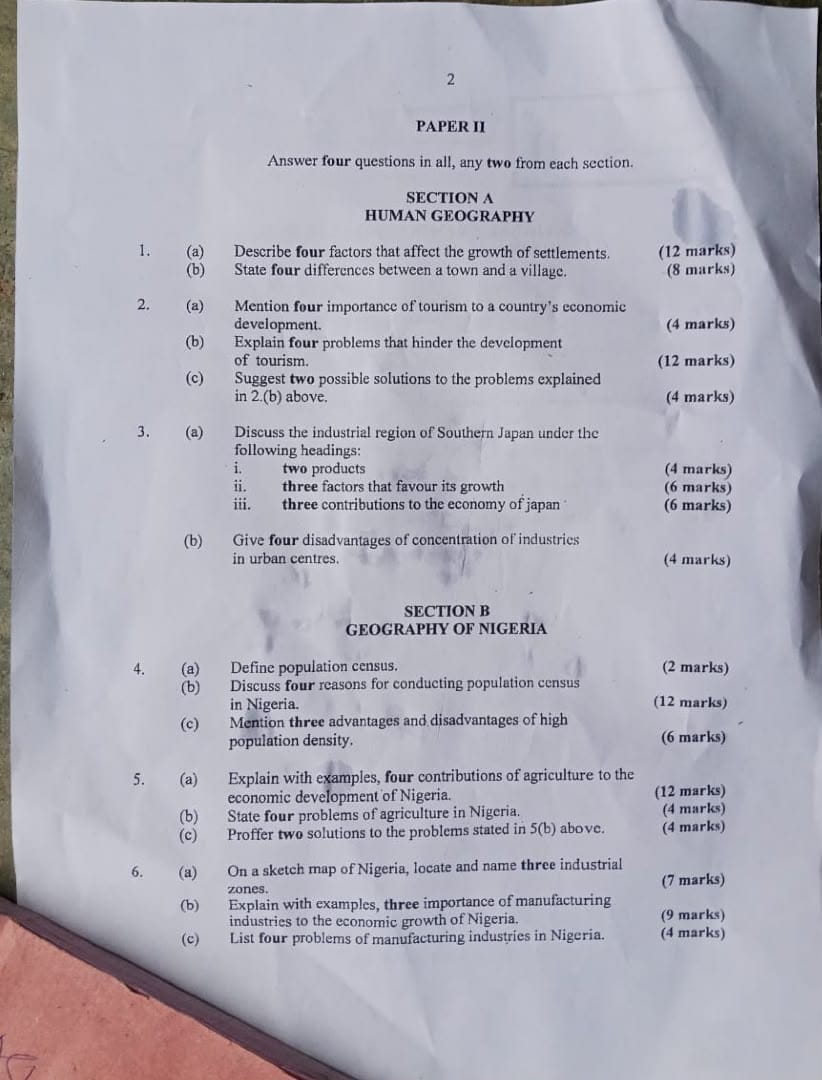
Neco Geography (Essay Human and Regional) 2026
(1a)
(PICK ANY FOUR)
(i) Availability of water supply: The availability of a reliable water supply greatly influences the growth of settlements. People need water for drinking, cooking, washing, farming, fishing and industrial activities. Rivers, lakes, streams and boreholes encourage people to settle permanently in an area. As the population increases, more houses, markets, schools and other facilities are built, leading to the expansion of the settlement.
(ii) Topography: The nature of the land affects the growth of settlements. Flat or gently sloping land is easier and cheaper to build on than steep or mountainous areas. It also makes farming, road construction and transportation easier. As a result, more people are attracted to such places, causing the settlement to expand steadily over time.
(iii) Fertile soil: Areas with fertile soil usually attract many settlers because they support profitable agriculture. Farmers can produce enough food and cash crops, which improves their standard of living. The availability of agricultural products also encourages trade, agro-based industries and employment opportunities, leading to an increase in population and the continuous growth of the settlement.
(iv) Transportation and accessibility: Good transport facilities encourage the growth of settlements by making movement of people and goods easier. Areas linked by roads, railways, airports or waterways attract traders, industries and investors. Easy accessibility promotes commercial activities and creates employment opportunities. As economic activities increase, more people move into the area, resulting in rapid settlement growth.
(v) Availability of minerals: The presence of valuable mineral resources such as coal, tin, limestone or crude oil attracts mining activities and industries. These industries create employment opportunities and increase commercial activities. Workers and their families settle near the mining centres, leading to the establishment of houses, schools, hospitals and markets, thereby promoting rapid settlement growth.
(vi) Government policies: Government decisions can encourage the growth of settlements by establishing state capitals, local government headquarters, universities, military barracks or industrial estates. Such developments attract civil servants, traders and businesses. Government also provides roads, electricity, hospitals and schools, which improve living conditions and encourage more people to settle in the area.
(vii) Security: People prefer to settle in peaceful and secure environments where lives and property are protected. Areas free from wars, crime, communal clashes and natural disasters attract more residents and investors. Security encourages business activities, farming and industrial development, leading to increased population and steady expansion of the settlement.
(viii) Climate: Favourable climatic conditions encourage settlement growth because they support farming, livestock rearing and comfortable living. Areas with moderate rainfall and suitable temperatures attract more people than regions experiencing excessive heat, drought or flooding. A good climate also encourages economic activities, resulting in population increase and the gradual expansion of settlements.
(1b)
(PICK ANY FOUR)
(i) A town is more densely populated, whereas a village has a smaller population.
(ii) A town has many modern social amenities, while a village has fewer social amenities.
(iii) People in a town mainly engage in commerce, industry and services, whereas people in a village mainly engage in farming, fishing and other primary occupations.
(iv) A town has well-developed roads and transport facilities, while a village has poorly developed transport facilities.
(v) Buildings in a town are closely packed together, whereas buildings in a village are widely spaced.
(vi) A town has more employment opportunities, while a village has fewer employment opportunities.
(vii) A town performs major administrative and commercial functions, whereas a village mainly performs agricultural functions.
(viii) A town has better infrastructure such as electricity, pipe-borne water and hospitals, while a village has less developed infrastructure.
Neco Geography (Essay Human and Regional) 2026
(2a)
(PICK ANY FOUR)
(i) Tourism creates employment opportunities for the people.
(ii) Tourism earns foreign exchange for the country.
(iii) Tourism increases government revenue through taxes and fees.
(iv) Tourism promotes the development of transport and other infrastructure.
(v) Tourism encourages the growth of hotels, restaurants and other businesses.
(vi) Tourism attracts local and foreign investments into the economy.
(vii) Tourism promotes cultural exchange and improves the country’s international image.
(2b)
(PICK ANY FOUR)
(i) Poor transportation network: Poor roads, inadequate railways and limited air transport make many tourist centres difficult to access. Tourists often experience delays, discomfort and high travelling costs when visiting such places. This discourages both local and international visitors, reduces tourist arrivals and slows the growth and development of the tourism industry.
(ii) Inadequate funding: Tourism development requires large financial investments for infrastructure, maintenance and promotion. When government and private investors provide insufficient funds, tourist sites become poorly maintained and unattractive. Lack of investment also limits the provision of modern facilities, reducing the ability of the country to attract more tourists.
(iii) Insecurity: Problems such as terrorism, kidnapping, armed robbery and communal conflicts discourage tourists from visiting a country. Visitors prefer destinations where their lives and property are safe. Continuous insecurity damages the country’s reputation, reduces tourist confidence and leads to a decline in tourism activities and revenue.
(iv) Poor accommodation and facilities: Many tourist destinations lack quality hotels, restaurants, healthcare services and recreational facilities. Visitors may experience discomfort due to poor services and inadequate conveniences. This creates a negative impression, discourages repeat visits and makes the country less competitive compared to other tourist destinations.
(v) Poor publicity: Many tourist attractions remain unknown because they are not properly advertised. Inadequate promotion through the media, travel agencies and international exhibitions limits awareness among potential visitors. As a result, fewer tourists visit the attractions, reducing revenue and slowing the development of the tourism sector.
(vi) Environmental pollution: Pollution of beaches, rivers, forests and tourist sites reduces their beauty and attractiveness. Poor waste disposal, oil spills and environmental degradation make many destinations less appealing to visitors. This discourages tourism activities, reduces tourist satisfaction and negatively affects the growth of the tourism industry.
(vii) Unfavourable government policies: Excessive taxes, complicated visa procedures and poor implementation of tourism policies discourage investors and tourists. Bureaucratic delays make travelling and investing difficult. Such policies reduce private sector participation, limit tourism development and decrease the country’s ability to compete with other tourist destinations.
(2c)
(PICK ANY TWO)
(i) Government should improve roads, airports and other transport facilities to tourist centres.
(ii) Adequate funds should be provided for the development and maintenance of tourist attractions.
(iii) Government should strengthen security to protect tourists and tourist centres.
(iv) More hotels and modern recreational facilities should be provided at tourist destinations.
(v) Tourist attractions should be widely advertised through the media and international tourism campaigns.
(vi) Government should implement favourable tourism policies and simplify visa procedures.
(vii) Environmental pollution should be controlled through proper sanitation and conservation programmes.
Neco Geography (Essay Human and Regional) 2026
(3ai)
(PICK ANY TWO)
(i) Iron and steel.
(ii) Ships.
(iii) Motor vehicles.
(iv) Electronic equipment.
(v) Chemicals and petrochemicals.
(3aii)
(PICK ANY THREE)
(i) Good transport facilities: Southern Japan has well-developed seaports, railways, roads and airports. These transport facilities make it easy to import raw materials, distribute manufactured goods and promote both local and international trade.
(ii) Large market: The region has many cities with a large population and high purchasing power. This provides a ready market for manufactured goods, encouraging industries to expand production and increase profits.
(iii) Availability of skilled labour: The presence of universities and technical institutions provides skilled workers, engineers and technicians. This improves production efficiency, promotes innovation and helps industries maintain high standards of manufacturing.
(iv) Government support: The Japanese government encourages industrial growth through favourable policies, tax incentives, financial assistance and investment in infrastructure. These measures help industries expand and remain competitive in global markets.
(v) Availability of capital: Industries have access to adequate capital from banks, investors and financial institutions. This enables factories to purchase modern machinery, expand production and adopt improved manufacturing technologies.
(vi) Reliable power supply: Stable electricity from hydroelectric and thermal power stations supports uninterrupted industrial activities. Continuous power supply reduces production costs, increases efficiency and encourages industrial development.
(3aiii)
(PICK ANY THREE)
(i) Employment generation: Industries provide jobs for millions of people, including factory workers, engineers and technicians. This reduces unemployment, improves living standards and increases the income of individuals and families.
(ii) Foreign exchange earnings: Manufactured products such as vehicles, ships and electronics are exported to many countries. These exports earn foreign exchange, strengthen the economy and improve Japan’s international trade position.
(iii) Government revenue: Industries pay company taxes, export duties and other levies to the government. These revenues are used to finance infrastructure, education, healthcare and other national development programmes.
(iv) Technological development: Industrial activities encourage research, innovation and technological advancement. This improves production methods, increases efficiency and enables Japan to remain one of the world’s leading industrial nations.
(v) Infrastructure development: Industrial growth encourages the construction of roads, railways, ports, airports and power stations. These facilities improve transportation, communication and economic activities throughout the country.
(vi) Growth of related industries: Manufacturing industries promote the development of transport, banking, insurance, commerce and engineering services. This creates more business opportunities and contributes to overall economic growth.
(3b)
(PICK ANY FOUR)
(i) It causes overcrowding in towns and cities.
(ii) It leads to heavy traffic congestion.
(iii) It increases air, water and noise pollution.
(iv) It puts pressure on housing and social amenities.
(v) It creates high competition for jobs.
(vi) It increases the cost of land and buildings.
(vii) It leads to improper waste disposal and environmental degradation.
(viii) It causes frequent road accidents due to heavy movement.
Neco Geography (Essay Human and Regional) 2026
(4a)
(PICK ANY ONE)
Population census is the official process of counting all the people living in a country or a particular area at a specific time. It also involves collecting important information about their age, sex, occupation, education, religion and other social and economic characteristics for planning and development.
OR
Population census is the systematic and official enumeration of the entire population of a country at a given time. It involves gathering detailed information about the number, distribution and characteristics of the people to assist the government in planning, policy formulation and effective allocation of resources.
(4b)
(PICK ANY FOUR)
(i) National planning: Population census provides reliable information on the size, distribution and characteristics of the population. Government uses these data to prepare development plans, establish schools, hospitals and other public facilities. Accurate census figures help ensure that resources are distributed fairly according to the needs of different communities.
(ii) Allocation of resources: Census data help the government distribute financial resources and social amenities among states and local government areas. Areas with larger populations may require more schools, hospitals, roads and water supply. This ensures that public resources are allocated according to population needs and promotes balanced national development.
(iii) Electoral representation: Population census helps determine the number of electoral constituencies and legislative seats allocated to different areas. This ensures fair political representation based on population size. Accurate census figures also assist electoral bodies in planning elections and maintaining equity in democratic governance throughout the country.
(iv) Economic planning: Census information enables the government to estimate labour supply, employment needs and future demand for goods and services. Investors also use census data to identify suitable locations for industries and businesses. This promotes economic growth, increases employment opportunities and supports sustainable national development.
(v) Provision of social amenities: Census data help the government determine where to build schools, hospitals, markets, roads and water supply facilities. Areas with growing populations receive additional services to meet increasing demands. This improves the standard of living and ensures that development projects are properly distributed across the country.
(vi) Security and administration: Population census provides useful information for maintaining law and order and improving public administration. Government agencies use census figures to deploy security personnel, establish police stations and plan emergency services. This contributes to effective governance and better protection of lives and property.
(vii) Population projection: Census data serve as the basis for estimating future population growth and demographic changes. Government and private organisations use these projections to plan future housing, healthcare, education, employment and food production. This helps prevent shortages and supports long-term national development.
(4c)
▪️ADVANTAGES OF HIGH POPULATION DENSITY:
(PICK ANY THREE)
(i) High population density provides a large labour force for economic activities.
(ii) High population density creates a large market for goods and services.
(iii) High population density encourages the development of industries and businesses.
(iv) High population density promotes efficient use of available infrastructure.
(v) High population density increases government revenue through taxes.
(vi) High population density encourages rapid urban and commercial development.
▪️DISADVANTAGES OF HIGH POPULATION DENSITY:
(PICK ANY THREE)
(i) High population density leads to overcrowding.
(ii) High population density increases unemployment.
(iii) High population density puts pressure on social amenities.
(iv) High population density causes traffic congestion.
(v) High population density increases environmental pollution.
(vi) High population density may lead to the spread of diseases.
Neco Geography (Essay Human and Regional) 2026
(5a)
(PICK ANY FOUR)
(i) Provision of food: Agriculture provides food crops and livestock products that feed Nigeria’s growing population. Crops such as yam, cassava, rice, maize and vegetables, as well as meat, fish, eggs and milk, supply essential nutrients. Adequate food production improves food security, reduces hunger and supports a healthy and productive population.
(ii) Supply of raw materials: Agriculture supplies raw materials needed by many industries in Nigeria. Cotton is used in textile industries, cocoa is processed into beverages, oil palm produces palm oil, while rubber is used for manufacturing tyres and other products. These raw materials promote industrial growth and increase national economic development.
(iii) Employment generation: Agriculture provides employment opportunities for millions of Nigerians through farming, livestock rearing, fishing, forestry and agro-processing. It also creates jobs in transportation, storage and marketing of agricultural products. This reduces unemployment, raises household incomes and improves the standard of living of many rural communities.
(iv) Source of foreign exchange: Nigeria earns foreign exchange through the export of agricultural products such as cocoa, sesame seeds, cashew nuts, rubber, ginger and palm produce. The income generated from these exports strengthens the country’s economy, improves the balance of payments and provides funds for national development projects.
(v) Source of government revenue: Agriculture contributes to government revenue through taxes, export duties, produce sales and licensing fees. The income generated enables the government to finance the provision of roads, schools, hospitals and other public services. This supports national development and improves the welfare of the citizens.
(vi) Development of rural areas: Agriculture promotes the development of rural communities by encouraging the construction of roads, electricity, irrigation facilities, markets and storage centres. These developments improve living conditions and attract other economic activities. As rural areas develop, migration to urban centres is reduced and balanced national development is achieved.
(vii) Market for industrial products: Agriculture creates a ready market for products manufactured by industries, including fertilizers, tractors, irrigation equipment, pesticides, improved seeds and farm tools. Farmers purchase these products to improve production. This increases industrial sales, encourages investment and strengthens the relationship between agriculture and manufacturing.
(5b)
(PICK ANY FOUR)
(i) Inadequate capital limits agricultural production.
(ii) Poor road networks make transportation of farm produce difficult.
(iii) Pests and diseases reduce crop and livestock production.
(iv) Lack of modern farm machinery lowers productivity.
(v) Inadequate storage facilities lead to post-harvest losses.
(vi) Poor access to credit discourages many farmers.
(vii) Unfavourable weather conditions affect agricultural output.
(5c)
(PICK ANY TWO)
(i) Government should provide farmers with affordable loans and credit facilities.
(ii) Modern farm machinery should be made available to farmers.
(iii) Good roads should be constructed to farming communities.
(iv) Farmers should be educated on modern farming methods through extension services.
(v) Government should provide improved seeds, fertilizers and other farm inputs.
(vi) Adequate storage and processing facilities should be provided.
(vii) Effective measures should be taken to control pests and diseases.
Neco Geography (Essay Human and Regional) 2026
(6a)
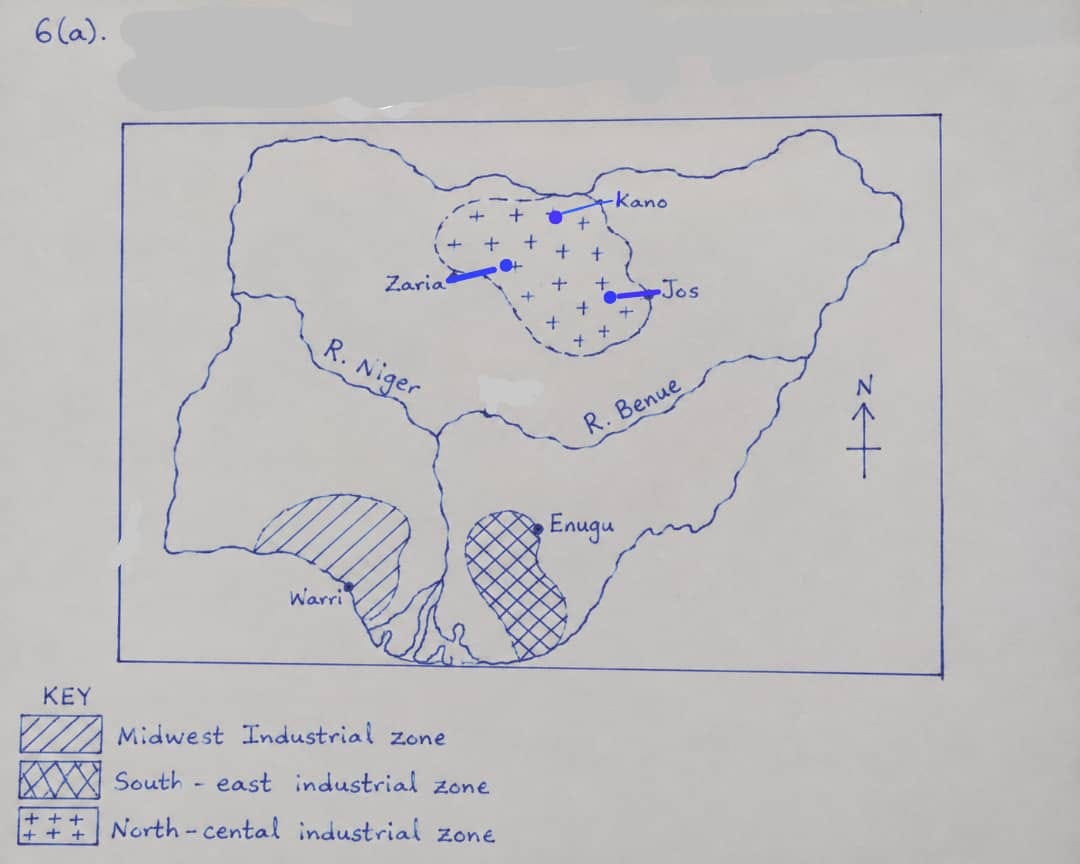
(6b)
(PICK ANY THREE)
(i) Employment generation: Manufacturing industries provide employment opportunities for both skilled and unskilled workers in production, administration, transportation and marketing. This reduces unemployment, increases household income and improves the standard of living of the people. For example, Dangote Cement, Nestlé Nigeria and Nigerian Breweries employ thousands of Nigerians across the country.
(ii) Provision of goods: Manufacturing industries produce essential goods needed by individuals and businesses, thereby reducing dependence on imported products. Goods such as cement, textiles, beverages, medicines and processed foods are manufactured locally to meet consumers’ needs. Examples include Dangote Cement, Flour Mills of Nigeria, Unilever Nigeria and Cadbury Nigeria, which supply products throughout the country.
(iii) Source of government revenue: Manufacturing industries contribute significantly to government revenue through company income taxes, import and export duties, value-added tax and licensing fees. The revenue generated is used to provide roads, schools, hospitals and electricity. Companies such as Dangote Group, BUA Group and Nigerian Breweries are major taxpayers in Nigeria.
(iv) Foreign exchange earnings: Manufacturing industries earn foreign exchange by exporting manufactured products to international markets. This increases Nigeria’s national income, improves the balance of payments and strengthens the value of the country’s economy. Examples include Dangote Cement exporting cement to African countries and Cadbury Nigeria exporting processed cocoa products to foreign markets.
(v) Promotion of industrial development: Manufacturing industries encourage the establishment of supporting industries that produce raw materials, packaging materials, machine parts and other industrial inputs. This promotes industrialization, attracts investors and increases production. For example, the activities of Nestlé Nigeria and Nigerian Breweries have encouraged the growth of packaging and logistics industries.
(vi) Development of infrastructure: Manufacturing industries encourage the construction of roads, electricity, water supply and communication facilities in industrial locations. These facilities also benefit nearby communities and attract additional investments. Examples include the development of infrastructure around the Ikeja Industrial Estate in Lagos, Agbara Industrial Estate and the Trans-Amadi Industrial Area in Port Harcourt.
(6c)
(PICK ANY FOUR)
(i) Inadequate power supply affects industrial production.
(ii) Poor transportation network increases production costs.
(iii) High cost of raw materials reduces industrial output.
(iv) Inadequate capital limits industrial expansion.
(v) Importation of cheap foreign goods discourages local industries.
(vi) Inconsistent government policies affect industrial growth.
(vii) Shortage of skilled manpower reduces industrial efficiency.
Neco Geography (Essay Human and Regional) 2026 Answers
Neco Geography (Essay Human and Regional) 2026 Answers
Neco Geography (Essay Human and Regional) 2026 Answers
Neco Geography (Essay Human and Regional) 2026 Answers
Neco Geography (Essay Human and Regional) 2026 Answers
Neco Geography (Essay Human and Regional) 2026 Answers
Neco Geography (Essay Human and Regional) 2026 Answers
Neco Geography (Essay Human and Regional) 2026 Answers
Neco Geography (Essay Human and Regional) 2026 Answers
Neco Geography (Essay Human and Regional) 2026 Answers
Neco Geography (Essay Human and Regional) 2026 Answers
Neco Geography (Essay Human and Regional) 2026 Answers
Neco Geography (Essay Human and Regional) 2026 Answers
Neco Geography (Essay Human and Regional) 2026 Answers
Neco Geography (Essay Human and Regional) 2026 Answers
Neco Geography (Essay Human and Regional) 2026 Answers
Neco Geography (Essay Human and Regional) 2026 Answers
Neco Geography (Essay Human and Regional) 2026 Answers
Neco Geography (Essay Human and Regional) 2026 Answers
Neco Geography (Essay Human and Regional) 2026 Answers
Neco Geography (Essay Human and Regional) 2026 Answers
Neco Geography (Essay Human and Regional) 2026 Answers
Neco Geography (Essay Human and Regional) 2026 Answers
Neco Geography (Essay Human and Regional) 2026 Answers
Neco Geography (Essay Human and Regional) 2026 Answers
Neco Geography (Essay Human and Regional) 2026 Answers
Neco Geography (Essay Human and Regional) 2026 Answers
Neco Geography (Essay Human and Regional) 2026 Answers
Neco Geography (Essay Human and Regional) 2026 Answers
Neco Geography (Essay Human and Regional) 2026 Answers
Neco Geography (Essay Human and Regional) 2026 Answers
Neco Geography (Essay Human and Regional) 2026 Answers
Neco Geography (Essay Human and Regional) 2026 Answers
Neco Geography (Essay Human and Regional) 2026 Answers
Neco Geography (Essay Human and Regional) 2026 Answers
Neco Geography (Essay Human and Regional) 2026 Answers
If you found this post helpful or have any questions, please leave a comment below.