
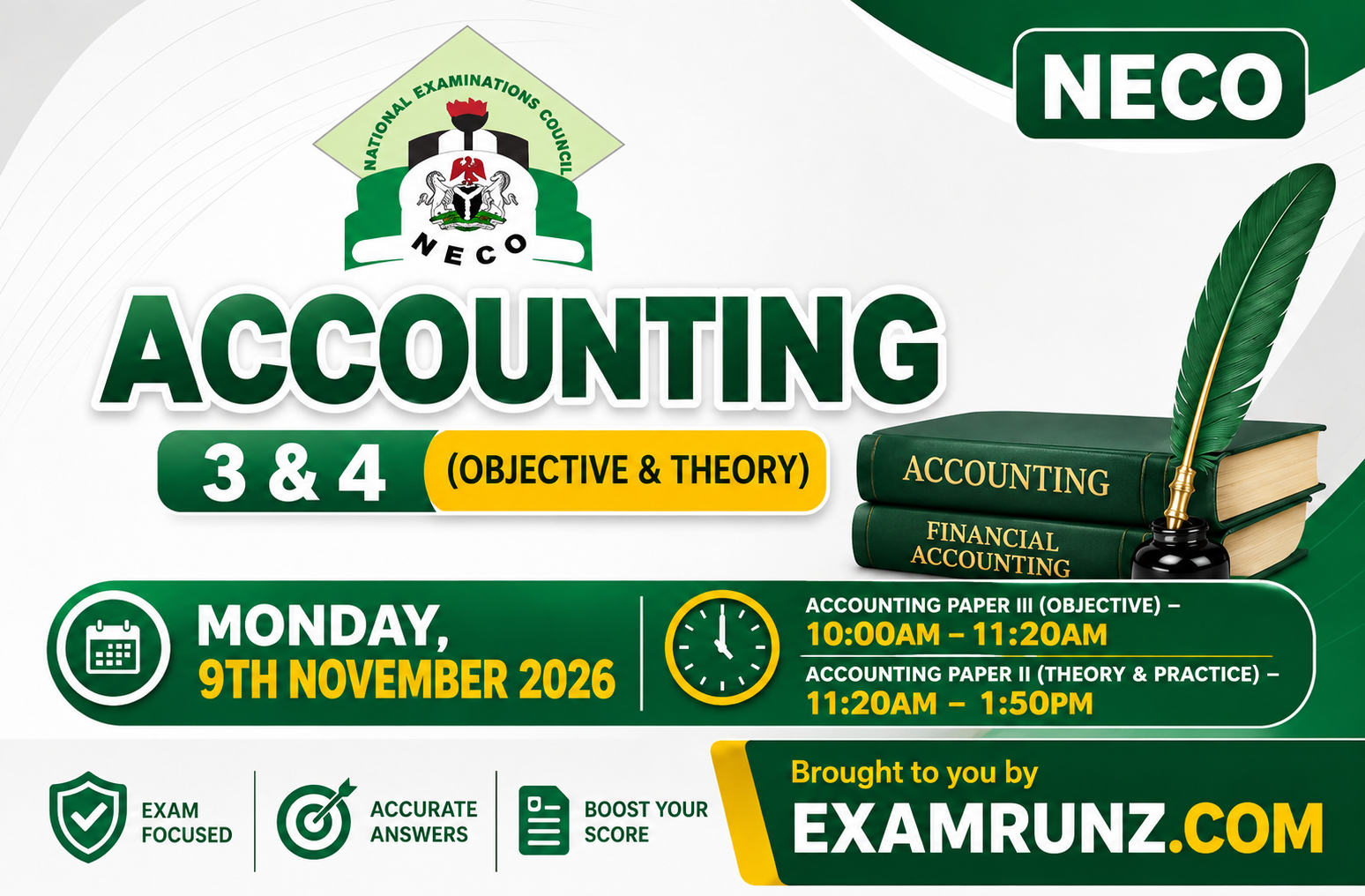
NECO GCE 2026 Accounting Questions and Answers (Objectives and Essay)
The NECO GCE 2026 Accounting exam will take place on Monday, 9th November, 2026 Accounting Paper III (Objective) – 10:00am – 11:20am.
Accounting Paper II (Theory & Practice) – 11:20am – 1:50pm
ACCOUNTING OBJ (FOR CBT CENTRES)
- Trace the answer wordings to your questions options
1. Net profit
2. hire-purchaser.
3. ₦130,000
4. has an indefinite useful life.
5. turnover.
6. compare the performance of a department.
7. Debit equipment ₦120,000, credit Bello enterprises ₦120,000
8. Credit sales
9. ₦198,000
10. show all relevant information.
11. ₦70,000
12. goodwill
13. Wear and tear
14. ecological
15. allocated directly
16. Money received by government
17. deducting closing stock.
18. debit
19. subvention.
20. ₦40,000
21. ₦85,000
22. confidentiality.
23. Realisation account
24. ordinary shares and bonds.
25. warrant.
26. ₦2,700,000
27. ₦91,200
28. Ledger
29. determine the total amount owed by customers.
30. Mining fees
31. ₦7,020
32. restricts the transfer of its shares
33. 7.
34. cashbook
35. Net sales – cost of sales.
36. Interest on drawing
37. purchases.
38. matching
39. subscription.
40. ₦7,500
41. ₦10,000
42. Returns inwards journal
43. ₦40,000
44. profit or loss
45. ₦45,000
46. trading
47. Net profit
48. credit purchases.
49. certificate of incorporation.
50. ₦83,000
51. cost of asset.
52. accumulated fund.
53. Credit ₦30,000
54. pay its current debts.
55. cost of production.
56. ₦80,000
57. Cash, machinery and building
58. standing order.
59. ₦102,000 loss
60. accrual.
NECO GCE 2026 Accounting Questions
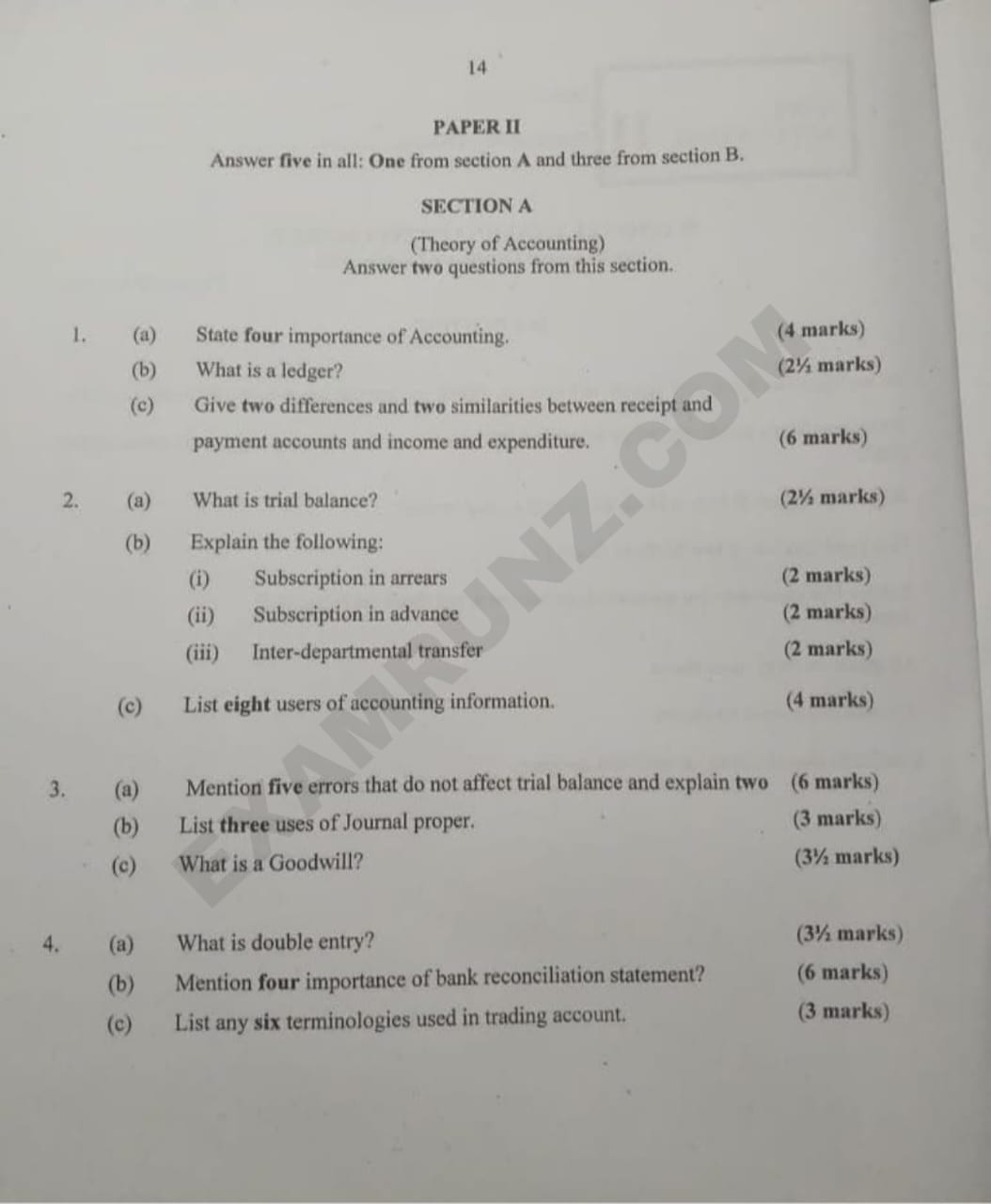
ACCOUNTING INSTRUCTIONS:
You are required to answer FIVE questions in total:
– TWO questions from Section A.
– THREE questions from Section B.
NECO GCE 2026 Accounting Questions and Answers (Objectives and Essay)
(1a)
(PICK ANY FOUR)
(i) Accounting helps to keep proper and permanent records of all financial transactions of a business.
(ii) It provides useful financial information that helps management make important business decisions.
(iii) Accounting helps a business to determine whether it has made a profit or suffered a loss.
(iv) It helps to detect and prevent errors, fraud and misappropriation of business funds.
(v) It helps to determine the financial position of a business at a particular period.
(vi) Accounting provides information needed for preparing budgets and planning future business activities.
(vii) It helps management to account for the resources entrusted to them by the owners.
(1b)
(PICK ANY ONE)
A ledger is the principal book of account in which financial transactions recorded in the journal are classified and posted into separate accounts. It contains different accounts such as cash, sales, purchases, debtors and creditors, and is used to determine the balance of each account.
OR
A ledger is a book of account used to record and classify all financial transactions of a business under their respective accounts. It is also known as the principal book of account because information from the journal is transferred into it for proper classification and preparation of the trial balance.
(1c)
DIFFERENCES:
(i) Receipts and payments account is prepared on a cash basis, while income and expenditure account is prepared on an accrual basis.
(ii) Receipts and payments account records all cash and bank transactions, while income and expenditure account records only revenue income and revenue expenses.
SIMILARITIES:
(i) Both accounts are prepared by non-profit-making organisations such as clubs, societies and associations.
(ii) Both accounts are used to summarise the financial activities of an organisation during a particular accounting period.
NECO GCE 2026 Accounting Questions and Answers (Objectives and Essay)
(2a)
(PICK ANY ONE)
A trial balance is a statement prepared by listing all the debit and credit balances extracted from the ledger accounts at a particular date to check the arithmetical accuracy of the double-entry bookkeeping system.
OR
A trial balance is a bookkeeping statement that contains the balances of all ledger accounts arranged in debit and credit columns to ascertain whether the total debit balances are equal to the total credit balances.
(2b)
(i) Subscription in arrears: Subscription in arrears refers to the amount of money owed by members of an organisation for a previous accounting period but which has not yet been paid. It is treated as an outstanding income and recorded as a current asset in the statement of financial position.
(ii) Subscription in advance: Subscription in advance refers to money received from members of an organisation before the period to which the payment relates. It is regarded as income received but not yet earned and is treated as a current liability in the statement of financial position.
(iii) Inter-departmental transfer: Inter-departmental transfer refers to the movement of goods, materials or resources from one department of an organisation to another. It is recorded to show the transfer between departments and helps maintain proper accounting records and control over departmental activities.
(2c)
(PICK ANY EIGHT)
(i) Owners of the business.
(ii) Managers.
(iii) Employees.
(iv) Creditors.
(v) Investors.
(vi) Government.
(vii) Customers.
(viii) Financial institutions.
(ix) Suppliers.
(x) Tax authorities.
NECO GCE 2026 Accounting Questions and Answers (Objectives and Essay)
(3a)
(i) Error of omission.
(ii) Error of commission.
(iii) Error of principle.
(iv) Compensating error.
(v) Error of original entry.
EXPLANATION:
(PICK ANY TWO)
(i) Error of omission: This occurs when a financial transaction is completely left out of the books of account. Since neither the debit nor the credit entry is recorded, the trial balance will still agree despite the omission.
(ii) Error of commission: This occurs when a transaction is recorded in the wrong account of the same class. For example, money received from John is wrongly posted to James’s account. The trial balance will still balance.
(iii) Error of principle: This occurs when a transaction is recorded in the wrong class of account, such as recording the purchase of machinery as an expense instead of a fixed asset. It does not affect the agreement of the trial balance.
(iv) Compensating error: This occurs when two or more errors cancel out each other’s effects. For example, an account may be over-debited by ₦500 while another account is also over-credited by ₦500, leaving the trial balance balanced.
(v) Error of original entry: This occurs when an incorrect amount is entered in the original book of entry and the same wrong amount is posted to both the debit and credit sides of the ledger. Therefore, the trial balance will still agree.
(3b)
(PICK ANY THREE)
(i) Recording opening entries.
(ii) Recording closing entries.
(iii) Recording correction of errors.
(iv) Recording transfer entries.
(v) Recording purchase or sale of fixed assets on credit.
(3c)
(PICK ANY ONE)
Goodwill is an intangible asset that represents the good reputation and customer loyalty enjoyed by a business. It arises from factors such as quality products, good customer relations, strategic location and efficient management, which enable the business to earn higher profits than similar businesses.
OR
Goodwill is the value of the reputation of a business built over time through customer satisfaction, quality services and efficient management. It is an intangible asset that gives a business an advantage over its competitors and helps it attract customers and generate additional profits.
NECO GCE 2026 Accounting Questions and Answers (Objectives and Essay)
(4a)
(PICK ANY ONE)
Double entry is a system of bookkeeping in which every financial transaction is recorded in two different accounts, with one account debited and another account credited with an equal amount. This system ensures that the total debit entries are always equal to the total credit entries.
OR
Double entry is an accounting principle which states that every business transaction has two effects and must be recorded in two accounts. One account receives a debit entry while the other receives a corresponding credit entry of the same amount to maintain accuracy.
(4b)
(PICK ANY FOUR)
(i) It helps to identify errors made by the bank or the business when recording financial transactions.
(ii) It helps to detect fraud and prevent the unauthorised withdrawal or misuse of business funds.
(iii) It helps to identify unpresented cheques and uncredited lodgements that cause differences between the cash book and bank statement.
(iv) It helps to determine the correct balance of the bank account at a particular date.
(v) It helps to ensure that the cash book is properly updated with bank charges, interest and other deductions.
(vi) It promotes proper financial control and improves the accuracy of accounting records.
(4c)
(PICK ANY SIX)
(i) Opening stock.
(ii) Purchases.
(iii) Sales.
(iv) Returns inward.
(v) Returns outward.
(vi) Carriage inward.
(vii) Closing stock.
(viii) Cost of goods sold.
===================================================
NECO GCE 2026 Accounting Questions and Answers (Objectives and Essay)
NECO GCE 2026 Accounting Questions and Answers (Objectives and Essay)
NECO GCE 2026 Accounting Questions and Answers (Objectives and Essay)
NECO GCE 2026 Accounting Questions and Answers (Objectives and Essay)
NECO GCE 2026 Accounting Questions and Answers (Objectives and Essay)
NECO GCE 2026 Accounting Questions and Answers (Objectives and Essay)
NECO GCE 2026 Accounting Questions and Answers (Objectives and Essay)
NECO GCE 2026 Accounting Questions and Answers (Objectives and Essay)
NECO GCE 2026 Accounting Questions and Answers (Objectives and Essay)
NECO GCE 2026 Accounting Questions and Answers (Objectives and Essay)
NECO GCE 2026 Accounting Questions and Answers (Objectives and Essay)
If you found this post helpful or have any questions, please leave a comment below.
please can i when can i get tomorrow’s chemistry questions
Chat us on WhatsApp for subscription