
NECO GCE 2026 Civic Education Questions and Answers – Objective and Theory
Are you preparing for the NECO GCE 2026 Civic Education Examination? Do you need reliable NECO GCE 2026 Civic Education Questions and answers–objective and theory delivered directly to your WhatsApp before exam time? Congratulations, your search ends here.
ExamRunz.com provides NECO GCE 2026 Civic Education Questions and Answers – Objective and Theory to candidates ahead of the exam.
Saturday, 7th November, 2026
Civic Education Paper III (Objective) – 10:00am – 11:00am.
Civic Education Paper II (Essay) – 11:00am – 1:00pm
CIVIC EDUCATION OBJ:
1 Colonial rule
2 Integrity
3 Terrorism
4 Godfatherism tendency
5 Protecting oil pipelines from vandalism
6 Slows down decision making due to checks and balances
7 Psychological trauma and long-term health problems
8 Togetherness
9 Encouraging family planning practices
10 Rights
11 Universal Declaration of Human Rights
12 Professional
13 Violation of human rights
14 Increase in exam malpractices
15 Slow down and wait for a moment
16 Use of gains to finance terrorist activities
17 Capitalism
18 Pharmacological
19 Apathy
20 Codeine
21 Receiving unscreened blood
22 Tolerance
23 Unilateral
24 Legislature
25 Providing free fuel to motorists
26 Military
27 Economic
28 Disenfranchised
29 Mediation
30 Human Rights Association
31 Trader
32 Discrimination against people living with HIV
33 Judiciary
34 Monarchical
35 Commitment
36 15
37 Destitution
38 Currency
39 Concealment
40 Chaos
41 Stability
42 Economic participation
43 Consistent use of condom
44 Executive
45 Want their interests and opinions represented
46 Act
47 Codified in a single document
48 Funding political parties from the national treasury and conventions
49 Interpret laws
50 The law
51 Manifesto
52 White horses
53 Fair
54 Confirm nominees before appointment
55 Loyalty
56 Patriotism
57 The sign indicates a pedestrian crossing where drivers must give way to them
58 Altruism
59 1985
60 Government officials are punished when they break the law
NECO GCE 2026 Civic Education THEORY
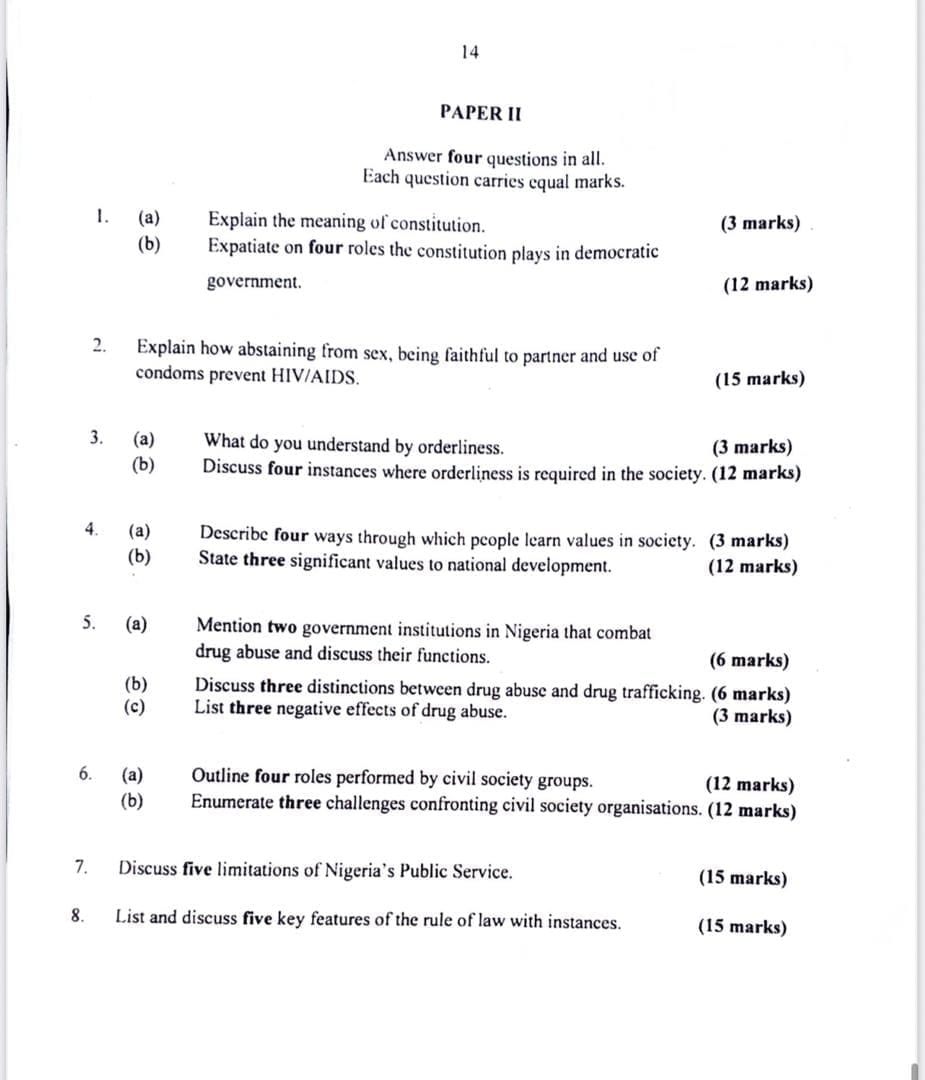
CIVIC EDUCATION TYPE A
CIVIC EDUCATION TYPE B
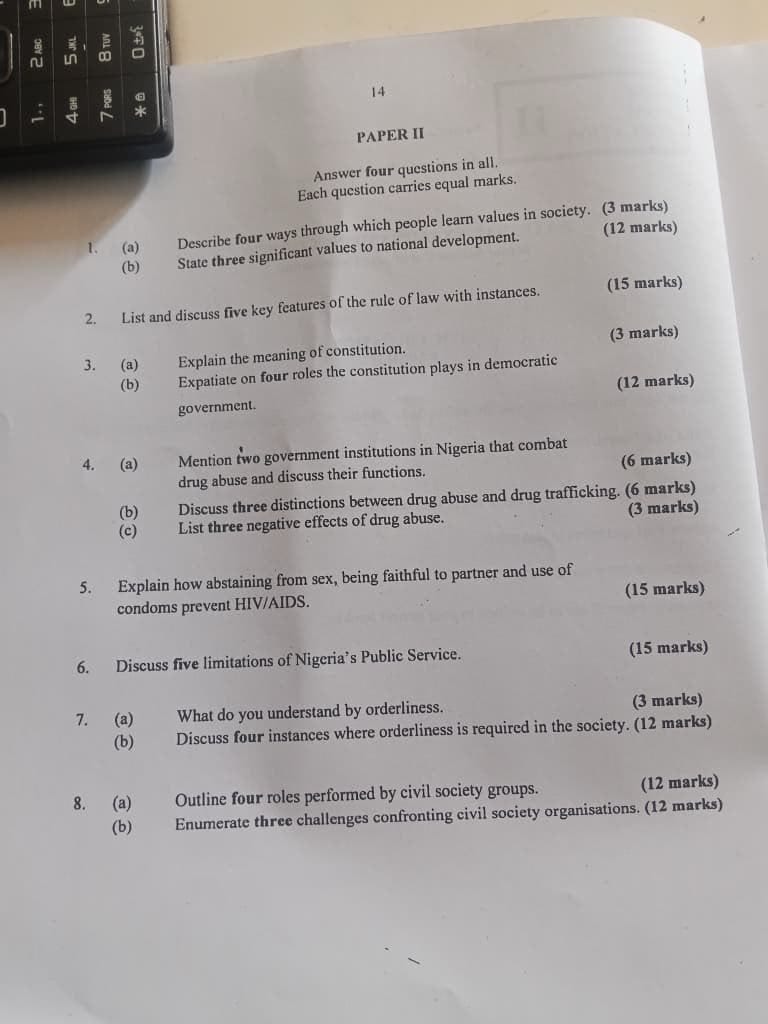
NECO GCE 2026 Civic Education Questions and Answers – Objective and Theory
QUESTIONS:
1. (a) Describe four ways through which people learn values in society. (12 marks)
(b) State three significant values to national development. (3 marks)
————————————————————————————
SOLUTIONS:
(1a)
(PICK ANY FOUR)
(i) Family upbringing: The family is the first agent of socialisation where individuals learn values from their parents and older relatives. Children acquire values such as honesty, respect, obedience, discipline, kindness and responsibility through the behaviour, instructions and examples provided by family members during their early years.
(ii) Formal education: Schools help individuals to acquire societal values through classroom teaching, school rules and interaction with teachers and fellow students. Students learn values such as punctuality, cooperation, tolerance, hard work, respect for authority and obedience to constituted rules, which prepare them for responsible participation in society.
(iii) Religious institutions: Churches, mosques and other religious organisations teach people moral and spiritual values through religious teachings, sermons and activities. Individuals learn values such as love, forgiveness, honesty, humility, kindness and respect for others, which help them develop good character and maintain peaceful relationships within society.
(iv) Peer groups: People learn values through their interactions with friends, classmates, colleagues and other members of their age groups. These interactions influence their attitudes, beliefs and behaviour. They learn values such as cooperation, loyalty, sharing, tolerance and respect through their daily relationships with other people.
(v) Mass media: Radio, television, newspapers, magazines and the internet influence people’s attitudes and behaviour. Through educational programmes, news, documentaries and public awareness campaigns, individuals learn values such as patriotism, tolerance, honesty, respect for human rights and peaceful coexistence, which promote responsible behaviour in society.
(vi) Community activities: Participation in community meetings, cultural festivals, traditional ceremonies and voluntary services exposes individuals to the values of their communities. Through these activities, people learn cooperation, unity, respect for elders, communal responsibility and peaceful coexistence, which help preserve the traditions and good practices of society.
(vii) Observation and imitation: Individuals learn societal values by observing and copying the behaviour of people around them, especially respected leaders, adults and role models. When people demonstrate honesty, kindness, discipline, respect and responsibility, others may imitate these behaviours and gradually develop similar positive attitudes and values.
(1b)
(PICK ANY THREE)
(i) Honesty: Honesty is an important societal value that promotes truthfulness, transparency and trust among citizens. It encourages people to perform their duties sincerely without cheating, stealing or engaging in fraudulent activities. When citizens and public officials are honest, corruption is reduced, public resources are protected and national development is encouraged.
(ii) Hard work: Hard work promotes productivity, efficiency and economic growth in a country. When citizens are committed to their responsibilities and work diligently, they contribute to the development of agriculture, industries, education and other sectors. It also encourages self-reliance, reduces poverty and improves the standard of living of citizens.
(iii) Patriotism: Patriotism is the love, loyalty and commitment citizens have towards their country. It encourages individuals to protect national interests, obey laws, pay taxes and contribute positively to society. Patriotic citizens promote national unity, defend the country’s integrity and participate in activities that encourage political, social and economic development.
(iv) Tolerance: Tolerance is the ability to accept and respect the opinions, beliefs, cultures and differences of other people. It promotes peaceful coexistence among citizens from different ethnic, religious and cultural backgrounds. Through tolerance, conflicts are reduced, national unity is strengthened and people can work together towards achieving national development.
(v) Discipline: Discipline involves the ability to obey rules, control one’s behaviour and perform duties responsibly. It encourages citizens to respect constituted authorities, follow regulations and avoid antisocial activities. A disciplined society experiences better organisation, effective leadership, reduced crime and improved productivity, all of which contribute to national development.
(vi) Cooperation: Cooperation is the willingness of individuals and groups to work together towards achieving common goals. It promotes teamwork, mutual assistance and collective responsibility among citizens. Through cooperation, communities can solve common problems, implement development projects, maintain peace and contribute effectively to the social and economic progress of the nation.
NECO GCE CIVIC EDUCATION
QUESTIONS:
2. List and discuss five key features of the rule of law with instances. (15 marks)
———————————————————————————
*SOLUTIONS:
(2)
(PICK ANY FIVE)
(i) Supremacy of the law: The law is supreme and applies to every person and authority in the country. Nobody is above the law, including the president, governors and ordinary citizens. Everyone must obey the constitution and other laws. For example, a governor who misuses public funds can be investigated and prosecuted according to legal procedures as other citizens.
(ii) Equality before the law: Every person should receive equal treatment under the law, regardless of wealth, position, religion, tribe or social status. Nobody should enjoy special treatment because of influence or power. For example, a wealthy businessperson and a poor trader who commit the same offence should be treated fairly and subjected to the same legal procedures in court.
(iii) Protection of fundamental human rights: The rule of law protects the basic rights and freedoms of citizens, such as freedom of expression, movement, association and religion. Government must respect these rights and cannot take them away unlawfully. For example, citizens have the right to criticise government policies peacefully without being unlawfully arrested, intimidated or punished for expressing their opinions freely.
(iv) Independent and impartial judiciary: The judiciary must be free from control or interference by the executive, legislature, wealthy individuals or other powerful groups. Judges should decide cases fairly, using evidence and the law. For example, a judge must be able to deliver judgment against a government official when evidence proves that the official has violated the law without fear.
(v) Fair hearing: Anyone accused of an offence must be given a fair opportunity to defend himself or herself before an impartial court. The accused should be informed of the charge, allowed to present evidence and permitted to obtain legal representation. For example, a person accused of stealing must be heard before the court gives its final judgment.
(vi) Legal certainty: Laws must be clear, known and understandable so that citizens can know what is expected of them. Nobody should be punished for an action that was not considered an offence under the law when it was committed. For example, government must publish laws and regulations to guide citizens and prevent arbitrary punishment.
(vii) Prevention of arbitrary arrest and detention: No person should be arrested, detained or punished without lawful reasons and proper legal procedures. Law enforcement officers must respect the rights of individuals when carrying out their duties. For example, the police must have legal grounds before arresting or detaining a suspected offender.
(viii) Access to justice: Every citizen should have the opportunity to approach the courts to seek justice when their rights are violated. Justice should not be restricted to wealthy or influential people. For example, a poor citizen should be able to report an injustice and seek legal assistance without being denied justice because of poverty.
NECO GCE CIVIC EDUCATION
QUESTIONS:
3. (a) Explain the meaning of constitution. (3 marks)
(b) Expatiate on four roles the constitution plays in democratic government. (12 marks)
———————————————————————————
SOLUTIONS:
(3a)
(PICK ANY ONE)
A constitution is a body of fundamental laws and principles by which a country is governed. It defines the powers and functions of the government, the rights and duties of citizens, and the relationship between the government and the people.
OR
A constitution is a set of written or unwritten rules and regulations that establishes the structure of government, guides its activities and defines the rights and responsibilities of citizens in a country.
(3b)
(PICK ANY FOUR)
(i) Defines the Structure of Government: The constitution establishes the different arms of government, namely the executive, legislature and judiciary. It clearly explains their powers, functions and responsibilities to ensure that each arm performs its duties properly without interfering unnecessarily in the activities of other arms of government.
(ii) Protects Citizens’ Rights: The constitution guarantees the fundamental human rights of citizens, such as freedom of speech, movement, religion and association. It protects individuals against oppression, discrimination and unlawful treatment by the government or other citizens, thereby ensuring that people enjoy their freedoms in a democratic society.
(iii) Limits Government Powers: The constitution places restrictions on the powers of government officials and institutions to prevent dictatorship, misuse of authority and arbitrary decisions. It ensures that political leaders do not exercise unlimited powers and that every government action must be carried out according to established constitutional provisions.
(iv) Promotes Rule of Law: The constitution promotes the principle of rule of law by ensuring that everybody, including the president, government officials and ordinary citizens, is subject to the law. It prevents arbitrary use of power and ensures that offenders are treated according to established legal procedures.
(v) Provides for Elections: The constitution establishes the legal framework for conducting free, fair and credible elections. It explains the qualifications for contesting political offices, voting procedures and electoral processes. This enables citizens to choose their leaders and participate actively in the democratic governance of their country.
(vi) Ensures Peaceful Change of Government: The constitution provides procedures for the peaceful transfer of political power from one government to another through regular elections and other constitutional means. It prevents unconstitutional changes of government, reduces political conflicts and ensures continuity, stability and order in a democratic society.
NECO GCE CIVIC EDUCATION
QUESTIONS:
4. (a) Mention two government institutions in Nigeria that combat drug abuse and discuss their functions. (6 marks)
(b) Discuss three distinctions between drug abuse and drug trafficking. (6 marks)
(c) List three negative effects of drug abuse. (3 marks)
———————————————————————————
SOLUTIONS:
(4a)
(PICK ANY THREE)
(i) National Drug Law Enforcement Agency (NDLEA): The NDLEA is responsible for controlling and preventing drug abuse and trafficking in Nigeria. It arrests and prosecutes drug traffickers, seizes illegal drugs, destroys illicit drug farms and conducts public awareness campaigns. It also works to prevent the production, distribution and consumption of prohibited substances across the country.
(ii) National Agency for Food and Drug Administration and Control (NAFDAC): NAFDAC regulates the manufacture, importation, distribution and sale of drugs in Nigeria. It prevents the circulation of fake, adulterated and unapproved drugs, monitors drug quality and educates the public on the dangers of drug misuse. It also takes action against illegal drug manufacturers and sellers.
(iii) Nigeria Police Force (NPF): The Nigeria Police Force helps to combat drug abuse by arresting people involved in the illegal possession, distribution and trafficking of drugs. It investigates drug-related offences, maintains law and order and collaborates with the NDLEA and other security agencies to prevent illegal drug activities in different parts of the country.
(iv) Nigeria Customs Service (NCS): The Nigeria Customs Service helps to combat drug abuse by preventing the smuggling of illegal drugs into and out of Nigeria. It inspects goods, luggage and shipments at borders, seaports and airports, seizes prohibited substances and works with the NDLEA and other security agencies to stop the illegal importation and exportation of drugs.
(4b)
(PICK ANY THREE)
(i) Meaning: Drug abuse is the improper use of drugs without medical prescription or beyond the recommended dosage. Drug trafficking is the illegal buying, selling, transportation or distribution of prohibited drugs.
(ii) Purpose: Drug abuse involves taking drugs for wrong purposes, such as getting high or feeling excited. Drug trafficking involves making money through the illegal supply and distribution of drugs to other people.
(iii) Nature of offence: Drug abuse mainly affects the health and behaviour of the person taking the drugs. Drug trafficking involves criminal activities such as smuggling, selling and distributing illegal substances.
(iv) Legal status: Drug abuse may involve the misuse of legally prescribed drugs or illegal substances. Drug trafficking is a criminal offence when it involves the illegal trade, supply or distribution of prohibited drugs.
(v) Effects on society: Drug abuse can cause addiction, mental illness and poor academic or work performance. Drug trafficking encourages crime, violence, insecurity and the widespread availability of harmful substances in society.
(4c)
(PICK ANY THREE)
(i) It can lead to premature death or suicide.
(ii) It damages vital organs such as the liver, kidney and brain.
(iii) It can lead to mental illness and psychological disorders.
(iv) It causes poor academic performance among students.
(v) It encourages criminal activities such as stealing, robbery and violence.
(vi) It can lead to road accidents due to impaired judgement.
(vii) It causes family problems and breakdown of relationships.
(viii) It can result in unemployment and loss of productivity.
(ix) It exposes individuals to dangerous diseases through unsafe drug use.
NECO GCE CIVIC EDUCATION:
QUESTIONS:
5. Explain how abstaining from sex, being faithful to partner and use of condoms prevent HIV/AIDS. (15 marks)
———————————————————————————
SOLUTIONS:
(5)
(i) Abstaining from sex: Abstaining from sex is an effective way of preventing HIV/AIDS because it involves avoiding sexual intercourse completely. Since HIV can be transmitted through unprotected sexual activities, a person who abstains from sex avoids the risk of contracting the virus through sexual contact. It is therefore a reliable method of preventing sexual transmission of HIV.
(ii) Being faithful to one partner: Being faithful to one partner helps to reduce the spread of HIV/AIDS by preventing sexual relationships with multiple partners. When two partners are tested and confirmed HIV-negative and remain faithful to each other, they reduce their chances of becoming infected. Faithfulness also encourages trust, commitment and responsible behaviour in relationships.
(iii) The use of condoms prevents: The use of condoms prevents HIV/AIDS by providing a protective barrier during sexual intercourse. Condoms help to prevent infected semen and vaginal fluids from entering the body of an uninfected partner. When used correctly and consistently during sexual activities, condoms greatly reduce the risk of HIV transmission. They also protect against other sexually transmitted infections.
NECO GCE CIVIC EDUCATION
QUESTIONS:
6. Discuss five limitations of Nigeria’s Public Service. (15 marks)
———————————————————————————
SOLUTIONS:
(6)
(PICK ANY FIVE)
(i) Corruption: Corruption is a major limitation of Nigeria’s public service. Some public officers misuse their positions to demand bribes, divert government funds and favour individuals in exchange for personal benefits. This practice reduces public confidence, encourages dishonesty, wastes government resources and prevents the effective delivery of essential services to citizens.
(ii) Political interference: Political interference occurs when politicians influence the activities and decisions of public servants for personal or political interests. This prevents officers from performing their duties independently and professionally. It can also lead to unfair appointments, frequent transfers, victimisation of honest workers and poor implementation of government policies and programmes.
(iii) Bureaucracy: Excessive bureaucracy involves too many rules, procedures and administrative processes before decisions can be made. This causes unnecessary delays in government activities and service delivery. It also discourages innovation, wastes valuable time and makes it difficult for citizens to obtain government services quickly and conveniently.
(iv) Inadequate funding: Insufficient financial resources affect the smooth operation of government ministries, departments and agencies. Many public institutions lack adequate funds to purchase equipment, maintain facilities and employ qualified personnel. This results in poor working conditions, inadequate service delivery and inability to achieve government objectives effectively.
(v) Lack of qualified personnel: Some government establishments suffer from shortages of skilled, experienced and competent workers. This affects the quality of decisions and services provided to the public. It may also lead to mistakes, inefficiency, poor performance and difficulty in implementing government policies and development programmes successfully.
(vI) Poor motivation: Many public servants experience low salaries, inadequate allowances, poor working conditions and limited opportunities for promotion. These conditions discourage workers and reduce their commitment to official duties. Consequently, lateness, absenteeism, low productivity and lack of dedication may become common problems within the public service.
(vii) Political instability: Frequent changes in government can disrupt the continuity of public policies and programmes. New administrations may abandon projects started by previous governments or replace important officials. This creates uncertainty, wastes public resources and makes long-term planning and effective administration difficult within the Nigerian public service.
(viii) Nepotism and favouritism: Some public officers give preferential treatment to relatives, friends and political associates instead of considering merit and qualifications. This affects recruitment, promotion and appointment into important positions. It discourages hardworking employees, promotes injustice and reduces the efficiency and professionalism of the public service.
NECO GCE CIVIC EDUCATION:
QUESTIONS:
7. (a) What do you understand by orderliness? (3 marks)
(b) Discuss four instances where orderliness is required in the society. (12 marks)
———————————————————————————
SOLUTIONS:
(7a)
(PICK ANY ONE)
Orderliness is the act of behaving in a disciplined, organised and responsible manner by obeying rules, regulations and established procedures. It involves respecting other people, maintaining peace and ensuring that activities are carried out properly to promote unity, cooperation and peaceful coexistence in society.
OR
Orderliness is the act of maintaining peace, discipline and proper arrangement in society by obeying rules, regulations and established procedures. It involves behaving responsibly, respecting other people’s rights and doing things in an organised manner to promote peaceful coexistence and effective functioning of society.
(7b)
(PICK ANY FOUR)
(i) At home: Orderliness is required at home to maintain peace, discipline and cooperation among family members. Children are expected to obey their parents, respect their elders and perform their assigned duties. Proper arrangement of household items and sharing of responsibilities help prevent unnecessary conflicts and promote a peaceful family environment.
(ii) In schools: Orderliness is necessary in schools to ensure effective teaching and learning. Students are expected to obey school rules, respect teachers, attend classes regularly and avoid examination malpractice. Maintaining discipline in the classroom helps students concentrate on their studies and creates a suitable environment for academic excellence.
(iii) On the roads: Orderliness is required on the roads to prevent accidents and ensure smooth movement of vehicles and pedestrians. Motorists must obey traffic lights, road signs and speed limits. Pedestrians should use designated crossings. These practices reduce road accidents, traffic congestion and unnecessary loss of lives.
(iv) In public places: Orderliness is necessary in public places such as markets, hospitals, banks and government offices. People should form queues, respect others and follow established procedures when receiving services. This prevents confusion, fighting and unnecessary delays while ensuring that everyone receives fair treatment.
(v) In the workplace: Orderliness is required in workplaces to promote efficiency, discipline and productivity. Workers must obey organisational rules, respect their superiors, report to work punctually and perform their duties responsibly. This encourages cooperation among employees and helps organisations achieve their goals effectively.
(vi) During religious activities: Orderliness is required in churches, mosques and other religious centres to ensure peaceful worship. Worshippers should obey religious leaders, avoid unnecessary noise and follow established procedures. This promotes unity, respect and peaceful worship among members of the religious community.
(vii) During public gatherings: Orderliness is necessary during meetings, political rallies, ceremonies and other public events. People should obey instructions, avoid fighting and respect one another. This helps prevent confusion, stampedes and violence while ensuring that activities are conducted peacefully and successfully.
NECO GCE CIVIC EDUCATION
QUESTIONS:
8. (a) Outline four roles performed by civil society groups. (12 marks)
(b) Enumerate three challenges confronting civil society organisations. (12 marks)
————————————————————————————
SOLUTIONS:
(8a)
(PICK ANY FOUR)
(i) Protection of human rights: Civil society groups protect the fundamental human rights of citizens by speaking against injustice, discrimination, oppression and unlawful arrests. They educate people about their rights and provide support to victims whose rights have been violated. This helps promote freedom, equality and justice in society.
(ii) Promotion of democracy: Civil society groups promote democracy by encouraging citizens to participate in political activities, elections and decision-making processes. They organise voter education programmes, monitor elections and encourage political participation. Their activities help strengthen democratic institutions and ensure that government operates according to democratic principles.
(iii) Holding government accountable: Civil society organisations monitor government activities and expose corruption, misuse of public funds and abuse of power. They demand transparency from public officials and encourage responsible leadership. This helps prevent mismanagement of public resources and ensures that government officials perform their duties in the interest of citizens.
(iv) Provision of social services: Civil society groups provide essential services such as healthcare, education, poverty alleviation, food assistance and support for vulnerable members of society. They organise community development programmes and humanitarian activities. These efforts help improve people’s living conditions and complement the responsibilities of government.
(v) Civic education: Civil society organisations educate citizens about their civic responsibilities, constitutional rights, democratic values and the importance of obeying laws. They organise seminars, workshops and public awareness campaigns. This helps citizens become more informed, responsible and actively involved in the development of their communities.
(vi) Conflict resolution: Civil society groups help to settle disputes among individuals, communities and groups through dialogue, mediation and peaceful negotiations. They encourage tolerance and mutual understanding, thereby preventing violence and promoting peaceful coexistence among members of society.
(vii) Promotion of good governance: Civil society organisations encourage transparency, accountability, participation and responsible leadership in government. They educate citizens on good governance and advocate policies that promote fairness, justice and effective administration for the benefit of the entire society.
(8b)
(PICK ANY THREE)
(i) Inadequate funding: Many civil society organisations lack sufficient money to carry out their activities. They depend on donations, grants and contributions, which may not always be available. This makes it difficult to organise programmes, employ qualified workers and achieve their objectives effectively.
(ii) Government interference: Some civil society organisations face intimidation, harassment and restrictions from government officials because of their criticism of government policies. This limits their freedom to operate independently and discourages them from exposing corruption and other government misconduct.
(iii) Corruption and mismanagement: Some organisations experience corruption, dishonesty and poor management of available resources. Leaders may divert donated funds for personal use instead of carrying out planned activities. This reduces public confidence and discourages donors from supporting their programmes.
(iv) Lack of qualified personnel: Some civil society organisations lack trained, experienced and competent workers to manage their activities. This affects planning, administration and service delivery, making it difficult for them to achieve their goals and respond effectively to the needs of society.
(v) Insecurity: Violence, kidnapping, terrorism and communal conflicts in some parts of the country make it difficult for civil society organisations to operate. Their workers may be threatened or attacked, while community programmes and humanitarian activities may be disrupted.
(vi) Lack of public awareness: Many citizens do not understand the activities and importance of civil society organisations. This reduces public participation, cooperation and support for their programmes, thereby making it difficult for these organisations to achieve their objectives.
(vii) Poor cooperation: Some civil society organisations experience difficulties working with government agencies, other organisations and community leaders. Lack of cooperation affects the sharing of information, resources and ideas, thereby limiting the success of their activities.
(viii) Unfavourable government policies: Restrictive laws, excessive registration requirements and difficult government regulations can prevent civil society organisations from operating freely. Such policies may increase their administrative costs and limit their ability to carry out programmes effectively.
==============================================
NECO GCE 2026 Civic Education Questions and Answers – Objective and Theory
NECO GCE 2026 Civic Education Questions and Answers – Objective and Theory
NECO GCE 2026 Civic Education Questions and Answers – Objective and Theory
NECO GCE 2026 Civic Education Questions and Answers – Objective and Theory
NECO GCE 2026 Civic Education Questions and Answers – Objective and Theory
NECO GCE 2026 Civic Education Questions and Answers – Objective and Theory
NECO GCE 2026 Civic Education Questions and Answers – Objective and Theory
NECO GCE 2026 Civic Education Questions and Answers – Objective and Theory
NECO GCE 2026 Civic Education Questions and Answers – Objective and Theory
NECO GCE 2026 Civic Education Questions and Answers – Objective and Theory
NECO GCE 2026 Civic Education Questions and Answers – Objective and Theory
NECO GCE 2026 Civic Education Questions and Answers – Objective and Theory
NECO GCE 2026 Civic Education Questions and Answers – Objective and Theory
NECO GCE 2026 Civic Education Questions and Answers – Objective and Theory
NECO GCE 2026 Civic Education Questions and Answers – Objective and Theory
NECO GCE 2026 Civic Education Questions and Answers – Objective and Theory
NECO GCE 2026 Civic Education Questions and Answers – Objective and Theory
NECO GCE 2026 Civic Education Questions and Answers – Objective and Theory
NECO GCE 2026 Civic Education Questions and Answers – Objective and Theory
NECO GCE 2026 Civic Education Questions and Answers – Objective and Theory
NECO GCE 2026 Civic Education Questions and Answers – Objective and Theory
NECO GCE 2026 Civic Education Questions and Answers – Objective and Theory
NECO GCE 2026 Civic Education Questions and Answers – Objective and Theory
NECO GCE 2026 Civic Education Questions and Answers – Objective and Theory
NECO GCE 2026 Civic Education Questions and Answers – Objective and Theory
NECO GCE 2026 Civic Education Questions and Answers – Objective and Theory
NECO GCE 2026 Civic Education Questions and Answers – Objective and Theory
NECO GCE 2026 Civic Education Questions and Answers – Objective and Theory
NECO GCE 2026 Civic Education Questions and Answers – Objective and Theory
NECO GCE 2026 Civic Education Questions and Answers – Objective and Theory
NECO GCE 2026 Civic Education Questions and Answers – Objective and Theory
NECO GCE 2026 Civic Education Questions and Answers – Objective and Theory
NECO GCE 2026 Civic Education Questions and Answers – Objective and Theory
NECO GCE 2026 Civic Education Questions and Answers – Objective and Theory
NECO GCE 2026 Civic Education Questions and Answers – Objective and Theory
NECO GCE 2026 Civic Education Questions and Answers – Objective and Theory
NECO GCE 2026 Civic Education Questions and Answers – Objective and Theory
NECO GCE 2026 Civic Education Questions and Answers – Objective and Theory
NECO GCE 2026 Civic Education Questions and Answers – Objective and Theory
NECO GCE 2026 Civic Education Questions and Answers – Objective and Theory
If you found this post helpful or have any questions, please leave a comment below.