
NECO GCE 2026 Commerce Questions and Answers
Are you searching for NECO GCE 2026 Commerce Questions and Answers, NECO GCE Commerce Objective and Theory Questions and Answers?
Welcome to Examrunz Team, where candidates can access carefully prepared Commerce Answers materials, examination questions, detailed solutions and important areas of concentration to help them succeed in 2026 NECO GCE Examination.
EXAMINATION TIME
Friday, 6th November, 2026
Commerce Paper III (Objective) – 10:00am – 11:00am.
Commerce Paper II (Essay) – 11:00am – 12:40pm.
COMMERCE OBJ:
1. D privatisation
2. E Sales of shares
3. B long-term liabilities
4. B provide capital for members to commence business
5. A Road
6. E employed
7. D export invoice
8. B seasonal
9. B secondary market
10. C co-insurance
11. B administrative bottleneck
12. B cocoa
13. A promotion
14. A 2-50
15. B the channel of distribution
16. D exploitation of consumers by firms
17. E legal tender
18. C political stability
19. C visible imports
20. A legal action for breach of contract
21. C Giro system
22. C bid
23. E social
24. C communication
25. B Partnership business
26. B Commercialisation
27. B service
28. A multilateral
29. E commerce
30. C hawking
31. C Air
32. D improve the economic welfare of members
33. D Insurance
34. D bonded
35. E running public enterprises as private businesses for profit
36. A 1998
37. D organising
38. A similarities in technology
39. D consortium
40. B is a free gift of nature
41. A Bill of exchange
42. A cartel
43. A radio
44. E Debit note
45. E wind up in accordance with the law
46. C limited liability company
47. D Limiting local industries
48. B Stocking variety of goods
49. C wages
50. D Consideration
51. E occupation
52. E second-tier securities
53. B comprehensive
54. A profit
55. D drawee
56. B Nigeria
57. D durability
58. B receipt
59. A Dangote Cement Plc
60. B net profit
NECO GCE 2026 Commerce Questions and Answers
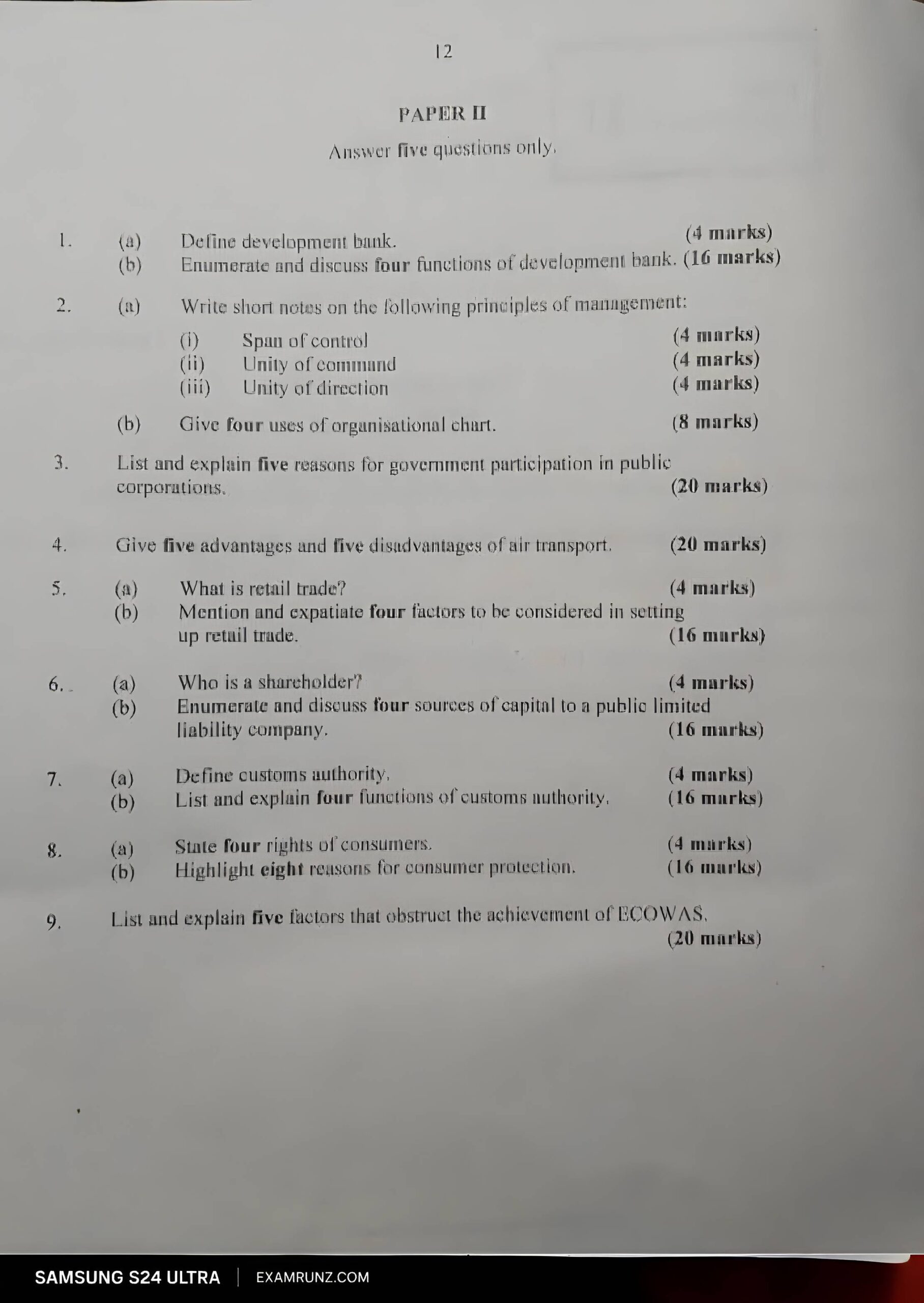
(1a)
(PICK ANY ONE)
A development bank is a financial institution established by the government or private organisations to provide long-term loans and financial assistance to individuals, businesses and industries for investment and economic development. It helps to promote agriculture, commerce, manufacturing and other productive activities that contribute to the growth of a country’s economy.
OR
A development bank is a specialised financial institution that provides funds, loans and other financial services to support economic development. It assists businesses and industries that may find it difficult to obtain long-term financing from ordinary commercial banks. It also promotes investment, employment opportunities and industrial growth.
(1b)
(PICK ANY FOUR)
(i) Provision of long-term loans: Development banks provide long-term loans to individuals, businesses and industries for establishing and expanding their operations. These loans are usually given for projects that require large amounts of money and take a long time to generate returns. Examples include the construction of factories, agricultural projects, industrial development and the purchase of expensive machinery and equipment.
(ii) Provision of financial advice: Development banks advise business owners and investors on how to obtain and manage financial resources effectively. They help entrepreneurs prepare business plans, assess investment opportunities and determine the financial requirements of their projects. This guidance enables businesses to make better financial decisions, reduce unnecessary expenses and improve their chances of achieving long-term success.
(iii) Promotion of industrial development: Development banks provide financial assistance to industries involved in manufacturing, processing and production. They help industries purchase machinery, construct factories and expand their production capacity. This encourages industrial growth, increases the availability of locally manufactured goods, reduces dependence on imported products and contributes to the overall development of the country’s economy.
(iv) Promotion of agricultural development: Development banks provide loans and financial support to farmers, agricultural businesses and agro-processing companies. The funds can be used to purchase tractors, fertilizers, improved seeds, livestock and other farming equipment. This support helps farmers increase agricultural production, improve food supply, create employment opportunities and contribute to national economic development.
(v) Encouragement of small and medium-scale enterprises: Development banks provide financial assistance to small and medium-scale businesses that may not have enough capital to expand their operations. They help entrepreneurs purchase equipment, employ workers and improve their production activities. This promotes entrepreneurship, reduces unemployment and encourages the development of local businesses.
(vi) Provision of loan guarantees: Development banks may provide guarantees to encourage other financial institutions to lend money to businesses and entrepreneurs. This reduces the risk faced by commercial banks when providing loans to certain businesses. It also makes it easier for companies that lack sufficient collateral to obtain the financial assistance required for their development projects.
(vii) Mobilisation of financial resources: Development banks obtain funds from government contributions, international financial institutions, private investors and other financial sources. They combine these resources and direct them towards important economic projects. This helps make more funds available for investment, infrastructure development, industrial expansion and other activities that support the economic growth of a country.
NECO GCE 2026 Commerce Questions and Answers
(2a)
(i) Span of control: Span of control refers to the number of employees or subordinates that a manager can effectively supervise and control at a particular time. A manager should have a reasonable number of workers under his supervision so that he can communicate instructions, monitor their performance and correct mistakes. A very wide span may make supervision difficult, while a narrow span may increase administrative costs.
(ii) Unity of command: Unity of command is a management principle which states that each employee should receive instructions and orders from only one immediate superior. This prevents confusion, conflicting instructions and disagreements among workers. It also makes employees clearly understand who they are responsible to and who has the authority to assess their performance and give directions.
(iii) Unity of direction: Unity of direction means that all activities having the same objectives should be organised under one manager and one coordinated plan. This ensures that employees work towards a common organisational goal rather than pursuing different directions. It improves coordination, prevents duplication of duties, encourages teamwork and helps an organisation achieve its objectives more effectively.
(2b)
(PICK ANY FOUR)
(i) It shows the structure and hierarchy of an organisation.
(ii) It identifies the different departments and units in an organisation.
(iii) It shows the chain of command and lines of authority.
(iv) It defines the duties and responsibilities of employees.
(v) It shows the relationship between superiors and subordinates.
(vi) It helps in effective communication and coordination within the organisation.
NECO GCE 2026 Commerce Questions and Answers
(3)
(PICK ANY FIVE)
(i) Provision Of Essential Services: The government establishes public corporations to provide essential services that are necessary for the well-being of the citizens. Some of these services include electricity, water supply, transportation, healthcare and communication. Private individuals may not have enough capital or interest to provide these services to everyone, especially in rural areas. Therefore, the government participates to ensure that these services are available and affordable to the general public.
(ii) Prevention Of Exploitation: Government participates in business activities to prevent private business owners from exploiting consumers. Some private companies may charge excessively high prices for essential goods and services because they want to make more profit. Through public corporations, the government can provide goods and services at reasonable prices and protect citizens from unfair business practices.
(iii) Creation Of Employment Opportunities: Public corporations provide employment opportunities for a large number of people in different sectors of the economy. They employ workers such as engineers, accountants, administrators, technicians, drivers and other professionals. This helps to reduce unemployment, improve the standard of living of citizens and increase the income available to households.
(iv) Promotion Of Economic Development: Government establishes public corporations to promote economic growth and development. These corporations provide important facilities and services that support industrial and commercial activities. For example, electricity, transportation and water supply are necessary for businesses to operate successfully. Their availability encourages investment, increases production and contributes to the overall development of the country.
(v) Control Of Strategic Industries: The government may participate in industries that are very important to the country’s economy and national security. Examples include petroleum, electricity, railway transportation and water supply. Government ownership or control of these industries helps to prevent essential resources from being controlled entirely by private individuals or foreign companies and ensures that they are managed in the national interest.
(vi) Generation Of Government Revenue: Public corporations can generate revenue for the government through the sale of goods and the provision of services. The money earned can be used to finance government projects, develop infrastructure, improve public facilities and provide other essential services. This reduces the government’s dependence on taxes and other sources of revenue.
(vii) Balanced Regional Development: Government establishes public corporations in different parts of the country to encourage even development. Some private investors may prefer to establish businesses only in developed cities where they expect to make higher profits. Government participation helps to provide industries, employment opportunities and essential services in less-developed areas, thereby reducing regional inequalities.
(viii) Protection Of National Interest: Government participation in business helps to ensure that important economic activities are carried out in the interest of the country and its citizens. It prevents essential industries from being controlled entirely by individuals or foreign organisations whose decisions may not favour the nation. This also helps the government maintain control over important resources and services.
NECO GCE 2026 Commerce Questions and Answers
(4)
ADVANTAGES:
(PICK ANY FIVE)
(i) Speed: Air transport is the fastest means of transportation. It helps people and goods to move from one place to another within a short period of time.
(ii) Suitable for long distances: It is suitable for travelling over long distances, especially between countries and continents.
(iii) Comfort: Air transport provides comfort and convenience to passengers during their journeys.
(iv) Safety: It is generally a safe means of transportation because aircraft are operated by trained pilots and other qualified workers.
(v) Emergency services: It is useful during emergencies for transporting sick people, doctors, drugs and other essential goods.
(vi) Promotion of international trade: It helps to promote international trade by making it easy to transport goods from one country to another.
(vii) Employment opportunities: It provides employment for pilots, air hostesses, engineers, airport workers and other people.
(viii) Saves time: It saves time because goods and passengers can reach their destinations faster than other means of transportation.
DISADVANTAGES:
(PICK ANY FIVE)
(i) High cost: Air transport is very expensive compared with other means of transportation. Both passengers and goods pay high charges.
(ii) Bad weather: Bad weather conditions such as heavy rain, fog and storms can delay or prevent flights.
(iii) Limited carrying capacity: Aircraft cannot carry as many goods and passengers as ships and some other means of transportation.
(iv) Expensive facilities: It requires expensive facilities such as airports, runways, control towers and other equipment.
(v) Air accidents: Air accidents may lead to serious loss of lives and property.
(vi) High maintenance cost: Aircraft require regular servicing and repairs, which involve a lot of money.
(vii) Noise pollution: Aircraft produce loud noise which can disturb people living near airports.
(viii) Not suitable for bulky goods: Air transport is not suitable for transporting heavy and bulky goods because of its high cost.
NECO GCE 2026 Commerce Questions and Answers
(5a)
(PICK ANY ONE)
Retail trade is the process of buying goods from manufacturers or wholesalers and selling them in smaller quantities directly to final consumers for their personal use.
OR
Retail trade is the final stage of distribution in which goods and services are made available to the final consumers who purchase them for use and not for resale.
(5b)
(PICK ANY FOUR)
(i) Availability Of Capital: A person intending to establish a retail business must consider the amount of capital available. Money is needed to rent or purchase a shop, buy goods, acquire equipment, pay workers and meet other operating expenses. Adequate capital will help the retailer maintain sufficient stock and run the business without unnecessary financial difficulties.
(ii) Location Of The Business: The retailer must choose a suitable location for the business. The shop should be situated where customers can easily reach it, preferably in a busy commercial area, residential neighbourhood or market. A good location increases the chances of attracting customers and making regular sales. The retailer should also consider accessibility and security.
(iii) Nature Of Goods To Be Sold: The retailer should consider the type of goods he intends to sell before establishing the business. Some products require special storage facilities, while perishable goods must be sold quickly to prevent spoilage. The nature of the products will determine the type of shop, equipment, storage facilities and arrangement required.
(iv) Availability Of Customers: The retailer should find out whether there are enough potential customers in the proposed location. The business should be established in an area where people need the products being sold and can afford to purchase them. A good understanding of customers’ needs and purchasing power will help the retailer select suitable goods and improve sales.
(v) Level Of Competition: The retailer should study the number of similar businesses operating in the area before establishing the shop. Too many competitors may reduce the number of customers and the profit made by the business. The retailer should consider how to attract customers through quality products, reasonable prices, good customer service and other advantages.
(vi) Availability Of Suppliers: A retailer should consider whether there are reliable suppliers who can provide goods regularly. Suppliers should be able to deliver products at reasonable prices and within the required period. Reliable sources of supply will help the retailer avoid frequent shortages, maintain adequate stock and satisfy customers’ demands.
(vii) Security Of The Area: The safety of the shop, goods, workers and customers should be considered before setting up a retail business. A location with frequent theft, robbery or other security problems may expose the retailer to unnecessary losses. The retailer should therefore choose a reasonably safe environment where business activities can take place peacefully.
NECO GCE 2026 Commerce Questions and Answers
(6a)
(PICK ANY ONE)
A shareholder is an individual, company or organisation that owns one or more shares in a company. A shareholder contributes capital to the company by purchasing shares and becomes a part-owner of the business. Shareholders may receive dividends from the company’s profits and have certain rights, such as voting on important company decisions.
OR
A shareholder is a person or corporate body that invests money in a company by buying its shares. Such a person becomes a part-owner of the company and is entitled to certain benefits, including dividends and participation in important decisions, depending on the number and type of shares owned.
(6b)
(PICK ANY FOUR)
(i) Issue of ordinary shares: A public limited liability company can raise capital by issuing ordinary shares to members of the public. Individuals and organisations purchase these shares and become part-owners of the company. The money raised is used to finance business activities, purchase equipment and expand operations. Ordinary shareholders may receive dividends when the company makes profits.
(ii) Issue of preference shares: A company can raise funds by issuing preference shares to investors. Preference shareholders are usually entitled to receive dividends at a fixed rate before ordinary shareholders receive theirs. This source of capital helps the company obtain additional funds without necessarily borrowing money from financial institutions. However, preference shareholders generally have limited voting rights.
(iii) Debentures: Debentures are long-term financial instruments issued by a company to borrow money from investors. The company promises to pay interest to debenture holders at an agreed rate and repay the borrowed amount according to the specified terms. This enables the company to obtain large amounts of capital for expansion without giving investors ownership of the business.
(iv) Bank loans: A public limited liability company can obtain capital by borrowing money from commercial banks and other financial institutions. The borrowed funds may be used to purchase machinery, acquire buildings, increase production or finance other business activities. The company is expected to repay the loan with interest according to the agreed repayment schedule.
(v) Retained profits: A company can obtain capital by keeping part of the profits earned from its business activities instead of distributing all the profits as dividends. These retained earnings can be reinvested in the business to purchase equipment, expand operations and improve production. This source reduces the company’s dependence on external borrowing and additional share issues.
(vi) Sale of assets: A public limited liability company can raise funds by selling assets that are no longer required for its operations. Such assets may include unused machinery, vehicles, land and buildings. The money obtained can be used to finance other important business activities, settle financial obligations or purchase more useful equipment for the company.
(vii) Government grants and assistance: A public limited liability company may obtain financial assistance from government agencies through grants, subsidies and special development programmes. Such assistance is often provided to encourage investment in important sectors of the economy. It helps businesses finance approved projects, improve production capacity and contribute to employment generation and national economic development.
NECO GCE 2026 Commerce Questions and Answers
(7a)
(PICK ANY ONE)
Customs authority is a government agency responsible for controlling and regulating the movement of goods into and out of a country. It collects duties and taxes on imported and exported goods, prevents smuggling and ensures that international trade activities comply with government laws and regulations.
OR
Customs authority is a government institution responsible for enforcing customs laws at the borders of a country. It supervises imports and exports, assesses duties payable on goods, prevents illegal trade and protects the country’s economy and security.
(7b)
(PICK ANY FOUR)
(i) Collection of import and export duties: Customs authority collects taxes and duties payable on goods entering or leaving a country. These payments are calculated according to the nature, value and classification of the goods involved. The revenue collected contributes to government income and helps finance public services, infrastructure development and other national expenditure.
(ii) Prevention of smuggling: Customs authority prevents the illegal movement of goods across national borders by inspecting cargo, vehicles, ships and other means of transportation. It monitors border activities and investigates suspicious transactions to identify prohibited or undeclared goods. This helps protect government revenue, local industries and the general security of the country.
(iii) Control of imported and exported goods: Customs authority examines goods entering and leaving a country to ensure that they comply with established laws and regulations. It checks import and export documents, verifies product descriptions and ensures that restricted goods are properly authorised. This helps prevent illegal trade and ensures that international commercial activities are conducted according to government requirements.
(iv) Prevention of the importation of prohibited goods: Customs authority prevents dangerous, illegal and prohibited goods from entering the country. Such goods may include illegal drugs, counterfeit products, unauthorised weapons and other restricted materials. Through inspection and enforcement activities, the authority protects public health, national security and the welfare of citizens against the harmful effects of illegal imports.
(v) Protection of local industries: Customs authority helps protect domestic industries by enforcing import regulations and collecting appropriate duties on foreign products. This reduces unfair competition from illegally imported or under-declared goods. It also helps create a fair trading environment in which locally manufactured products can compete more effectively with imported goods.
(vi) Collection of trade statistics: Customs authority keeps records of goods imported and exported through the country’s borders. These records provide information about the quantity, value, type and origin of traded products. Government uses such information to prepare trade statistics, formulate economic policies, monitor international business activities and make decisions concerning national development.
(vii) Enforcement of trade regulations: Customs authority ensures that individuals and businesses involved in international trade obey established import and export laws. It checks relevant licences, certificates and other required documents before goods are cleared. This promotes lawful business practices, reduces fraudulent activities and helps maintain proper control over international commercial transactions.
NECO GCE 2026 Commerce Questions and Answers
(8a)
(PICK ANY FOUR)
(i) Right to safety.
(ii) Right to information.
(iii) Right to choose.
(iv) Right to be heard.
(v) Right to consumer education.
(vi) Right to redress.
(vii) Right to a healthy environment.
(8b)
(PICK ANY EIGHT)
(i) To prevent exploitation: Consumer protection prevents sellers and manufacturers from exploiting consumers through excessive prices and unfair business practices.
(ii) To prevent the sale of fake goods: It helps to protect consumers against counterfeit, adulterated and substandard products.
(iii) To ensure consumer safety: It protects consumers from goods and services that may be harmful to their health and lives.
(iv) To prevent misleading advertisements: Consumer protection prevents traders from deceiving buyers through false and misleading advertisements.
(v) To ensure fair prices: It helps to prevent sellers from charging unreasonable prices or taking advantage of consumers.
(vi) To protect consumers against cheating: It prevents traders from using false weights and measures to deceive consumers.
(vii) To promote consumer awareness: It educates consumers about their rights, responsibilities and the quality of products they purchase.
(viii) To provide channels for complaints: It gives consumers the opportunity to report unsatisfactory products and seek compensation or redress.
(ix) To prevent hoarding: Consumer protection helps to discourage artificial scarcity and the deliberate withholding of essential goods to increase prices.
(x) To ensure quality standards: It encourages manufacturers and sellers to maintain acceptable standards in the production and distribution of goods and services.
(xi) To promote fair competition: It discourages unfair business practices and ensures that businesses compete fairly in the interest of consumers
NECO GCE 2026 Commerce Questions and Answers
(9)
(PICK ANY FIVE)
(i) Political instability: Political instability in member countries affects the successful implementation of ECOWAS programmes and policies. Military coups, changes in government and political disagreements can interrupt regional cooperation and delay important decisions. When governments are unstable, they may concentrate on domestic problems rather than regional development. This makes it difficult for member states to maintain consistent commitments to ECOWAS objectives.
(ii) Language barriers: ECOWAS consists of countries with different official languages, mainly English, French and Portuguese. These language differences create communication difficulties among government officials, business people and citizens. They may also affect negotiations, administrative activities and the implementation of regional policies. As a result, misunderstandings can occur and cooperation among member countries may become more difficult.
(iii) Differences in economic development: Member countries of ECOWAS have different levels of economic development, industrialisation and financial resources. Some countries have stronger economies and better infrastructure than others. These differences make it difficult to implement common economic policies because member states may have different priorities and capacities. Consequently, some countries may benefit more from regional programmes than others.
(iv) Inadequate infrastructure: Poor road networks, inadequate railway systems, unreliable electricity and insufficient communication facilities hinder trade and movement among ECOWAS member countries. These infrastructure problems increase transportation costs and make the movement of goods and people difficult. They also discourage investors and reduce the effectiveness of regional economic integration and commercial activities.
(v) Political and national interests: Some member countries place their national interests above the collective objectives of ECOWAS. Governments may introduce policies that protect local industries or restrict foreign goods even when such actions conflict with regional agreements. This lack of commitment to common objectives makes it difficult to establish effective cooperation and achieve economic integration.
(vi) Inadequate funding: The successful implementation of ECOWAS programmes requires sufficient financial resources from member countries and other funding sources. However, some member states fail to make their financial contributions regularly because of economic difficulties or poor commitment. This creates funding shortages and delays regional projects involving infrastructure, security, education, trade and economic development.
(vii) Trade restrictions and customs barriers: Some ECOWAS member countries impose unnecessary restrictions, tariffs and administrative procedures on goods entering their territories. These barriers make cross-border trade expensive and discourage business activities among member states. They also weaken efforts to establish a common market and encourage the free movement of goods and services within the region.
(viii) Insecurity and terrorism: Terrorism, armed conflicts, kidnapping, banditry and other security challenges affect several parts of West Africa. These problems discourage investment, disrupt transportation and make cross-border commercial activities dangerous. They also force governments to spend more resources on security instead of development projects. Consequently, insecurity slows down regional cooperation and economic integration.
===========================================
NECO GCE 2026 Commerce Questions and Answers
NECO GCE 2026 Commerce Questions and Answers
NECO GCE 2026 Commerce Questions and Answers
NECO GCE 2026 Commerce Questions and Answers
NECO GCE 2026 Commerce Questions and Answers
NECO GCE 2026 Commerce Questions and Answers
NECO GCE 2026 Commerce Questions and Answers
NECO GCE 2026 Commerce Questions and Answers
NECO GCE 2026 Commerce Questions and Answers
NECO GCE 2026 Commerce Questions and Answers
NECO GCE 2026 Commerce Questions and Answers
NECO GCE 2026 Commerce Questions and Answers
NECO GCE 2026 Commerce Questions and Answers
NECO GCE 2026 Commerce Questions and Answers
NECO GCE 2026 Commerce Questions and Answers
NECO GCE 2026 Commerce Questions and Answers
NECO GCE 2026 Commerce Questions and Answers
NECO GCE 2026 Commerce Questions and Answers
NECO GCE 2026 Commerce Questions and Answers
NECO GCE 2026 Commerce Questions and Answers
NECO GCE 2026 Commerce Questions and Answers
NECO GCE 2026 Commerce Questions and Answers
NECO GCE 2026 Commerce Questions and Answers
NECO GCE 2026 Commerce Questions and Answers
NECO GCE 2026 Commerce Questions and Answers
NECO GCE 2026 Commerce Questions and Answers
NECO GCE 2026 Commerce Questions and Answers
NECO GCE 2026 Commerce Questions and Answers
NECO GCE 2026 Commerce Questions and Answers
NECO GCE 2026 Commerce Questions and Answers
NECO GCE 2026 Commerce Questions and Answers
NECO GCE 2026 Commerce Questions and Answers
NECO GCE 2026 Commerce Questions and Answers
NECO GCE 2026 Commerce Questions and Answers
NECO GCE 2026 Commerce Questions and Answers
If you found this post helpful or have any questions, please leave a comment below.