
WAEC GCE 2026 AGRIC Question And Answers
WAEC GCE 2026 AGRIC Question And Answers are now available with us. All interested candidates/ teachers etc. should contact us on WhatsApp to get the full Agric Questions and Answer package.

WAEC GCE 2026 AGRIC Question And Answers
The Waec Gce Agric examination will take place on
Wednesday, 21st October, 2026
Agriculture 2 (Essay) – 2hrs 10mins – 09:30 hrs – 11:40 hrs.
Agriculture 1 (Objective) – 50mins – 11:40 hrs – 12:30 hrs.
Agriculture 3 (Alternative to Practical Work) – 1hr 30mins – 14:00 hrs – 15:30 hrs.
WAEC GCE 2026 AGRIC Question And Answers
(1a)
Subsistence agriculture is practiced on a small scale primarily to produce food for the farmer and their immediate family with little or no surplus for sale, whereas commercial agriculture is a large-scale system focused entirely on producing crops and rearing animals for sale and profit.
(1bi)
(i) Crude Tools: High reliance on manual labor using simple tools like hoes and cutlasses.
(ii) Small/Fragmented Land: Land tenure practices often divide plots into sizes too small for modern farm machinery.
(iii) Lack of Capital: Limited access to credit facilities or savings to purchase improved farm inputs.
(iv) Low Yields: High vulnerability to pests, crop diseases, and unpredictable weather due to lack of modern protection.
(1bii)
(i) High Capital Requirement: Tremendous financial investment is needed for machinery, specialized labor, and maintenance.
(ii) Land Acquisition Difficulties: Complex land tenure systems make it hard to secure large, continuous expanses of land.
(iii) Pest and Disease Outbreaks: Monoculture practices permit pests and diseases to spread quickly across large fields.
(iv) Post-Harvest Losses: Inadequate storage and processing infrastructure lead to significant food wastage before reaching consumers.
(1ci)
(i) Measuring Tape (or Gunter’s Chain)
(ii) Ranging Poles
(iii) Prismatic Compass
(iv) Theodolite (or Surveying Pegs/Arrows)
(1cii)
(i) Boundary Clarification: Establishes exact borders to prevent land disputes and encroachment from neighbors.
(ii) Farm Layout Planning: Assists in the organized placement of structures, roads, irrigation lines, and crop plots.
(iii) Input Calculation: Provides precise acreage numbers to accurately calculate needed volumes of seeds, fertilizer, and agrochemicals.
(iv) Collateral and Financing: Produces an official survey map required by financial institutions to secure agricultural loans.
==============================================
VERSION II
(1a)
Subsistence agriculture is a type of farming in which crops and animals are produced mainly to feed the farmer and their family.
WHILE
Commercial agriculture is a type of farming in which crops and animals are produced mainly for sale and to make profit.
(1bi)
=Subsistence agriculture=
(PICK ANY FOUR)
(i) Small farm holdings: Farmers cultivate small areas of land, which limit production.
(ii) Use of crude implements: Traditional tools such as hoes and cutlasses reduce the efficiency of farm work.
(iii) Low capital: Farmers lack sufficient money to purchase improved seeds, fertilisers and machinery.
(iv) Poor transportation: Bad roads make it difficult to transport farm produce to markets.
(v) Pest and disease attacks: Pests and diseases destroy crops and animals, reducing yields.
(vi) Low productivity: Traditional farming methods often result in low output per hectare.
(vii) Poor storage facilities: Farm produce may spoil due to inadequate storage facilities.
(viii) Dependence on rainfall: Farming activities are affected by irregular rainfall and drought.
(1bii)
=Commercial agriculture=
(PICK ANY FOUR)
(i) Small farm holdings: Farmers cultivate small areas of land, which limit production.
(ii) Use of crude implements: Traditional tools such as hoes and cutlasses reduce the efficiency of farm work.
(iii) Low capital: Farmers lack sufficient money to purchase improved seeds, fertilisers and machinery.
(iv) Poor transportation: Bad roads make it difficult to transport farm produce to markets.
(v) Pest and disease attacks: Pests and diseases destroy crops and animals, reducing yields.
(vi) Low productivity: Traditional farming methods often result in low output per hectare.
(vii) Poor storage facilities: Farm produce may spoil due to inadequate storage facilities.
(viii) Dependence on rainfall: Farming activities are affected by irregular rainfall and drought.
(1ci)
(PICK ANY FOUR)
(i) Measuring tape.
(ii) Ranging poles.
(iii) Arrows or chain pins.
(iv) Gunter’s chain.
(v) Prismatic compass.
(vi) Pegs.
(vii) Cross-staff.
(viii) Field book.
(1cii)
(PICK ANY FOUR)
(i) To determine the size of the farmland: It helps the farmer to know the exact area of the land.
(ii) To establish boundaries: It helps to identify and mark the limits of the farmland.
(iii) To prevent land disputes: Accurate boundary measurements help to prevent disagreements with neighbouring landowners.
(iv) To plan farm layout: It enables the farmer to arrange farm buildings, roads, irrigation channels and other facilities.
(v) To allocate land to crops: It helps the farmer to divide the farmland into plots for different crops.
(vi) To calculate input requirements: It makes it easier to estimate the quantities of seeds, fertilisers and chemicals needed.
(vii) To improve farm management: It helps the farmer to organise and supervise farming activities effectively.
(viii) To facilitate land development: It assists in planning drainage, irrigation, fencing and other farm improvements.
WAEC GCE 2026 AGRIC Question And Answers
(2ai)
=Rainfall=
(PICK ANY FOUR)
(i) Adequate rainfall provides water needed for seed germination and crop growth.
(ii) Rainfall dissolves mineral salts in the soil, making them available for absorption by plant roots.
(iii) Excessive rainfall causes soil erosion and leaching of soil nutrients.
(iv) Inadequate rainfall leads to drought, wilting of crops and low crop yield.
(v) Adequate rainfall increases soil moisture, which supports healthy crop development.
(vi) Rainfall softens the soil, making land preparation and tillage easier.
(vii) Seasonal rainfall determines the planting and harvesting periods of many crops.
(viii) Heavy rainfall may cause flooding, which can destroy crops and wash away seedlings.
(2aii)
=Wind=
(PICK ANY FOUR)
(i) Wind helps in the pollination of some crops by carrying pollen grains from one flower to another.
(ii) Wind aids the dispersal of seeds and fruits to new areas.
(iii) Strong winds cause lodging and breakage of crop stems and branches.
(iv) Wind increases evaporation and transpiration, leading to excessive loss of water from the soil and plants.
(v) Wind helps to distribute pollen grains in wind-pollinated crops, promoting fertilisation.
(vi) Strong winds may uproot crops and destroy farm buildings and structures.
(vii) Wind reduces excessive humidity around crops, which may help to reduce some fungal diseases.
(viii) Hot, dry winds increase transpiration and may cause crops to wilt and dry up.
(2b)
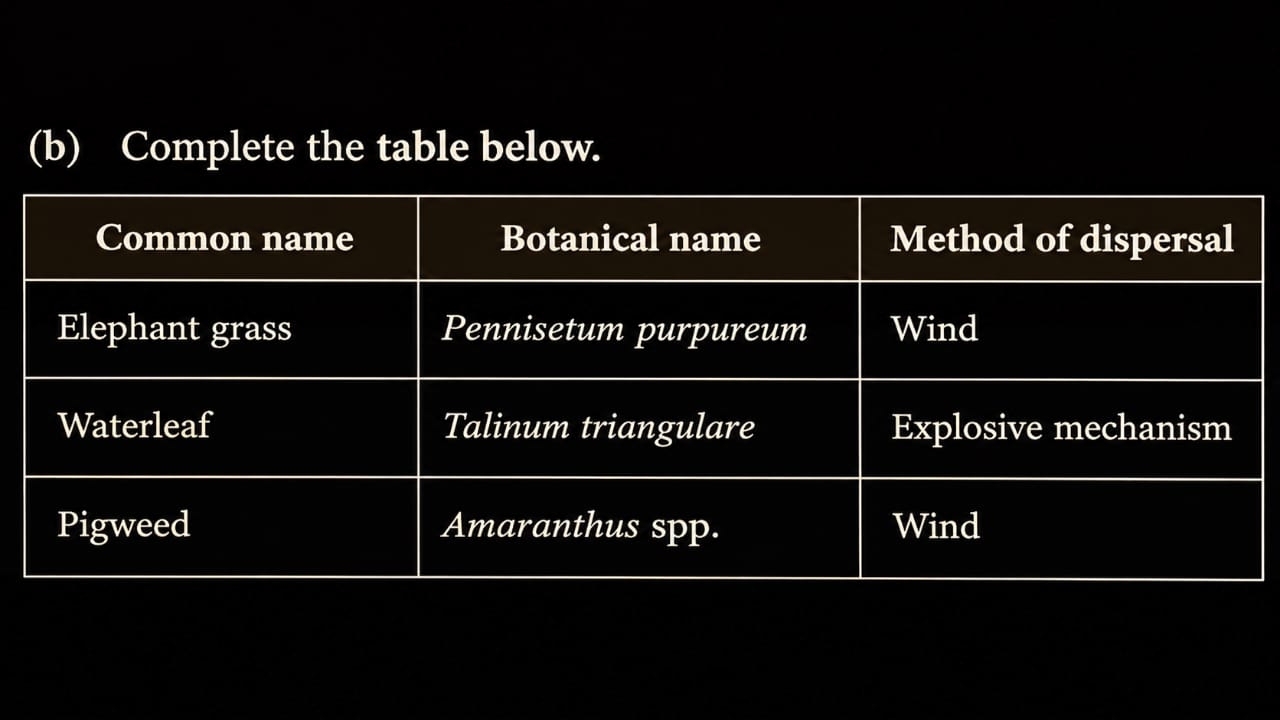
(2ci)
Clay soil.
(2cii)
(PICK ANY THREE)
(i) It has low permeability, so it prevents water from seeping away easily.
(ii) It retains water for a long period, thereby maintaining the required water level in the pond.
(iii) It is cohesive and can be compacted firmly to form strong pond walls and embankments.
(iv) Clay soil is readily available in many areas, making it relatively easy to obtain for pond construction.
(v) It can be moulded and compacted to form firm and stable pond embankments.
(vi) It helps to maintain a constant water level by reducing seepage through the pond floor.
(vii) It reduces water loss, thereby lowering the cost of frequently refilling the pond.
WAEC GCE 2026 AGRIC Question And Answers
(3ai)
Agricultural pollution refers to the contamination, degradation, or alteration of the environment (soil, water, and air) resulting from farming activities, such as the misuse of agrochemicals, improper waste disposal, and unsustainable land management practices.
(3aii)
(i) Chemical pesticides (insecticides, herbicides, and fungicides).
(ii) Excessive chemical fertilizers.
(iii) Industrial effluent / Plastics / Heavy metals (or untreated sewage sludge).
(3aiii)
(i) Reduction of soil fertility due to the alteration of soil pH and nutrient depletion.
(ii) Destruction of beneficial soil microorganisms that aid in decomposition and nutrient cycling.
(iii) Reduced crop yield and quality caused by toxicity and stunted plant growth.
(iv) Bioaccumulation of toxic materials in crops, making them unsafe for consumption.
(3b)
COMPLETE THE TABLES;
UNDER: Nature of damage ;
(i) Sucks sap from leaves and growing shoots.
(ii) Causes “bunchy top” or distortion of terminal shoots.
(iii) Causes defoliation (loss of leaves).
(iv) Stunts plant growth, reducing tuber yield.
UNDER; Control measures
(v) Biological control using the parasitic wasp (Anagyrus lopezi).
(vi) Planting resistant or tolerant cassava varieties
(3c)
(i) Hand pulling / Hand weeding: Directly pulling weeds out of the ground by hand.
(ii) Hoeing / Tillage: Utilizing hand tools (hoes) or machinery (plows/cultivers) to cut, uproot, and bury weeds.
(iii) Mulching: Covering the soil surface with organic matter (like straw) or plastic sheets to suffocate weeds and block sunlight.
WAEC GCE 2026 AGRIC Question And Answers
(4a)
(i) Beverage crops: Cocoa, coffee, tea, cola.
(ii) Fibre crops: Cotton, jute, sisal, kenaf.
(iii) Oil crops: Groundnut, palm oil, soybean, sunflower.
(4b)
(i) Improves the nutritional value of rice by driving B-vitamins (like thiamine) from the husk into the grain.
(ii) Hardens the grain, which reduces breakage during milling and increases head rice recovery.
(iii) Gelatinizes the starch, making the rice less prone to insect and pest infestation during storage.
(iv) Improves the shelf-life and milling quality of the rice.
(4c)
(i) Stocking density: Overcrowding leads to competition for food and space, stunted growth, and stress.
(ii) Feed availability and quality: Inadequate or poor-nutrient feed results in slow growth and mortality.
(iii) Predation and pests: Presence of predators (e.g., frogs, snakes, birds, or water beetles) reduces fish survival rates.
(iv) Pond soil quality/type: The bottom soil affects nutrient release, primary productivity (plankton growth), and water retention (e.g., clayey soils are better than sandy soils).
WAEC GCE 2026 AGRIC Question And Answers
(5ai)
(i) Total Floor Area: 10 m x 50 m = 500 m²
(ii) Total Capacity: 500 m² x 4 quails/m² = 2,000 quails
(5aii)
(i) Deep litter system
(5aiii)
(i) Protection: Guards birds against adverse weather conditions, predators, and theft.
(ii) Space Efficiency: Maximizes land utility by keeping a high concentration of birds in a contained footprint.
(iii) Manure Accumulation: Accumulates valuable organic fertilizer as the litter bedding mixes with droppings.
(iv) Labor Reduction: Centralizes feeding, watering, and management tasks, requiring fewer laborers.
(5b)
(i) Smallholder/Subsistence farmers
(ii) Commercial livestock and crop producers
(iii) Rural youth groups and young farmers associations
(iv) Women agricultural cooperatives
(5c)
(i) Beef production for dietary animal protein.
(ii) Dairy output including fresh milk and localized processed dairy goods.
(iii) Revenue generation through the commercial sale of live stock and animal products.
(iv) Draft power for plowing farmlands and pulling transport carts.
(v) Leather raw materials sourced from the processing of hides and skins.
WAEC GCE 2026 AGRIC Question And Answers
(6a)
(i) Poor Transportation Infrastructure: Bad roads and lack of proper transport vehicles cause severe delays, high shipping costs, and frequent spoilage of perishable goods before they reach urban markets.
(ii) Inadequate Storage and Processing Facilities: A lack of modern storage facilities (like silos and cold rooms) forces farmers to sell their produce immediately after harvest at very low prices to avoid total loss.
(iii) Exploitation by Middlemen: Due to a disorganized market structure, middlemen often buy produce from rural farmers at extremely low rates and resell them at high prices in cities.
(iv) Lack of Standardized Weights and Measures: The absence of uniform weighing scales means produce is often bought using arbitrary volumetric measures (like baskets or bags), which disadvantages the farmer.
(6b)
(i) Earns Foreign Exchange: Exporting goods generates foreign currencies, which strengthens national reserves and stabilizes the local economy.
(ii) Generates Government Revenue: Governments collect taxes, duties, and licensing fees from exporters to fund public infrastructure.
(iii) Creates Employment: The export sector provides jobs across the supply chain, including farming, processing, packaging, and logistics.
(iv) Diversifies the Economy: It reduces a country’s over-reliance on a single non-renewable resource (such as oil or minerals) for economic survival.
(v) Boosts Rural Development: Higher income flowing back to agricultural sectors improves the living standards of rural communities.
(6c)
(i) Reduces Pest and Disease Damage: Gathering crops early protects them from field pests like birds, rodents, and insects, as well as fungal infections.
(ii) Prevents Shattering Losses: It prevents over-ripening, which causes the cereal grains to dry out and shatter (fall out of the seed head) onto the ground during handling.
(iii) Minimizes Weather Damage: Early harvesting protects the mature crop from lodging (falling over) or rotting due to unexpected late-season heavy rainfall or strong winds.
(iv) Secures Better Market Prices: Farmers can sell their fresh harvest earlier in the season before the market becomes saturated during the peak harvest glut.
(v) Frees Up Land: It allows the farmer to clear and prepare the field early for the next planting cycle or crop rotation.
==============================================
WAEC GCE 2026 AGRIC Question And Answers
WAEC GCE 2026 AGRIC Question And Answers
WAEC GCE 2026 AGRIC Question And Answers
WAEC GCE 2026 AGRIC Question And Answers
WAEC GCE 2026 AGRIC Question And Answers
WAEC GCE 2026 AGRIC Question And Answers
WAEC GCE 2026 AGRIC Question And Answers
WAEC GCE 2026 AGRIC Question And Answers
WAEC GCE 2026 AGRIC Question And Answers
WAEC GCE 2026 AGRIC Question And Answers
WAEC GCE 2026 AGRIC Question And Answers
WAEC GCE 2026 AGRIC Question And Answers
WAEC GCE 2026 AGRIC Question And Answers
WAEC GCE 2026 AGRIC Question And Answers
WAEC GCE 2026 AGRIC Question And Answers
WAEC GCE 2026 AGRIC Question And Answers
WAEC GCE 2026 AGRIC Question And Answers
WAEC GCE 2026 AGRIC Question And Answers
WAEC GCE 2026 AGRIC Question And Answers
WAEC GCE 2026 AGRIC Question And Answers
WAEC GCE 2026 AGRIC Question And Answers
Examrunz.com Team !.
If you found this post helpful or have any questions, please leave a comment below.