
WAEC GCE 2026 Geography Questions and Answers
Are you searching for WAEC GCE 2026 Geography Questions and Answers: Objective and Essay Questions and Answers?

You are welcome to Examrunz, where candidates can access study materials, solved questions, and solutions to help them prepare for the 2026 WASSCE for Private Candidates examination.
This website is designed to help candidates prepare for WAEC GCE 2026 Geography Questions and Answers: Objective and Essay.
WAEC GCE 2026 Geography Questions and Answers: Objective and Essay
Wednesday, 14th October, 2026
Geography 2 (Essay) – 2hrs – 09:30 hrs – 11:30 hrs.
Geography 1 (Objective) – 1hr – 11:30 hrs – 12:30 hrs.
Geography 3 (Practical and Physical Geography) – 1hr 50mins – 14:30 hrs – 16:20 hrs.
WAEC GCE GEOGRAPHY OBJ:
PLEASE NOTE: THE NUMBERING AND OPTIONS ARE SHUFFLED. KINDLY TRACE
1. One centimetre on the map represents one kilometre on the ground
2. 50 metres
3. 1:50,000
4. 12 kilometres
5. South west
6. Nodal town
7. Dendritic
8. West
9. Asi
10. OBUO
11. 870 mm
12. 9°C
13. June
14. December 22nd
15. 7,770 km
16. Rift valley
17. 14°C
18. Isotherm
19. Faulting
20. Active
21. Parallel to the prevailing wind direction
22. Sedimentary
23. 11:00 a.m.
24. Temperature and precipitation
25. Yardang
26. Scree
27. Moderating influence of the sea
28. Prime Meridian
29. Waterfall
30. Exfoliation
31. When the Earth comes directly between the sun and the moon
32. I and IV only
33. Volcanic mountain
34. September 23rd
35. Mediterranean climate
36. Tombolo
37. Availability of power and large market
38. Effective advertizing of natural attractions
39. Wheat
40. Clustering of industries
41. From villages to towns
42. Production of similar products
43. Low population density
44. Ability to connect all continents
45. High level of technology and adequate capital
46. Availability of future labour force
47. Provision of agricultural products
48. Climate characteristics
49. Tertiary economic activities
50. Generation of revenue and foreign exchange
WAEC GCE 2026 Geography Questions and Answers: Objective and Essay
(1a)
(PICK ANY FIVE)
(i) Favourable Climate: A favourable climate with warm temperatures, adequate sunshine and pleasant weather attracts tourists to developing countries for relaxation, sightseeing and other recreational activities.
(ii) Beautiful Natural Scenery: Beautiful natural landscapes such as mountains, valleys, hills and green plains attract tourists who want to enjoy nature and take photographs.
(iii) Beaches and Coastlines: Sandy beaches, clear coastal waters and attractive seashores encourage tourism by providing opportunities for swimming, sunbathing, surfing and other recreational activities.
(iv) Wildlife Resources: The presence of wild animals such as lions, elephants, giraffes and gorillas in national parks and game reserves attracts tourists interested in wildlife viewing and safaris.
(v) Forests and Vegetation: Dense forests, tropical rainforests and unique plant species attract tourists interested in nature, ecological studies and the exploration of natural environments.
(vi) Rivers and Lakes: Rivers and lakes promote tourism by providing opportunities for fishing, boating, swimming, canoeing and other water-based recreational activities.
(vii) Mountains and Highlands: Mountains and highlands attract tourists for mountain climbing, hiking, sightseeing and other adventure activities. They also provide beautiful views of the surrounding environment.
(viii) Waterfalls and Caves: Natural features such as waterfalls and caves attract tourists for sightseeing, exploration, photography and scientific studies. They also serve as important tourist attractions in many developing countries.
(ix) Deserts and Unique Landforms: Deserts, sand dunes, rock formations and unusual landforms attract tourists interested in adventure, sightseeing and the study of unique physical environments.
(x) Hot Springs and Geothermal Features: Natural hot springs and other geothermal features attract tourists seeking relaxation, recreation and health-related experiences. These features can encourage the development of tourism facilities around them.
(1b)
(PICK ANY FIVE)
(i) Employment Generation: The tourism industry creates employment opportunities for people working as tour guides, hotel attendants, drivers, travel agents, security officers and restaurant workers. This helps to reduce unemployment and poverty in Tropical Africa.
(ii) Generation of Foreign Exchange: International tourists spend foreign currencies on accommodation, transportation, food, entertainment and other services. This increases foreign exchange earnings and helps countries pay for imported goods and services.
(iii) Increase in Government Revenue: Governments earn revenue from taxes paid by hotels, restaurants, travel agencies and other tourism businesses. They also collect entrance fees from national parks, museums and other tourist attractions.
(iv) Development of Infrastructure: Tourism encourages the construction and improvement of roads, airports, hotels, electricity, water supply and communication facilities. These facilities also benefit local communities and other sectors of the economy.
(v) Promotion of Local Businesses: Tourism creates markets for locally produced goods and services. Traders, farmers, transport operators, restaurant owners and traditional craft makers benefit from the spending of tourists.
(vi) Improvement in the Standard of Living: Tourism provides income and employment opportunities for individuals and families. The income earned enables people to afford better housing, education, healthcare, food and other basic necessities.
(vii) Conservation of Natural Resources: Tourism encourages the protection of wildlife, forests, waterfalls, national parks and other natural attractions. Revenue generated from tourism can be used to maintain protected areas and conserve the environment.
(viii) Promotion of Cultural Heritage: Tourism helps to preserve and promote the cultural heritage of Tropical Africa. Traditional festivals, historical monuments, local music, dances, arts and crafts are showcased to visitors, encouraging the preservation of cultural values.
(ix) Attraction of Foreign Investment: The tourism industry attracts foreign investors who establish hotels, resorts, recreational centres and other tourism facilities. These investments contribute to capital formation, business expansion and economic growth.
WAEC GCE 2026 Geography Questions and Answers: Objective and Essay
(2a)
Population distribution refers to the way people are spread over a particular geographical area at a given time. It shows whether people are evenly or unevenly distributed in an area.
(2b)
(PICK ANY FIVE)
(i) Overcrowding: Rapid population growth leads to overcrowding in urban centres as more people move into cities than the available space can accommodate. This results in congested streets, crowded public places and uncomfortable living conditions.
(ii) Unemployment: The rapid increase in the urban population creates a situation where the number of job seekers exceeds the available employment opportunities. This leads to unemployment and underemployment among urban residents.
(iii) Housing Shortage: Rapid population growth increases the demand for accommodation, making it difficult for many people to find affordable houses. As a result, people may live in overcrowded rooms or poorly constructed buildings.
(iv) Development of Slums: The inability of many urban residents to afford decent accommodation leads to the development of slums and shanty towns. These areas often lack proper sanitation, clean water, drainage systems and other essential facilities.
(v) Traffic Congestion: An increase in the urban population leads to more vehicles and road users, causing traffic congestion. This results in delays, waste of time, increased transport costs and difficulty moving from one place to another.
(vi) Pressure on Social Amenities: Rapid population growth puts excessive pressure on social amenities such as schools, hospitals, electricity, water supply and recreational facilities. These facilities may become inadequate to meet the needs of the growing population.
(vii) Increase in Crime Rate: Rapid population growth, especially when accompanied by unemployment and poverty, may contribute to increased crime rates. Crimes such as theft, robbery, fraud and other social vices may become more common.
(viii) Environmental Pollution: A large urban population generates enormous amounts of waste, sewage and other pollutants. Poor waste disposal and vehicle emissions contribute to land, water and air pollution, making the environment unhealthy.
(ix) High Cost of Living: Rapid population growth increases the demand for food, housing, transportation and other essential goods and services. When supply cannot meet demand, prices and rents may rise, making life difficult for low-income earners.
(x) Inadequate Water Supply and Poor Sanitation: The increasing population places heavy demands on available water supplies and sanitation facilities. This may result in water shortages, blocked drainage systems and the spread of waterborne diseases such as cholera and typhoid.
(2c)
(PICK ANY FIVE)
(i) High Birth Rate: Many Tropical African countries have high birth rates because families often have several children. This contributes to a rapid increase in the total population, especially where the number of births exceeds the number of deaths.
(ii) Decline in Death Rate: Improvements in healthcare, medical facilities and disease prevention have reduced death rates in many countries. Consequently, more people survive, contributing to an increase in the population.
(iii) Improved Medical Facilities: The availability of hospitals, health centres, vaccines and trained medical personnel has helped to reduce deaths from preventable diseases. This increases life expectancy and contributes to population growth.
(iv) Early Marriage: Early marriage in some communities allows individuals to begin having children at a relatively young age. This may increase the length of the childbearing period and contribute to a higher number of births.
(v) Cultural Beliefs and Traditions: Certain cultural beliefs encourage large families because children are regarded as a source of family pride, wealth, security and continuity. Such beliefs may encourage couples to have many children.
(vi) Low Level of Education: Limited access to education, particularly among girls and women, may contribute to high fertility rates. Education often increases awareness of family planning and encourages people to make informed decisions about family size.
(vii) Inadequate Family Planning: Limited access to contraceptives, reproductive health services and family planning information may lead to unintended pregnancies. This can contribute to high birth rates and rapid population growth.
(viii) Preference for Male Children: In some communities, families place greater value on having male children because they are expected to continue the family name, inherit property or provide support in old age. This may encourage couples to continue having children until they have sons.
(ix) Immigration: The movement of people from other countries into Tropical African countries increases the population of the receiving areas. People may migrate in search of employment, education, business opportunities, political stability or better living conditions.
WAEC GCE 2026 Geography Questions and Answers: Objective and Essay
(3a)
(PICK ANY FIVE)
(i) Availability of Water Supply: The availability of rivers, lakes, springs and groundwater encourages the growth of settlements because people need water for drinking, cooking, washing, farming and industrial activities.
(ii) Favourable Climate: Areas with favourable climatic conditions, such as moderate temperatures and adequate rainfall, attract people to establish settlements. Such conditions support agriculture and provide a comfortable environment for human habitation.
(iii) Availability of Fertile Soil: Areas with fertile soils attract farmers because they support the cultivation of crops and the rearing of animals. Agricultural activities provide food and employment, encouraging the growth of settlements.
(iv) Availability of Employment Opportunities: The presence of industries, commercial activities, offices and other sources of employment attracts people to an area. As more people move in search of jobs, the settlement expands in size and population.
(v) Good Transportation Network: The presence of good roads, railways, airports and waterways promotes the growth of settlements by facilitating the movement of people, goods and services. Settlements located along major transport routes often develop into important commercial centres.
(vi) Availability of Mineral Resources: Areas with mineral deposits such as coal, gold, petroleum, limestone and iron ore attract mining companies and workers. Mining activities create employment opportunities and encourage the development of settlements around mining sites.
(vii) Presence of Social Amenities: The availability of schools, hospitals, electricity, markets, recreational facilities and communication services attracts people to an area. These facilities improve living conditions and encourage settlements to grow.
(viii) Security and Political Stability: Areas with peace, security and political stability attract people to live, work and invest. The absence of war, violence and insecurity encourages economic activities and promotes the expansion of settlements.
(3b)
(PICK ANY FIVE)
(i) Low Population Density: Rural settlements in Tropical Africa generally have relatively low population densities compared with major urban centres. Houses and villages are often widely separated, with large areas of land used for farming and other activities.
(ii) Predominance of Agricultural Activities: Farming is the major occupation of many rural dwellers. People engage in the cultivation of crops such as cassava, maize, yam, rice and cocoa, as well as livestock rearing, fishing and other primary activities.
(iii) Small Settlement Size: Rural settlements are usually small in size and population. They may consist of a few houses, family compounds or clusters of buildings surrounded by farmland and natural vegetation.
(iv) Simple Housing Structures: Many rural settlements have houses constructed with locally available materials such as mud, timber, bamboo, thatch and laterite. However, the types and quality of houses vary from one area to another.
(v) Inadequate Social Amenities: Rural settlements often have limited access to modern facilities such as hospitals, good schools, electricity, pipe-borne water and recreational centres. Residents may have to travel to nearby towns to obtain certain services.
(vi) Poor Transportation Network: Many rural settlements have unpaved roads and limited public transportation services. During the rainy season, some roads become difficult to use, making the movement of people and agricultural products challenging.
(vii) Strong Family and Community Ties: Rural communities often have close relationships among family members, neighbours and other residents. Traditional institutions, community leaders and cultural practices play important roles in maintaining social order.
(viii) Low Level of Industrial Development: Rural settlements generally have few large-scale industries. Most economic activities involve agriculture, fishing, craftwork, petty trading and small-scale processing of agricultural products.
WAEC GCE 2026 Geography Questions and Answers: Objective and Essay
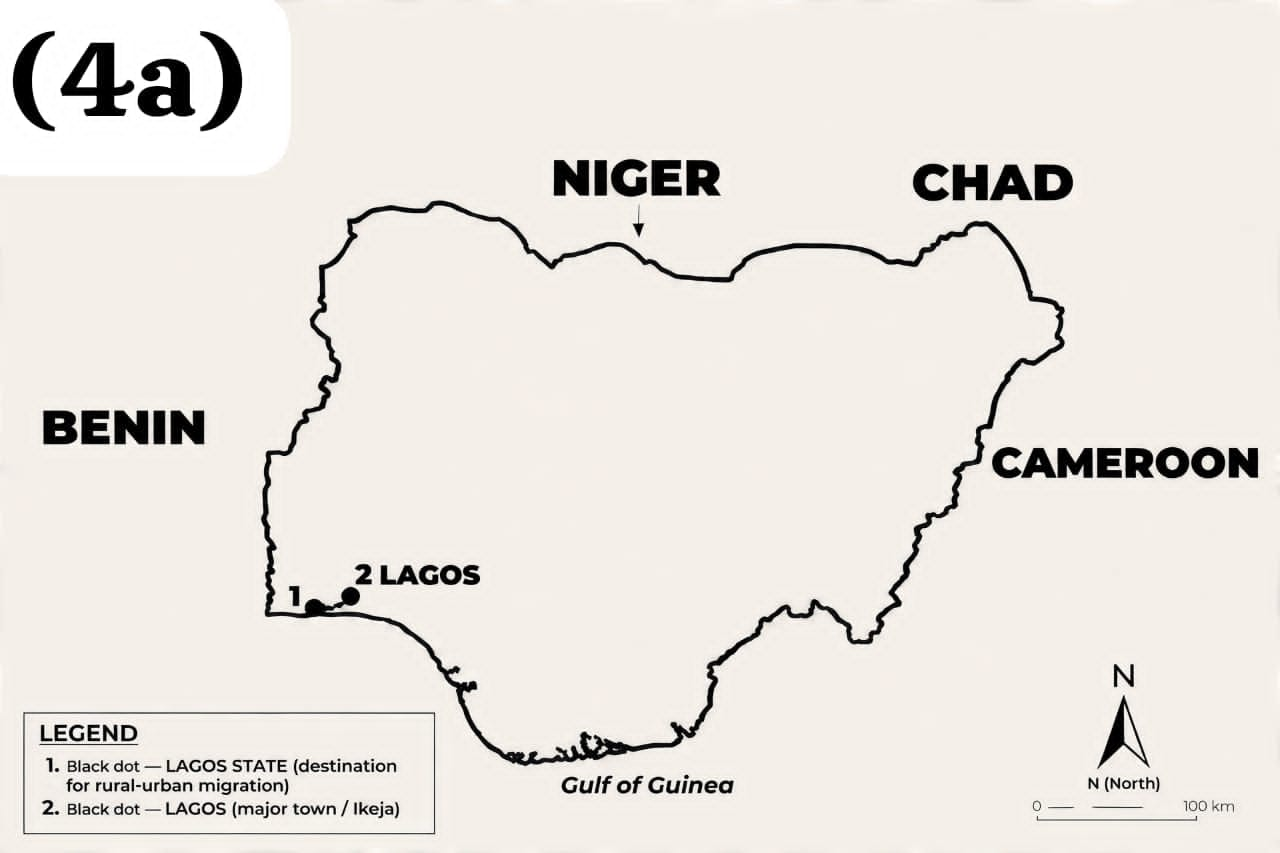
(4a)
(i) LAGOS STATE on the south-west coast – destination region noted for rural-urban migration
(ii) LAGOS (major town / Ikeja) – the major town in Lagos State
(4b)
(i) Development of rural areas. Government should provide roads, electricity, water, schools and hospitals in villages. This reduces rural-urban migration and eases pressure on cities.
(ii) Provision of adequate housing. Government and private developers should build affordable housing estates and replace slums. This reduces overcrowding and improves living conditions.
(iii) Creation of employment opportunities. Industries and other businesses should be established in smaller towns and rural areas, and skills training and agriculture should be supported. This reduces unemployment and crime in cities.
(iv) Improvement of social amenities and infrastructure. Water supply, electricity, healthcare, schools and waste disposal should be expanded to match population needs. Roads and public transport should also be improved to reduce traffic congestion.
(v) Proper urban planning and decentralisation. Government should create satellite towns and new growth centres, and relocate some industries and offices from big cities. Land use laws and building regulations should be enforced, e.g. the planning of Abuja.
(4c)
Calculation of population density
Formula:
Population density = Total population ÷ Total land area
Working:
Population = 560 million = 560,000,000
Area = 1,400,000 km²
Population density = 560,000,000 ÷ 1,400,000
= 560 ÷ 1.4
= 400 persons per square kilometre
= 400 persons/km²
WAEC GCE 2026 Geography Questions and Answers: Objective and Essay
(5a)
Mixed farming is a system of agriculture in which a farmer engages in both crop production and the rearing of livestock on the same farm.
(5b)
(PICK ANY FIVE)
(i) Combination of Crop Production and Livestock Rearing: Mixed farming involves the cultivation of crops such as maize, yam, cassava and rice alongside the rearing of animals such as cattle, goats, sheep and poultry on the same farm.
(ii) Use of Animal Droppings as Manure: Animal wastes are collected and used as organic manure to improve soil fertility and increase crop yields.
(iii) Use of Crop Residues as Animal Feed: Crop residues such as maize stalks, yam peels and cassava peels are used to feed livestock, thereby reducing the cost of animal feed.
(iv) Diversification of Farm Products: Farmers produce different crops and rear different animals on the same farm. This enables them to obtain a variety of agricultural products for consumption and sale.
(v) Large Labour Requirement: Mixed farming requires labour for land preparation, planting, weeding, harvesting, feeding animals and maintaining livestock facilities.
(vi) Seasonal Nature of Farming Activities: Crop production often follows the rainy and dry seasons, while livestock rearing continues throughout the year, although feeding and management practices may change seasonally.
(vii) Use of Modern and Traditional Farming Methods: Mixed farmers in Nigeria may use traditional tools such as hoes and cutlasses, as well as modern equipment such as tractors, ploughs and irrigation facilities.
(viii) Production for Subsistence and Commercial Purposes: Some mixed farmers produce crops and rear animals mainly to feed their families, while others sell their products in local markets to earn income.
(5c)
(PICK ANY FIVE)
(i) Increased Farm Income: Farmers earn income from the sale of both crops and livestock products, such as maize, yam, eggs, milk and meat.
(ii) Improvement of Soil Fertility: Animal droppings provide organic manure that adds nutrients to the soil and improves crop growth.
(iii) Reduction in the Cost of Animal Feed: Crop residues and agricultural by-products can be used to feed livestock, reducing the amount of money spent on purchasing animal feed.
(iv) Reduction of Farming Risks: If crops fail because of drought, pests or diseases, farmers may still earn income from livestock. Similarly, losses in livestock production may be compensated for by successful crop production.
(v) Provision of Food: Mixed farming provides a variety of food products, including cereals, tubers, vegetables, meat, milk and eggs, helping to improve food availability.
(vi) Employment Opportunities: Mixed farming creates employment for farmers, farm labourers, livestock attendants and people involved in the processing and marketing of agricultural products.
(vii) Efficient Use of Farm Resources: Farm resources are used more efficiently because crop residues can feed animals, while animal manure can be used to fertilise crops.
(viii) Increased Agricultural Productivity: The combination of crop production and livestock rearing can improve the overall output and profitability of a farm when properly managed.
WAEC GCE 2026 Geography Questions and Answers: Objective and Essay
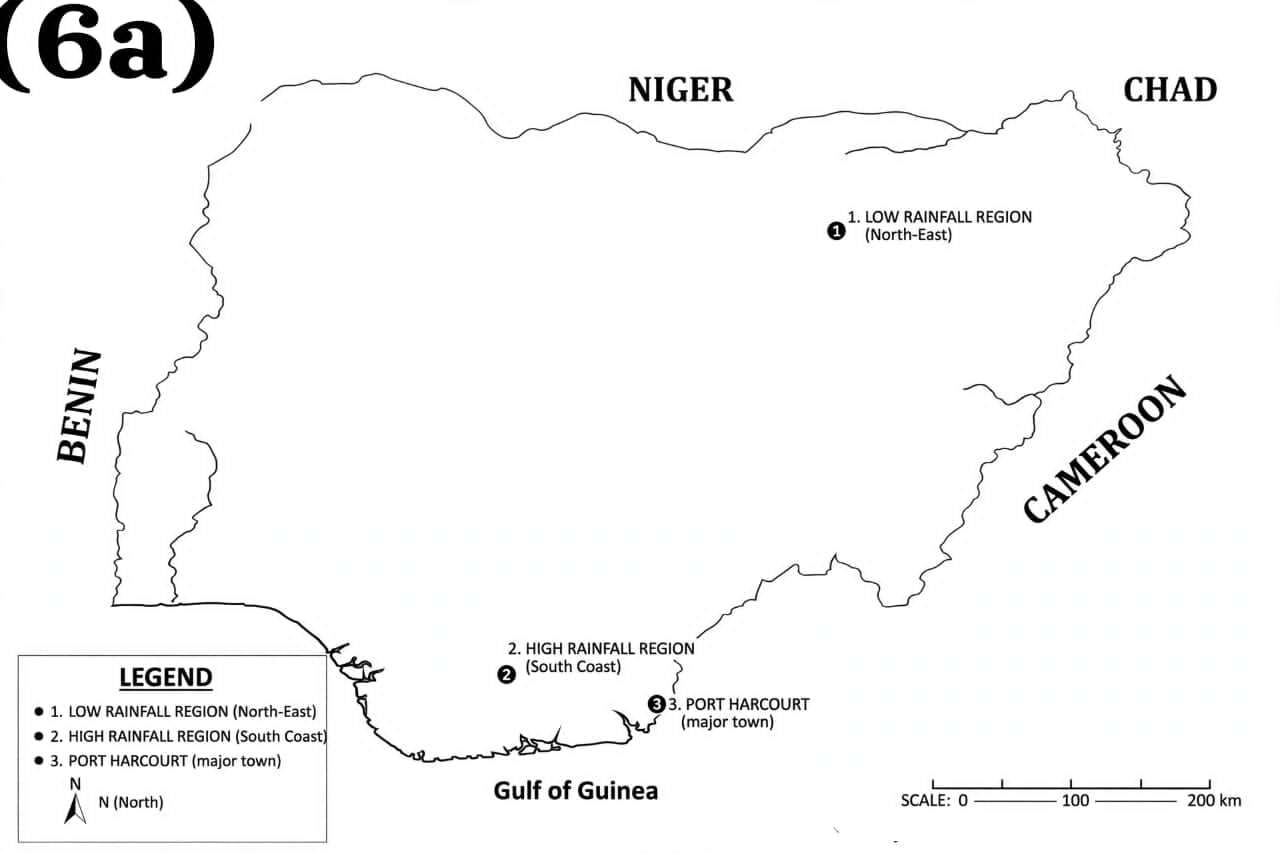
(6ai)
LOW RAINFALL REGION – North-Eastern Nigeria (Borno / Yobe area, Sahel/Sudan savanna). Receives low annual rainfall, usually less than 750mm per year.
(6aii)
HIGH RAINFALL REGION – South coastal region (Niger Delta / South-South coast). Receives high annual rainfall, usually over 2000mm per year, tropical rainforest climate.
(6aiii)
Major town in 6(a)(ii) – PORT HARCOURT (also acceptable: Calabar, Warri, Lagos, Benin City, Yenagoa)
(6b)
(i) Latitude (distance from the equator). Nigeria lies between about latitudes 4°N and 14°N. Places nearer the equator, such as the south, receive more direct sunlight and more rainfall, while those farther north become drier and have a wider temperature range.
(ii) Distance from the sea (nearness to the ocean). Coastal areas are cooler, more humid and wetter because of moist air from the Atlantic Ocean. Inland and northern areas are drier and hotter, with larger temperature ranges.
(iii) Prevailing winds (air masses). The moist tropical maritime (MT) south-westerly winds bring rain in the wet season. The dry, dusty tropical continental (CT) north-easterly (Harmattan) winds bring dry conditions and dusty haze from December to February.
(iv) Altitude (relief). Temperature falls with height, at about 1°C for every 150 metres. Highland areas such as the Jos Plateau, the Obudu Plateau and the Mambilla Plateau are cooler than lowland areas, and highlands also affect rainfall (relief rainfall).
(6c)
(i) Supplies water for crop growth. Rain provides the moisture crops need to germinate, grow and mature. Most Nigerian farming depends on rain, so crops such as yam, cassava, maize and cocoa thrive in rainy areas.
(ii) Supports the growth of pasture and animal feed. Rain makes grasses and fodder grow for livestock such as cattle, goats and sheep, and it supplies drinking water for animals. This supports livestock rearing, especially in the savanna.
(iii) Replenishes rivers, streams and groundwater for irrigation. Rainfall fills rivers, dams and wells, which farmers use for dry-season farming and fishing. This allows farming and fish production throughout the year.
==============================================
WAEC GCE 2026 Geography Questions and Answers: Objective and Essay
WAEC GCE 2026 Geography Questions and Answers: Objective and Essay
WAEC GCE 2026 Geography Questions and Answers: Objective and Essay
WAEC GCE 2026 Geography Questions and Answers: Objective and Essay
WAEC GCE 2026 Geography Questions and Answers: Objective and Essay
WAEC GCE 2026 Geography Questions and Answers: Objective and Essay
WAEC GCE 2026 Geography Questions and Answers: Objective and Essay
WAEC GCE 2026 Geography Questions and Answers: Objective and Essay
WAEC GCE 2026 Geography Questions and Answers: Objective and Essay
WAEC GCE 2026 Geography Questions and Answers: Objective and Essay
WAEC GCE 2026 Geography Questions and Answers: Objective and Essay
WAEC GCE 2026 Geography Questions and Answers: Objective and Essay
WAEC GCE 2026 Geography Questions and Answers: Objective and Essay
WAEC GCE 2026 Geography Questions and Answers: Objective and Essay
WAEC GCE 2026 Geography Questions and Answers: Objective and Essay
WAEC GCE 2026 Geography Questions and Answers: Objective and Essay
WAEC GCE 2026 Geography Questions and Answers: Objective and Essay
WAEC GCE 2026 Geography Questions and Answers: Objective and Essay
WAEC GCE 2026 Geography Questions and Answers: Objective and Essay
WAEC GCE 2026 Geography Questions and Answers: Objective and Essay
WAEC GCE 2026 Geography Questions and Answers: Objective and Essay
WAEC GCE 2026 Geography Questions and Answers: Objective and Essay
WAEC GCE 2026 Geography Questions and Answers: Objective and Essay
WAEC GCE 2026 Geography Questions and Answers: Objective and Essay
WAEC GCE 2026 Geography Questions and Answers: Objective and Essay
WAEC GCE 2026 Geography Questions and Answers: Objective and Essay
WAEC GCE 2026 Geography Questions and Answers: Objective and Essay
If you found this post helpful or have any questions, please leave a comment below.